
Research
/Security News
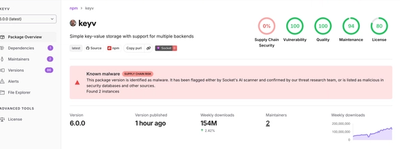
Popular npm Packages in the keyv and Cacheable Namespaces Compromised in Active Supply Chain Attack
Popular npm packages keyv and cacheable compromised.
By Socket Research Team - Aug 04, 2026
fitbit-mcp
Advanced tools


MCP server for the Fitbit Web API with OAuth PKCE, local SQLite cache, and trend analysis.
Designed for Claude Code and other MCP clients. Syncs your Fitbit data to a local database for fast, offline queries - no API calls needed after the initial sync.
rate_limited and resume on the next sync| Tool | Data |
|---|---|
fitbit_get_heart_rate | Resting HR, HR zones |
fitbit_get_activity | Steps, calories, active minutes, distance |
fitbit_get_exercises | Exercise sessions (name, duration, HR, calories) |
fitbit_get_sleep | Duration, efficiency, sleep stages |
fitbit_get_weight | Weight, BMI, body fat % |
fitbit_get_spo2 | Blood oxygen saturation (avg/min/max) |
fitbit_get_hrv | Heart rate variability (RMSSD) |
fitbit_get_azm | Active Zone Minutes with per-zone breakdown |
fitbit_get_breathing_rate | Nightly breaths per minute |
fitbit_get_skin_temperature | Nightly skin temperature variation (degrees C from baseline) |
fitbit_get_core_temperature | Manually-logged core (body) temperature readings (degrees C) |
fitbit_get_cardio_fitness | VO2 Max / Cardio Fitness Score |
fitbit_get_food_log | Daily food calories + water intake |
fitbit_get_devices | Paired devices, battery level, last sync (live) |
fitbit_get_lifetime_stats | All-time totals and personal best records (live) |
fitbit_get_goals | User-set daily/weekly activity goals (live) |
fitbit_trends | Aggregated averages (weekly/monthly/quarterly) |
pip install fitbit-mcp
Or run it without installing:
uvx fitbit-mcp
For development from a clone:
pip install -e ".[dev]"
http://localhost:8080fitbit-mcp auth
This opens your browser for Fitbit login, exchanges the auth code via PKCE, and saves tokens locally.
Tokens are stored in ~/.config/fitbit-mcp/fitbit_tokens.json with 0600 permissions. Access tokens expire in 8 hours and are refreshed automatically. Refresh tokens expire after 90 days of inactivity.
claude mcp add -s user fitbit -- fitbit-mcp
Query tools auto-sync on first use, so you can skip this step. To pre-populate the cache or sync a longer history, run:
fitbit-mcp sync --days 30
fitbit-mcp              Start the MCP server (stdio transport)
fitbit-mcp -V, --version  Print the installed package version
fitbit-mcp auth         Interactive OAuth setup
fitbit-mcp sync         Sync data to local cache
  --days N              Days of history for first sync (default: 30)
  --types TYPE,...      Data types to sync (default: all)
  --since YYYY-MM-DD    Backfill from this date, overriding the incremental
                        resume-from-last-sync cursor and --days
  --until YYYY-MM-DD    Inclusive end date for a --since backfill; together
                        they re-fetch exactly that window (e.g. to repair a
                        gap in the middle of the cache)
fitbit-mcp import       Import existing JSON data files
  --data-dir PATH       Directory containing JSON files
Query tools auto-sync on the first query of each day per data type. Use live=True
to bypass the cache entirely and fetch directly from the API.
All query tools accept these common parameters:
start_date - Start date as YYYY-MM-DD, YYYY-MM, or 30d (relative). Default: last 30 days.end_date - End date as YYYY-MM-DD. Default: today.live - If true, fetch from Fitbit API instead of cache (bypasses auto-sync).fitbit_get_exercises also accepts:
exercise_type - Filter by activity name (case-insensitive substring match), e.g. "cycling", "walk", "run". Default: all types.Syncs data from the Fitbit API to the local SQLite cache. Query tools call this automatically on first use of the day, so explicit calls are only needed for longer history or forced refresh.
data_types - What to sync: all, heart_rate, activity, exercises, sleep, weight, spo2, hrv, azm, breathing_rate, skin_temperature, core_temperature, cardio_fitness, food_log. Comma-separated. Default: all.days - Days of history for first sync (default: 30). Subsequent syncs are incremental.since - Optional YYYY-MM-DD. Backfill from this date regardless of what is already cached, overriding incremental resume and days.until - Optional YYYY-MM-DD inclusive end date; requires since. Together they re-fetch and upsert exactly the since..until window - use to repair a gap in the middle of the cache without re-pulling everything up to today.Aggregated trend analysis from cached data.
data_type - What to analyse: heart_rate, activity, exercises, sleep, weight, spo2, hrv, azm, breathing_rate, skin_temperature, core_temperature, cardio_fitness, food_log. Default: activity.period - Aggregation: weekly, monthly, quarterly. Default: monthly.start_date - Start date. Default: last 12 months (365 days).end_date - End date. Default: today.compare - Compare two periods: last_30d vs previous_30d, 2026-03 vs 2026-02, 2026-Q1 vs 2025-Q4. When set, period/start_date/end_date are ignored.The following Fitbit API scopes are requested during setup:
| Scope | Data accessed |
|---|---|
activity | Steps, calories, active minutes, distance, AZM, lifetime stats, goals |
heartrate | Resting HR, HR zones, HRV |
sleep | Sleep duration and stages |
weight | Weight, BMI, body fat % |
oxygen_saturation | SpO2 (blood oxygen) |
profile | User profile (user ID, display name) |
respiratory_rate | Nightly breathing rate |
temperature | Skin temperature variation and manually-logged core temperature |
cardio_fitness | VO2 Max / Cardio Fitness Score |
nutrition | Daily food calorie and water log |
location | GPS data on logged exercises |
settings | Paired devices (battery, last sync) |
These are the scopes needed for all tools. If you only need a subset, edit FITBIT_SCOPES in config.py before setup. After upgrading from a smaller scope set, re-run fitbit-mcp auth to re-authorise.
Paths are overridable via environment variables:
| Variable | Default | Description |
|---|---|---|
FITBIT_MCP_CONFIG_DIR | ~/.config/fitbit-mcp/ | Directory for OAuth credentials |
FITBIT_MCP_DB_PATH | ~/.local/share/fitbit-mcp/fitbit.db | SQLite database path |
FITBIT_MCP_OFFLINE | unset | If truthy (1, true, yes, on), run as a cache-only reader: no credentials required, no live API calls. See below. |
By default the server auto-syncs on demand, so query tools fetch fresh data
without a cron job. Set FITBIT_MCP_OFFLINE=1 to run as a pure cache reader
instead:
live=True, the
live-only tools (fitbit_get_devices, fitbit_get_lifetime_stats,
fitbit_get_goals), and fitbit_sync return a clear "offline mode" message
instead of calling the API."offline_mode": true.Typical uses:
fitbit-mcp sync (via cron/systemd)
against a shared database; other hosts set FITBIT_MCP_OFFLINE=1 and point
FITBIT_MCP_DB_PATH at the same cache, and only read. This keeps the Fitbit
OAuth token (single-use, rotating) owned by exactly one host, avoiding refresh
collisions.Keeping the cache fresh is then the syncing host's job. Unset
FITBIT_MCP_OFFLINE to return to on-demand auto-sync.
The Fitbit API allows 150 requests per hour. Activity and food log syncs sleep and retry automatically on a 429; the date-range data types instead mark that sync as rate_limited and pick up again on the next run. Be aware:
Use live=False (the default) to query from cache and avoid API calls entirely.
This project includes a pre-commit hook (scripts/check-no-data.sh) that prevents accidentally committing:
*.db, *.db-journal, *.db-wal)config/*.json)Install it after cloning:
ln -sf ../../scripts/check-no-data.sh .git/hooks/pre-commit
If you have existing Fitbit data as JSON files (e.g. from a previous export or script), you can bulk-import them:
fitbit-mcp import --data-dir /path/to/json/files/
Expected file names: heart_rate.json, activity.json, exercises.json, sleep.json, weight.json, spo2.json, hrv.json. See src/fitbit_mcp/importer.py for the expected JSON format. Import currently covers these seven types only; the newer types (AZM, breathing rate, skin/core temperature, cardio fitness, food log) are populated via sync, not import.
See CONTRIBUTING.md for development setup, the test workflow, and the pre-commit hook. Changes are tracked in CHANGELOG.md.
FAQs
MCP server for the Fitbit Web API with OAuth PKCE, local cache, and trend analysis.
The pypi package fitbit-mcp receives a total of 22 weekly downloads. As such, fitbit-mcp popularity was classified as not popular.
We found that fitbit-mcp demonstrated a healthy version release cadence and project activity because the last version was released less than a year ago. It has 1 open source maintainer collaborating on the project.
Did you know?

Socket for GitHub automatically highlights issues in each pull request and monitors the health of all your open source dependencies. Discover the contents of your packages and block harmful activity before you install or update your dependencies.
Research
/Security News
Popular npm packages keyv and cacheable compromised.

Security News
A misconfiguration gave three Anthropic models internet access, and one, believing it was in a simulation, shipped a credential-stealing package to PyPI.

Security News
/Company News
Socket has joined the new Composer and Packagist sponsorship program as a launch sponsor, supporting the team that keeps PHP's package ecosystem secure.