

Product
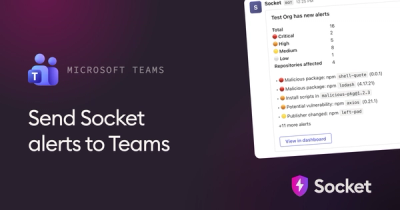
Microsoft Teams Notifications Are Now Available in Socket
Socket can now send alerts and supply chain attack notifications to Microsoft Teams, with filters that route the right updates to each channel.
By Jeppe Hasseriis - Sep 01, 2026
gcphelpit
Advanced tools
A friendly CLI that scans Google Cloud snapshots and finds security, IAM, cost, and reliability issues.


gcphelpit is a free, open-source command-line tool that scans a snapshot of your Google Cloud project and finds security, IAM, cost, and reliability issues — with a plain-English fix for each finding.
It is mock-first: it reads a JSON snapshot of your resources, so it runs — and is fully testable — with zero live cloud access or credentials. A live GCP adapter can be layered on later behind the same interface.
📦 Install from PyPI: pip install gcphelpit
🌐 Documentation & guides: https://eliyas-123.github.io/gcphelpit/
📋 Check catalog: All 16 checks →
pip install gcphelpit
gcphelpit scan
You'll get a colour-coded table of findings, each with the offending resource and a recommended fix.
From source (for development):
git clone https://github.com/EliyaS-123/gcphelpit-cli && cd gcphelpit-cli
python3 -m venv .venv && source .venv/bin/activate
pip install -e .
gcphelpit scan
gcphelpit checks lists all built-in checks. They span four categories, each finding
paired with a plain-English fix:
| Category | Examples |
|---|---|
security | public buckets, world-open firewall ports, public/no-SSL Cloud SQL |
iam | primitive owner/editor roles, external members, user-managed SA keys |
cost | unattached disks, idle static IPs, stopped VMs, no budget alert |
reliability | no DB backups, single-zone prod DB, no deletion protection |
gcphelpit scan                          # scan the bundled demo snapshot
gcphelpit scan -f my-project.json       # scan your own snapshot
gcphelpit scan --category security      # only security checks (repeatable)
gcphelpit scan --min-severity high      # only high/critical findings
gcphelpit scan --format json            # machine-readable output
gcphelpit scan --fail-on high           # exit non-zero for CI/CD gating
gcphelpit checks                        # list every check in the catalog
Exit codes: 0 clean, 1 findings at/above --fail-on, 2 usage/error.
Fail the build when a project snapshot has issues at or above a severity — for example in GitHub Actions:
# .github/workflows/gcp-audit.yml
name: GCP audit
on: [push, pull_request]
jobs:
  scan:
    runs-on: ubuntu-latest
    steps:
      - uses: actions/checkout@v4
      - uses: actions/setup-python@v5
        with:
          python-version: "3.11"
      - run: pip install gcphelpit
      - run: gcphelpit scan -f snapshot.json --fail-on high
A snapshot is a plain JSON object describing what you collected from a project. Every top-level key is optional — checks simply skip data that isn't there:
{
  "project_id": "my-project",
  "buckets": [ { "name": "assets", "uniform_bucket_level_access": true, "iam_bindings": [] } ],
  "firewalls": [],
  "instances": [],
  "disks": [],
  "addresses": [],
  "service_accounts": [],
  "iam_policy": { "bindings": [] },
  "sql_instances": [],
  "budgets": []
}
See fixtures/insecure_project.json for a fully
populated example (and clean_project.json for a
passing one).
gcphelpit's niche is being the scanner you can point at an exported snapshot with no credentials, covering all four categories at once with plain-English fixes. For broad multi-cloud security coverage, tools like Prowler are stronger. See the honest gcphelpit vs Prowler / ScoutSuite / gcp-auditor comparison.
Every check is one decorated function. Drop it in the right file under
src/gcphelpit/checks/ and it auto-registers:
from ..catalog import check
from ..models import Category, Detail, ResourceRef, Severity

@check(id="SEC099", title="…", category=Category.SECURITY,
       severity=Severity.HIGH, references=["https://cloud.google.com/…"])
def my_check(snapshot):
    for bucket in snapshot.get("buckets", []):
        if bad(bucket):
            yield Detail(
                resource=ResourceRef("storage.bucket", bucket["name"]),
                message="What's wrong.",
                recommendation="How to fix it.",
            )
pip install -e ".[dev]"
pytest
MIT
FAQs
A friendly CLI that scans Google Cloud snapshots and finds security, IAM, cost, and reliability issues.
The pypi package gcphelpit receives a total of 19 weekly downloads. As such, gcphelpit popularity was classified as not popular.
We found that gcphelpit demonstrated a healthy version release cadence and project activity because the last version was released less than a year ago. It has 1 open source maintainer collaborating on the project.
Product
Socket can now send alerts and supply chain attack notifications to Microsoft Teams, with filters that route the right updates to each channel.

Security News
pnpm 12 rewrites the package manager in Rust, cutting install times by up to 90% while preserving pnpm 11 workflows and lockfiles.

Security News
Socket CTO Ahmad Nassri joins AppSec leaders at Black Hat to discuss active malware, package manager risks, and software supply chain defense.