

Product
PHP and Composer Support Is Now in Beta
Socket’s PHP and Composer support is now in Beta for all customers, with PHP reachability analysis generally available.
By Trevor Norris, Benjamin Barslev - Aug 21, 2026
gigamail
Advanced tools
GigaMail — mail for your AI agent: MCP server giving agents safe, permission-controlled access to email (Microsoft Graph + IMAP), calendar and knowledge files.
MCP server that gives Claude (or any MCP-compatible agent) safe, controlled access to your email — multi-account (Microsoft Graph + IMAP), calendar, local search index, sender memory, and an agent-aware permission model.
No built-in LLM: the intelligence is your agent's. The MCP server speaks stdio only — no network port. (An optional human console adds a local HTTP API bound to 127.0.0.1.)
On your data: GigaMail keeps mail indexes, credentials, memory and configuration on your machine — we run no service and receive nothing. Mail content your agent reads is, of course, handled by that agent and its model provider under their own data policies. Choose your agent accordingly; the masker (coming) lets you hide sensitive fields before the agent ever sees them.

A real draft: the agent pulled the figures from the account's documents, picked the floor plans to attach, and proposed slots from the calendar. The human reviews and sends — or edits the instruction and regenerates.
pip install "gigamail[all]"
gigamail login # Microsoft device flow
gigamail accounts add-imap # or IMAP: Aruba, Gmail, Libero, ...
Microsoft login note: the bundled Azure app is not yet publisher-verified, so the consent screen shows an "unverified" notice (works fine; some corporate tenants may block it). Standard alternative: register your own Azure app and set your
client_idinsrc/ade_mail_agent/core/ms_config.json. IMAP needs none of this.
Give the account its identity and knowledge (this is what makes replies yours):
gigamail identity set                       # who am I, what I do, tone
gigamail identity add-file C:\docs\pricelist.xlsx
gigamail identity add-file C:\docs\catalog\   # whole folder
Register in Claude Desktop / Claude Code (mcpServers):
{
  "gigamail": {
    "command": "gigamail-server"
  }
}
The commands are also available under their legacy names
(ade-mail-agent, ade-mail-agent-server), so existing setups keep working.
Using OpenClaw or Hermes instead of Claude? Verified configs in INTEGRATIONS.md.
Are you an AI agent setting this up on behalf of a human? You can do the install and the MCP registration:
pip install "gigamail[all]", then addgigamail-serverto your client's MCP config (see INTEGRATIONS.md; declareGIGAMAIL_ROOTif your client filters the environment). Stop there. Connecting a mailbox (gigamail login,gigamail accounts add-imap) asks for credentials and must be done by the human in their own shell — it is not something you should do, and GigaMail is built so that it cannot be done through you. Tell them what to run, then wait.
Then just ask your agent: "reply to the last quote request using the price list" — it reads the mail, pulls the numbers from your file, drafts the reply, and asks you before sending.
24 typed tools, generated from the server itself:
Full map and design decisions: MAPPA_MCP.md.
Email content is treated as untrusted data (prompt injection). The
agent cannot approve its own actions, by construction: a dangerous tool
returns only an inert request_id, and approving it — from the console or
from gigamail approvals approve — requires an OS-level verification of
the person at the machine (Windows Hello / Touch ID). A process,
including an agent that holds a shell, can open that prompt but cannot
pass it; with no such backend available, nothing approves. No secret ever
enters the model context, so an injected instruction has nothing to
spend. Repeating the id just returns awaiting approval. The agent
can only read files explicitly registered by the user, never the rest of the
filesystem. Every write action is logged to %APPDATA%/ADE/agent_audit.jsonl
(append-only: GigaMail never rewrites past entries — it is not, and does not
claim to be, tamper-proof storage).
We red-team this: hostile emails ordering exfiltration, mass deletion, and the agent to approve itself — fed to a real agent with every mail tool enabled.
This design is a fix. v0.1.0 returned a one-time confirm token in the tool result, which put it in the model's context: the agent held both halves. Thanks to u/ranbuman and u/anderson_the_one on r/mcp for catching it. The switch now sits where the agent cannot reach.

The structural half of that suite runs in CI on every push (tests/test_injection.py); the real-agent half is opt-in (scripts/injection_e2e.py) and runs with a dry-run guard so confirmed actions are audited but never executed.
AGPL-3.0-or-later. Free to use, study, modify and share. If you distribute a modified version — or run one as a network service — you must make its source available under the same license. Commercial licenses for closed-source use are available from the copyright holder.
Server MCP che dà a Claude (o a qualunque agente compatibile) accesso sicuro e controllato alla tua posta — multi-account (Microsoft Graph + IMAP), calendario, indice di ricerca locale, memoria dei mittenti e un modello di permessi pensato per gli agenti.
Nessun LLM interno: l'intelligenza è quella del tuo agente. Il server MCP parla solo stdio — nessuna porta di rete. (La console per l'umano, che è opzionale, aggiunge una API HTTP locale su 127.0.0.1.)
Sui tuoi dati: GigaMail tiene indici della posta, credenziali, memoria e configurazione sul tuo computer — noi non gestiamo alcun servizio e non riceviamo nulla. Il contenuto delle mail che il tuo agente legge è ovviamente trattato da quell'agente e dal suo fornitore di modello secondo le loro policy. Scegli l'agente di conseguenza; il masker (in arrivo) permette di nascondere i dati sensibili prima che l'agente li veda.
Una bozza vera: l'agente ha preso i dati dai documenti collegati all'account, scelto le planimetrie da allegare e proposto gli orari liberi dal calendario. L'umano rivede e invia — oppure corregge l'istruzione e rigenera.
pip install "gigamail[all]"

gigamail login                # device flow Microsoft
gigamail accounts add-imap    # oppure IMAP: Aruba, Gmail, Libero, ...
Nota sul login Microsoft: l'app Azure inclusa non è ancora publisher-verified, quindi la schermata di consenso mostra l'avviso "unverified" (funziona comunque; alcuni tenant aziendali potrebbero bloccarla). Alternativa standard: registra la tua app Azure e metti il tuo
client_idinsrc/ade_mail_agent/core/ms_config.json. Per IMAP non serve nulla di tutto questo.
Dai all'account la sua identità e la sua conoscenza (è ciò che rende le risposte tue):
gigamail identity set                       # chi sono, cosa faccio, tono
gigamail identity add-file C:\docs\listino.xlsx
gigamail identity add-file C:\docs\catalogo\   # intera cartella
Registrazione in Claude Desktop / Claude Code (mcpServers):
{
  "gigamail": {
    "command": "gigamail-server"
  }
}
I comandi restano disponibili anche con i vecchi nomi
(ade-mail-agent, ade-mail-agent-server), così le installazioni esistenti
continuano a funzionare.
Usi OpenClaw o Hermes invece di Claude? Configurazioni verificate in INTEGRATIONS.md.
Poi chiedi al tuo agente: "rispondi all'ultima richiesta di preventivo usando il listino" — legge la mail, prende i numeri dal tuo file, prepara la risposta e ti chiede conferma prima di inviare.
24 tool tipizzati, generati dal server stesso:
Mappa completa e decisioni di design: MAPPA_MCP.md.
Il contenuto delle email è trattato come dato non fidato (prompt
injection). L'agente non può approvare le proprie azioni, per costruzione:
un tool pericoloso restituisce solo un request_id inerte, e approvarlo —
dalla console o con gigamail approvals approve — richiede una verifica
dell'utente fisico a livello di sistema operativo (Windows Hello /
Touch ID). Un processo, compreso un agente con la shell, può aprire quel
prompt ma non superarlo; senza un backend del genere, nulla viene approvato.
Nessun segreto entra nel contesto del modello, quindi un'istruzione
iniettata non ha nulla da spendere. Ripetere
l'id restituisce solo in attesa di approvazione. L'agente può leggere solo i file
registrati esplicitamente dall'utente, mai il resto del filesystem. Ogni
azione di scrittura finisce in %APPDATA%/ADE/agent_audit.jsonl (append-only:
GigaMail non riscrive mai le voci passate — non è, e non pretende di essere,
un archivio a prova di manomissione).
Lo mettiamo alla prova: mail ostili che ordinano esfiltrazione, cancellazione di massa e all'agente di approvarsi da solo, date a un agente reale con tutti i tool attivi.
Questo disegno è una correzione. La v0.1.0 restituiva un token di conferma monouso nel risultato del tool, quindi dentro il contesto del modello: l'agente aveva entrambe le metà. Grazie a u/ranbuman e u/anderson_the_one su r/mcp per averlo notato. Ora l'interruttore sta dove l'agente non arriva.
La metà strutturale della suite gira in CI a ogni push (tests/test_injection.py); quella con l'agente reale è opt-in (scripts/injection_e2e.py) e usa una modalità dry-run, così le azioni confermate finiscono nell'audit ma non vengono mai eseguite.
AGPL-3.0-or-later. Libero di usarlo, studiarlo, modificarlo e condividerlo. Se distribuisci una versione modificata — o la offri come servizio in rete — devi rendere disponibile il sorgente con la stessa licenza. Licenze commerciali per usi closed-source sono disponibili dal titolare del copyright.
FAQs
GigaMail — mail for your AI agent: MCP server giving agents safe, permission-controlled access to email (Microsoft Graph + IMAP), calendar and knowledge files.
The pypi package gigamail receives a total of 101 weekly downloads. As such, gigamail popularity was classified as not popular.
We found that gigamail demonstrated a healthy version release cadence and project activity because the last version was released less than a year ago. It has 1 open source maintainer collaborating on the project.
Product
Socket’s PHP and Composer support is now in Beta for all customers, with PHP reachability analysis generally available.
Product
Socket is bringing experimental protection to Firefox, scanning 97,000+ extensions in Mozilla's official directory for malware and risky updates.
Research
/Security News
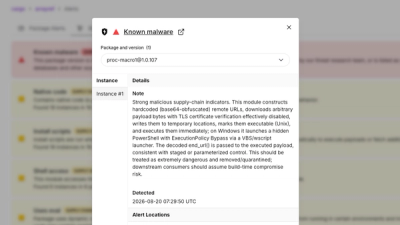
Three compromised Rust crates pulled in a malicious dependency that downloaded and executed cross-platform malware during Cargo builds.