

Company News
AWS Security Hub Adds Socket for Supply Chain Security
Socket is now in the AWS Security Hub Extended plan. Adopt it through AWS, apply committed spend, and block malicious open source packages.
By Feross Aboukhadijeh - Aug 04, 2026
gjalla
Advanced tools
Visibility and control for your software architecture. Agentic engineering made magical.
pip install gjalla
Requires Python >= 3.10.
| Command | Description |
|---|---|
auth login | Browser-backed sign in — saves a user-scoped API key locally |
setup | Set up gjalla in a repository (interactive wizard, or use subcommands) |
log | Semantic change history — what primitives changed, when, and by whom |
status | Show configuration status |
state | Navigate project state (architecture, tech stack, capabilities, etc.) |
rules | View and manage project rules, principles, ADRs, and invariants |
attest | Create commit attestation (interactive or programmatic) |
check | Validate commit attestation (used by pre-commit hook) |
skills | View project skills (list, filter by category/persona, show detail) |
sync | Upload pending attestations and refresh local cache |
project | Manage gjalla projects |
gjalla auth login       # browser-backed sign in (one command)
gjalla setup            # link a project + install hooks + MCP server
auth login opens your browser to approve the request. Once approved, a
user-scoped API key is saved locally and works for every project your
account can access.
setup launches the interactive wizard:
auth login).gjalla/ project configNon-interactive subcommands:
gjalla setup auth <api-key>         # Save and verify an API key
gjalla setup project <pid>          # Link this repo to a project
gjalla setup project --check-access # List accessible projects
gjalla setup hooks                  # Install git hooks
gjalla setup mcp                    # Install MCP server entry
gjalla state show                                # List top-level keys with entry counts
gjalla state show -c architecture                # Full architecture section
gjalla state show -c architecture -v             # Architecture + file evidence
gjalla state show -e architecture.api-server     # Drill into a single element
gjalla state show -e architecture.api-server -v  # Element + file evidence
gjalla state show -c tech_stack                  # Tech stack, frameworks, vendors
gjalla state show -c capabilities                # Project capabilities and status
gjalla state show -c data_model                  # Data entities, domains, attributes
gjalla state show -c services                    # External services and integrations
gjalla state show -c surface_area                # API endpoints and auth requirements
gjalla state show --system                       # Cross-project system context
gjalla rules show                # List rule categories with counts
gjalla rules show -c adr         # Show only ADRs
gjalla rules show -c principle   # Show only principles
gjalla rules show -c invariant   # Show only invariants
gjalla rules add -n "No ORM" -d "Use raw SQL queries"  # Add a rule
Automatic (via pre-commit hook):
gjalla check runs on each git commit and validates the attestationManual / Agent workflow:
git add <files>
gjalla attest            # interactive mode
git commit -m "message"
Programmatic (for agents/scripts):
gjalla attest \
  --staged-diff-hash $(git diff --staged | shasum -a 256 | cut -d' ' -f1) \
  --agent claude-code --provider anthropic --model claude-opus-4-6 \
  --summary "Added rate limiting to auth endpoints" \
  --provenance '{"type": "spec", "ref": "docs/specs/rate-limiting.md"}' \
  --rules '{"checked": true, "applicable": [...]}' \
  --arch-changes '{"architecture": {"elements": [{"name": "web-api", "change": "modified", ...}], ...}}'
Print attestation template:
gjalla attest --example
gjalla sync
Uploads pending attestations and refreshes the local cache from the remote server.
gjalla status
Shows: git repo, global config, API key, project mapping, project config, guardrails, telemetry, attestation log.
gjalla skills show                        # List all enabled skills
gjalla skills show --category context     # Filter by category
gjalla skills show --persona code-reviewer # Filter by persona
gjalla skills show analyze-before-coding  # Show full skill content
Global config: ~/.gjalla/config.yaml
api_key: "your-api-key"
telemetry: true  # opt-in CLI usage analytics
Project config: .gjalla/config.yaml (in repo root)
Environment variables:
GJALLA_API_KEY — overrides config file API keyGJALLA_TELEMETRY — 1/0 to override telemetry consentSKIP_ATTESTATION — 1 to skip attestation for a commitGJALLA_NO_VERIFY — 1 to skip field validation (hash check still runs)Gjalla collects commit attestations and allowlisted agent session telemetry. Memories are never harvested: users and agents add them explicitly through Gjalla's CLI or MCP. All collection is transparent and documented here.
When: Every git commit (via pre-commit validation + post-commit processing).
What's collected:
| Field | Source | Required? |
|---|---|---|
staged_diff_hash | SHA-256 of staged diff | Yes (user computes) |
agent | Agent name (e.g., "claude-code") | Yes |
agent_provider | Provider (e.g., "anthropic") | Yes |
agent_model | Model ID (e.g., "claude-opus-4-6") | Yes |
summary | Impact description of the change | Yes |
provenance | What prompted this: {type: "spec|ticket|bug-fix|ad-hoc", ref: "..."} | Yes |
rules | Rule compliance report: {checked: true, applicable: [...]} | Yes |
changes | Architecture changes across 8 primitives (see below) | Yes |
timestamp | ISO 8601 timestamp | Auto-generated |
developer | {git_author_name, git_author_email} from git config | Auto-detected |
agent_session_id | Session/conversation UUID | Auto-detected from agent runtime |
telemetry | Session metrics (see section 2) | Auto-extracted |
8 architecture primitives tracked in changes: architecture, data_model, data_flows, rules, capabilities, surface_area, external_services, tech_stack. Each is {changed: false} or {changed: true, details: [...]}.
Where stored locally:
.gjalla/.commit-attestation.yaml — pending attestation (ephemeral, deleted after commit).gjalla/attestations/<commit-hash>.yaml — archived attestation (permanent).gjalla/log.jsonl — one JSON entry per commit with all fields aboveWhere uploaded: POST /api/agent/projects/{id}/attestations during gjalla sync.
When: Auto-extracted at commit time from the active agent's local session files.
What's collected:
| Field | Claude Code | Gemini CLI | Codex CLI | OpenCode | Aider |
|---|---|---|---|---|---|
| Token counts (in/out/cache) | Yes | Yes (OTel) | No | Best-effort | No |
| Duration (seconds) | Yes | Yes | Yes | Best-effort | No |
| Model name | Yes | Yes | Yes | Best-effort | Partial |
| Tool call count | Yes | Yes | No | Best-effort | No |
| Tool names + categories | Yes | Yes (OTel spans) | Best-effort | Best-effort | Best-effort |
Tool categories: builtin (Read, Edit, Bash), mcp (mcp__gjalla__*), skill (Skill tool), agent (Agent tool).
Security: The Claude Code adapter reads session JSONL files with a strict field allowlist (type, message, timestamp, sessionId, durationMs). It never reads message content, tool arguments, tool results, or any user-authored text. Tool names (e.g., "Read", "mcp__gjalla__get_context") are metadata, not content.
Where stored: Embedded in the attestation's telemetry field → same local + upload path as attestations.
Gjalla memory is explicit. Agents and users create or update memories with
gjalla memory add (or the compatible memory save spelling) or the
save_memory MCP tool and recall them with
gjalla memory show or get_memories.
Personal memory stays local. Hosted team, system, and project memory uses
explicit --scope / MCP scope arguments. Anyone with access to a hosted scope
can read and contribute; owners/admins can archive and restore with
gjalla memory archive|restore or the matching MCP tools.
gjalla sync downloads hosted memory into Gjalla's own cache for offline
recall. It does not scan, import, modify, or delete Claude Code, OpenCode,
Codex, Gemini, Cursor, or other provider-native memory. It also does not embed
memory bodies in provider guidance files.
Where stored locally:
~/.gjalla/user/memory/*.md.gjalla/.platform/memories.jsonProvider-native memory remains owned entirely by the provider and user.
When: On each CLI command execution, if the user has opted in.
What's collected: Command name, CLI version, OS, Python version, install ID (persistent UUID), whether a project is linked. Never collects: code, project data, file contents, credentials.
Consent: Prompted on first run. Stored in ~/.gjalla/config.yaml as telemetry: true|false. Override with GJALLA_TELEMETRY=0.
Where sent: POST /api/cli/telemetry (fire-and-forget, 2s timeout). Error tracking via Sentry (same consent gate, 10% sample rate, sensitive keys scrubbed).
.gjalla/                              # Project root (gitignored)
├── config.yaml                       # Project config (project_id, api_key)
├── .commit-attestation.yaml          # Pending attestation (ephemeral)
├── example-attestation.yaml          # Template for agents
├── log.jsonl                         # Cumulative attestation log
├── attestations/                     # Archived attestation YAMLs
│   └── <commit-hash>.yaml
└── cache/                            # Pulled from platform by `gjalla sync`
    ├── gjallastate.yaml              # Architecture, capabilities, data model
    ├── gjallarules.yaml              # Rules, principles, ADRs, checks
    ├── gjallamap.yaml                # Element-to-file mappings
    ├── architecture.txt              # Rich-formatted architecture overview
    ├── rules.md                      # Markdown-formatted rules
    ├── state.json                    # Full project state (JSON)
    ├── context.md                    # Agent guidance from platform
    ├── skills/                       # Available project skills (one .md per skill)
    │   └── <slug>.md
    ├── memories.json                 # Merged memories from all agents
    ├── system-context.md             # Cross-project context
    ├── system-mappings.yaml          # Cross-project element mappings
    └── specs/                        # Domain behavioral specs
        └── <domain>/spec.md

~/.gjalla/                            # Global config
└── config.yaml                       # API key, telemetry consent, install ID
Questions or feedback: hello@gjalla.io
FAQs
gjalla CLI — visibility and control for your software architecture.
The pypi package gjalla receives a total of 611 weekly downloads. As such, gjalla popularity was classified as not popular.
We found that gjalla demonstrated a healthy version release cadence and project activity because the last version was released less than a year ago. It has 1 open source maintainer collaborating on the project.
Did you know?

Socket for GitHub automatically highlights issues in each pull request and monitors the health of all your open source dependencies. Discover the contents of your packages and block harmful activity before you install or update your dependencies.
Company News
Socket is now in the AWS Security Hub Extended plan. Adopt it through AWS, apply committed spend, and block malicious open source packages.
Research
/Security News
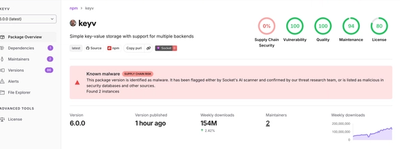
Popular npm packages keyv and cacheable compromised.

Security News
A misconfiguration gave three Anthropic models internet access, and one, believing it was in a simulation, shipped a credential-stealing package to PyPI.