
Research
/Security News
Popular npm Packages in the keyv and Cacheable Namespaces Compromised in Active Supply Chain Attack
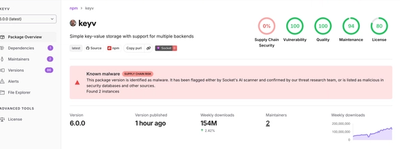
Popular npm packages keyv and cacheable compromised.
By Socket Research Team - Aug 04, 2026
graphmem-mcp
Advanced tools
Production-grade Graph-RAG MCP server with local embeddings — persistent knowledge graphs for any LLM-powered CLI agent
Persistent knowledge graph memory for AI agents and IDEs


Graph-Mem MCP is a universal MCP server that gives any agent or IDE persistent, structured memory through a knowledge graph. It combines graph storage, semantic vector search, and multi-hop traversal in a single package — install it, add it to your MCP config, and your agent gains memory that survives across sessions. It works everywhere MCP does.
| 1055 tests | Property-based against a brute-force reference, plus fuzzing on every parser |
| mypy strict | Clean, enforced in CI — not just configured |
| Authenticated UI | Host + Origin allow-lists and a session token; a cross-origin write is a 403, verified against a running server |
| Bounded | Every traversal, search, and list response has a named, configurable cap and reports truncation |
| Honest docs | Performance claims come with measurements and a reproducible benchmark; known gaps are written down |
graph-mem is a standard MCP server, so it works with any MCP-compatible
agent, IDE, or framework. graph-mem install additionally writes the skill
file straight into the right place for these 13, each at a path cited against
the vendor's own documentation:
| Claude Code | OpenCode | Cursor | Windsurf | Codex CLI |
| Gemini CLI | GitHub Copilot | Amp | Kiro | Roo Code |
| Continue | Antigravity | Droid (Factory) | add yours → |
Using something else? The MCP config below is all you need; the skill file is a convenience, not a requirement. Adding your agent to the installer takes a documented path and about ten lines — see Adding an Agent.
AI agents forget everything between sessions. They re-read files, re-discover architecture, and repeat mistakes. Graph-Mem MCP solves this by providing persistent, per-project knowledge graphs that any MCP-compatible agent can read and write to. The graph builds organically as the agent works — extracting entities, decisions, and relationships from every conversation. It runs as a standard MCP server with 28 tools that plug into any agent, IDE, or framework that supports the Model Context Protocol.
Vector search finds similar things. Graphs find connected things. When an agent asks "what depends on the auth service?", a vector store returns text that mentions auth. A knowledge graph traverses the actual dependency edges and returns every upstream consumer — even ones that never mention "auth" in their description. Graph-Mem gives you both: vector similarity for fuzzy discovery, graph traversal for structural queries.
1. Install:
pip install graphmem-mcp
Or run it without installing — uvx fetches and isolates it the way npx
does for Node:
uvx --from graphmem-mcp graph-mem server
Listed in the official MCP Registry
as io.github.Sathvik-1007/graphmem-mcp, so MCP-aware clients can discover and
install it directly.
2. Install the skill for your agent:
graph-mem install claude       # Claude Code
graph-mem install opencode     # OpenCode
graph-mem install codex        # Codex CLI
graph-mem install gemini       # Gemini CLI
graph-mem install cursor       # Cursor
graph-mem install windsurf     # Windsurf
graph-mem install amp          # Amp
graph-mem install antigravity  # Antigravity
graph-mem install copilot      # GitHub Copilot
graph-mem install kiro         # Kiro
graph-mem install roocode      # Roo Code
graph-mem install continue     # Continue
graph-mem install droid        # Droid (Factory)
This writes a skill file that teaches your agent how to use all 28 MCP tools — when to search, when to add entities, naming conventions, and common workflows.
3. Configure MCP by adding this to your agent's MCP config:
{
  "mcpServers": {
    "graph-mem": {
      "command": "graph-mem",
      "args": ["server"]
    }
  }
}
With full customization:
{
  "mcpServers": {
    "graph-mem": {
      "command": "graph-mem",
      "args": [
        "server",
        "--project-dir", "/path/to/my/project",
        "--embedding-model", "sentence-transformers/all-mpnet-base-v2",
        "--use-onnx",
        "--cache-size", "20000",
        "--log-level", "INFO"
      ]
    }
  }
}
That's it. Your agent now has persistent memory. Verify by asking it to run read_graph().
Paste this into your agent's chat to get started immediately:
I want you to give yourself persistent memory using graph-mem. Run the following:

pip install graphmem-mcp
graph-mem install claude    # or: opencode, codex, gemini, cursor, windsurf, amp,
                            #     antigravity, copilot, kiro, roocode, continue, droid

This installs a skill file that teaches you how to use all 28 MCP tools.
The server should already be configured in your MCP config. If not, add it:

{
  "mcpServers": {
    "graph-mem": {
      "command": "graph-mem",
      "args": ["server", "--project-dir", "/path/to/your/project"]
    }
  }
}

Now start using the knowledge graph:

1. read_graph() to see current state
2. search_nodes("relevant topic") to find existing knowledge
3. add_entities, add_relationships, add_observations as you learn things
4. update_observation / update_relationship to fix mistakes in-place
5. open_dashboard() to explore the graph visually in your browser
6. At session end, capture anything important you discovered

Your goal: build a rich knowledge graph of this project so future sessions
start with full context instead of from zero. Search before adding to avoid
duplicates. Be specific with entity names and types.
pip install graphmem-mcp
graph-mem server
uvx --from graphmem-mcp graph-mem server
uvx downloads the package into an isolated environment and runs it in one command. Nothing to pre-install beyond uv.
git clone https://github.com/Sathvik-1007/GraphMem-MCP
cd graph-mem
pip install -e ".[full,dev]"
graph-mem server
pip install "graphmem-mcp[embeddings]"   # sentence-transformers for local embeddings
pip install "graphmem-mcp[onnx]"         # ONNX runtime for embedding inference
pip install "graphmem-mcp[ui]"           # aiohttp for interactive graph visualisation
pip install "graphmem-mcp[full]"         # all of the above
Graph-Mem exposes 28 MCP tools — ten for writing, nine for reading, four for maintenance, four for multi-graph management, and one utility. Full CRUD on every primitive: entities, relationships, and observations can all be created, read, updated, and deleted.
| Tool | Description |
|---|---|
add_entities | Batch-create entities with optional observations; auto-merges on name conflict; returns quality screening hints |
add_relationships | Create typed, directed edges between entities; merges duplicates by max weight |
add_observations | Attach factual statements to entities with optional source provenance |
update_entity | Modify entity name, description, properties, or type in-place (rename with collision check) |
update_relationship | Change weight, type, or properties of an existing edge without delete+re-create |
update_observation | Edit observation text content in-place with automatic embedding recompute |
delete_entities | Remove entities with cascade to relationships, observations, and embeddings |
delete_relationships | Remove specific edges between entities, optionally filtered by type |
delete_observations | Remove specific observations by ID with ownership validation |
merge_entities | Combine duplicate entities: moves observations and relationships, deduplicates edges |
| Tool | Description |
|---|---|
search_nodes | Hybrid semantic + full-text search with RRF fusion ranking |
search_observations | Semantic search directly over observation text content |
find_connections | Multi-hop BFS graph traversal with direction and type filters |
get_entity | Full entity details with all observations and relationships |
list_entities | Browse/paginate all entities with optional type filter |
list_relationships | Browse/paginate relationships with entity, type, or combined filters |
read_graph | Graph statistics: counts, type distributions, most-connected entities |
get_subgraph | Extract neighborhood subgraph around seed entities |
find_paths | Find shortest paths between two entities via BFS |
| Tool | Description |
|---|---|
graph_health | Health stats: counts, hotspots, missing descriptions, suggested actions |
compact_observations | Atomic observation compaction — delete old and add merged summaries in one step |
suggest_connections | Find semantically similar entities for a node to connect to |
audit_graph | Full quality screening — disconnected nodes, missing data, weak links. Returns structured findings plus a rendered report field |
| Tool | Description |
|---|---|
open_dashboard | Launch interactive graph visualisation UI and return its URL |
| Tool | Description |
|---|---|
list_graphs | List all named graphs in the .graphmem/ directory with entity/relationship/observation counts |
create_graph | Create a new named graph (.graphmem/<name>.db) |
switch_graph | Switch the active graph — hot-swaps storage, search, and graph engines |
delete_graph | Delete a named graph (cannot delete the currently active graph) |
Multi-graph storage: Each named graph is a separate SQLite database in
.graphmem/. The default graph isgraph.db. Use--graph <name>on CLI commands to target a specific graph.
graph TD
    Agent[Any MCP-Compatible Agent or IDE] --> Transport

    subgraph Transport
        STDIO[stdio]
        SSE[SSE]
        HTTP[streamable-http]
    end

    Transport --> Tools

    subgraph Tools[Graph-Mem MCP Server — 28 MCP Tools]
        Write[Write · 10 tools]
        Read[Read · 9 tools]
        Maint[Maintenance · 4 tools]
        Graph[Multi-Graph · 4 tools]
        UI[Dashboard · 1 tool]
    end

    Write --> Engines
    Read --> Engines
    Maint --> Engines

    subgraph Engines
        GE[GraphEngine]
        SE[HybridSearch]
        EE[EmbeddingEngine]
        GT[GraphTraversal]
        EM[EntityMerger]
    end

    Engines --> Storage

    subgraph Storage[SQLite Storage]
        DB[SQLite WAL]
        VEC[sqlite-vec]
        FTS[FTS5]
    end

    UI --> Dashboard[React SPA + aiohttp]
    Dashboard --> DB
Everything lives in a single SQLite database per project. The server communicates over MCP's standard stdio transport (SSE and streamable-http also supported) and stores all data in .graphmem/graph.db at your project root. The database file is portable — copy it between machines, check it into version control, or back it up like any other file.
| Document | What is in it |
|---|---|
| How It Works | Data model, search pipeline, traversal, entity resolution, storage layout, request flow |
| Architecture | Why the design is what it is — the load-bearing decisions, their costs, and the measured baselines |
| Security | Threat model, the MCP and browser trust boundaries, and what is deliberately out of scope |
| Contributing | Local setup and the gates CI enforces |
Graph-Mem MCP is a standard MCP server. It communicates with your agent over the Model Context Protocol (stdio by default, SSE and streamable-http also supported) and exposes 28 tools that the agent calls directly — the same way it calls any other MCP tool. It works with every MCP-compatible agent, IDE, and framework out of the box.
To verify it's working, ask your agent to run read_graph() — it should return the current graph statistics.
graph-mem ui                              # open interactive graph explorer
graph-mem ui --no-open                    # start server without opening browser
graph-mem ui --port 9090                  # use a specific port
graph-mem ui --graph harry-potter         # open a specific named graph
The URL printed by graph-mem ui contains a session token — treat it as a
password. The dashboard reads and writes the graph, so the API requires that
token in a custom header, and rejects requests whose Origin or Host is not
the interface it bound. Without those checks any website you visited while the
UI was running could rewrite your knowledge graph. See
SECURITY.md for the details.
The open_dashboard MCP tool also starts this UI server and returns the URL to
your agent. It always binds localhost: the bind address is deliberately not a
tool parameter, so a prompt-injected agent cannot publish your graph to the
network.
Dashboard features:
By default, Graph-Mem stores its database at .graphmem/graph.db relative to the current working directory. You can control this with:
| Method | Example | Result |
|---|---|---|
--project-dir | --project-dir /home/user/myproject | Stores at /home/user/myproject/.graphmem/graph.db |
--db | --db /custom/path/memory.db | Stores at exactly that path |
GRAPHMEM_DB_PATH env | export GRAPHMEM_DB_PATH=/tmp/test.db | Stores at that path |
| Default | (nothing) | .graphmem/graph.db relative to CWD |
Priority order: --db > --project-dir > GRAPHMEM_DB_PATH env var > default.
The .graphmem/ directory is automatically created if it doesn't exist. Add .graphmem/ to your .gitignore if you don't want to track the database in version control.
graph-mem server                          # stdio transport (default)
graph-mem server --transport sse          # SSE transport
graph-mem server --db /path/to/graph.db   # custom database path
graph-mem server --project-dir /my/project  # store memory in <dir>/.graphmem/
graph-mem server --project-dir /my/project --graph harry-potter  # use named graph

# Embedding customization
graph-mem server --embedding-model sentence-transformers/all-mpnet-base-v2
graph-mem server --no-onnx --embedding-device cuda
graph-mem server --cache-size 50000

# Tuning
graph-mem server --search-limit 20 --max-hops 6
graph-mem server --log-level DEBUG
All server options:
| Flag | Description | Default |
|---|---|---|
--transport | stdio, sse, or streamable-http | stdio |
--db | Path to SQLite database file | .graphmem/graph.db |
--project-dir | Project root; DB at <dir>/.graphmem/graph.db | CWD |
--graph | Named graph (resolves to <dir>/.graphmem/<name>.db) | graph |
--host | Bind address (SSE/HTTP only) | 127.0.0.1 |
--port | Port (SSE/HTTP only) | 8080 |
--embedding-model | HuggingFace model ID for embeddings | all-MiniLM-L6-v2 |
--use-onnx / --no-onnx | Use the ONNX embedding backend (needs optimum[onnxruntime]) | off |
--embedding-device | cpu or cuda | cpu |
--cache-size | Embedding LRU cache max entries | 10000 |
--search-limit | Default max results for search_nodes | 10 |
--max-hops | Default max depth for find_connections | 4 |
--log-level | DEBUG / INFO / WARNING / ERROR / CRITICAL | WARNING |
graph-mem install <agent>                 # project-level install
graph-mem install <agent> --global        # global/user-level install
graph-mem install <agent> --domain code   # use domain overlay (code, research, general)
Every path below is cited against the vendor's current documentation. An agent whose install location cannot be cited is not listed here — a guessed path reports success, writes a file, and the agent never reads it, which is worse than no support. Six agents were removed on exactly those grounds.
| Agent | Project path | User-level path | Written as | Source |
|---|---|---|---|---|
claude | .claude/skills/graph-mem/SKILL.md | ~/.claude/skills/graph-mem/SKILL.md | own file | docs |
opencode | .opencode/skills/graph-mem/SKILL.md | ~/.config/opencode/skills/graph-mem/SKILL.md | own file | docs |
codex | AGENTS.md | ~/.codex/AGENTS.md | section | docs |
gemini | GEMINI.md | ~/.gemini/GEMINI.md | section | docs |
cursor | .cursor/rules/graph-mem.mdc | — | own file | docs |
windsurf | .windsurf/rules/graph-mem.md | ~/.codeium/windsurf/memories/global_rules.md | own file | docs |
amp | .agents/skills/graph-mem/SKILL.md | ~/.config/agents/skills/graph-mem/SKILL.md | own file | docs |
antigravity | AGENTS.md | ~/.gemini/AGENTS.md | section | docs |
copilot | .github/copilot-instructions.md | — | section | docs |
kiro | .kiro/steering/graph-mem.md | ~/.kiro/steering/graph-mem.md | own file | docs |
roocode | .roo/rules/graph-mem.md | ~/.roo/rules/graph-mem.md | own file | docs |
continue | .continue/rules/graph-mem.md | — | own file | docs |
droid | AGENTS.md | ~/.factory/AGENTS.md | section | docs |
Agents whose target file is shared — AGENTS.md, GEMINI.md,
.github/copilot-instructions.md, Windsurf's global rules — get a delimited
section written into it. Anything you already have in the file survives, and
re-installing replaces the section instead of appending a second copy.
Want another agent supported? See Adding an Agent — it takes a documented path and about ten lines.
graph-mem init                            # create .graphmem/ directory
graph-mem init --project-dir /my/project  # create in specific directory
graph-mem init --graph research           # create a named graph
graph-mem status                          # print graph statistics
graph-mem status --json                   # graph statistics as JSON
graph-mem status --graph research         # status of a named graph
graph-mem export --format json            # export entire graph
graph-mem export --output backup.json     # export to file
graph-mem import graph.json               # import graph from file
graph-mem validate                        # run integrity checks
All management commands accept --db, --project-dir, and --graph for targeting a specific database.
Multi-graph support: Use --graph <name> to work with named graphs stored as .graphmem/<name>.db. Without --graph, commands target the default graph.db. The MCP tools list_graphs, create_graph, switch_graph, and delete_graph provide runtime graph management for agents.
All settings are optional. Defaults work out of the box. Every setting can be controlled via CLI flags (see graph-mem server --help), environment variables, or both. CLI flags take precedence over environment variables, which take precedence over defaults.
| Environment Variable | CLI Flag | Default | Description |
|---|---|---|---|
GRAPHMEM_DB_PATH | --db | .graphmem/graph.db | Database file path |
GRAPHMEM_BACKEND_TYPE | -- | sqlite | Storage backend |
GRAPHMEM_EMBEDDING_MODEL | --embedding-model | all-MiniLM-L6-v2 | HuggingFace model ID |
GRAPHMEM_USE_ONNX | --use-onnx / --no-onnx | false | Use ONNX runtime if available |
GRAPHMEM_EMBEDDING_DEVICE | --embedding-device | cpu | Inference device (cpu or cuda) |
GRAPHMEM_CACHE_SIZE | --cache-size | 10000 | Embedding cache max entries |
GRAPHMEM_SEARCH_LIMIT | --search-limit | 10 | Default search result limit |
GRAPHMEM_MAX_HOPS | --max-hops | 4 | Default max traversal depth |
GRAPHMEM_LOG_LEVEL | --log-level | WARNING | Logging verbosity |
GRAPHMEM_TRANSPORT | --transport | stdio | MCP transport protocol |
Measured numbers, not adjectives. Reproduce the traversal figures with
python benchmarks/bench_traversal.py; the full table is in
docs/ARCHITECTURE.md.
Traversal — breadth-first with a global visited set, one indexed adjacency query per hop. A dense 60-node graph traverses to depth 6 in 5 ms. The obvious recursive-CTE formulation enumerates every simple path instead: on a 14-node graph it materialised 1,409,006 intermediate rows in 6.4 seconds to return the same 13 entities that BFS returns in 1 ms.
Graph canvas — Barnes-Hut force simulation (θ = 0.9). 2000 nodes run at 215 fps; 5000 nodes, the API's own cap, at 80 fps. The previous all-pairs implementation managed 30 fps and 3.7 fps respectively. Approximation error against the exact sum is 1.30% RMS, and settled layouts are equivalent.
Storage
BEGIN IMMEDIATE so a read-to-write upgrade cannot fail unretryablyIN (...) chunked below SQLite's
bound-variable limitEmbeddings
(hash, model), so two models coexist instead of
clobbering each other; LRU eviction, batched reads and writesoptimum[onnxruntime] is installed and
--use-onnx is set, falling back to PyTorch. Off by default; this project
publishes no benchmark for it, so no speedup is claimed here.Bounds — every traversal, search, and list response is capped by a named, configurable limit, and a capped response says so rather than returning a silent subset.
git clone https://github.com/Sathvik-1007/GraphMem-MCP
cd graph-mem

# Using uv (recommended)
uv venv
uv pip install -e ".[full,dev]"

# Or using pip
python -m venv .venv
source .venv/bin/activate
pip install -e ".[full,dev]"
pytest                            # all tests
pytest tests/test_graph/          # graph engine tests
pytest tests/test_server/         # MCP server tool tests (all 28 tools)
pytest tests/test_cli/            # CLI command tests
pytest tests/test_models/         # data model tests
pytest tests/test_semantic/       # search + vector tests
pytest tests/test_storage/        # storage backend tests
pytest tests/test_db/             # database + migration tests
pytest tests/test_utils/          # config, logging, ID generation tests
pytest -x -q                      # stop on first failure, quiet output
FAQs
Production-grade Graph-RAG MCP server with local embeddings — persistent knowledge graphs for any LLM-powered CLI agent
We found that graphmem-mcp demonstrated a healthy version release cadence and project activity because the last version was released less than a year ago. It has 1 open source maintainer collaborating on the project.
Did you know?

Socket for GitHub automatically highlights issues in each pull request and monitors the health of all your open source dependencies. Discover the contents of your packages and block harmful activity before you install or update your dependencies.
Research
/Security News
Popular npm packages keyv and cacheable compromised.

Security News
A misconfiguration gave three Anthropic models internet access, and one, believing it was in a simulation, shipped a credential-stealing package to PyPI.

Security News
/Company News
Socket has joined the new Composer and Packagist sponsorship program as a launch sponsor, supporting the team that keeps PHP's package ecosystem secure.