

Company News
AWS Security Hub Adds Socket for Supply Chain Security
Socket is now in the AWS Security Hub Extended plan. Adopt it through AWS, apply committed spend, and block malicious open source packages.
By Feross Aboukhadijeh - Aug 04, 2026
grounded-reasoning
Advanced tools
Zero-token, precision-guaranteed verifier for LLM/agent multi-hop relational reasoning


TL;DR. LLMs hallucinate on multi-hop relational reasoning. This is a relation-algebra verifier an agent calls to check a claim before asserting it: zero model tokens, precision-guaranteed (accepts a claim iff a grounded proof path exists), language-agnostic, and provider-agnostic. Plugs in as a library, a function-calling tool, or an MCP server. Validated on real LLMs (DeepSeek et al.) and the public CLUTRR benchmark. See docs/integration.md.
📄 Full paper: PAPER.md · Integration guide: docs/integration.md · Try it in 30 seconds: quickstart notebook
Đọc bằng tiếng Việt: README.vi.md
LLMs are solid on one-hop facts but collapse on composition — chaining several correct facts into a multi-step conclusion. On CLUTRR (kinship reasoning), DeepSeek's accuracy falls off with depth, while a grounded operator-composition solver holds ~100% flat — at zero tokens:
acc
100% ●─────●─────●─────●─────●─────●─────● ● Grounded solver (algebra, 0 tokens)
90% |
80% ○
70% | ╲
60% | ╲
50% | ╲
40% | ○ ○ ○ DeepSeek (LLM)
30% | ╲ ╱ ╲
20% | ○─────○ ╲
10% | ○─────○
0% +──┴─────┴─────┴─────┴─────┴─────┴─────┴─
hop 2 3 4 5 6 7 8 (composition steps)
hop: 2 3 4 5 6 7 8
DeepSeek: 83% 42% 25% 25% 42% 17% 8%
Solver: 100% 100% 100% 100% 100% 100% 100%
(CLUTRR/v1 gen_train234_test2to10, clean-chain, n=12/hop; full test set n=635: solver
covers 99.5%, accuracy 99.2%. grounded_reasoning/experiments/clutrr_eval.py.)
Is: a guaranteed reasoning-verification layer built on relation operator algebra.
calibrate_transitivity doesn't care
whether facts came from an external KB or the model's own assertions, so it
already calibrates SGDC's real output precision with zero new code (see
self_grounded_calibration_eval.py,
PAPER.md §6's remark).Is not: an "unprecedented breakthrough." The Katz index, the Neumann series, graph reachability, and neuro-symbolic grounding are all classical math and technique. The contribution here is unification, a measured guarantee, and benchmark numbers — not a new primitive. The guard needs a relation graph (supplied, or extracted from LLM facts); flexibility is bounded (see PAPER §5).
Raised in review, reproduced, and fixed with an opt-in guard each — not swept under the rug:
"Bob" vs "bob"), the graph
treats them as two nodes and a real path silently breaks — the guard then
(correctly, per its own contract) rejects a claim that is actually true.
Fix (binary): GroundedReasoner(normalize=lambda s: s.strip().casefold())
folds surface-form variants together before they become graph keys; proofs
still display each entity's original first-seen spelling. Theorem N
characterizes exactly when this is safe: precision stays exactly 1.0 as
long as normalize never merges two genuinely distinct entities — that's
the only way it can go wrong, so it's exactly what
gr.calibrate_normalization(labeled_pairs) measures from held-out evidence,
reusing the same Clopper-Pearson machinery as Theorem M.via is transitive in reality. It guarantees
"a path exists under the closure of via," not "via actually composes in
the world." Compose a relation that's only partially/conditionally
transitive ("trusts": A trusts B, B trusts C, does not imply A trusts C)
and you get a confident, mathematically correct grounded=True that answers
a different question than the one you meant to ask. Fix (binary):
GroundedReasoner(transitive_relations={"parent", "is_a", ...}) makes the
guard raise ValueError for any undeclared relation, turning a silent
modeling assumption into an explicit, checked one. Fix (measured — Theorem
M): gr.calibrate_transitivity(rel, labeled_pairs) replaces the binary
declare-or-reject with an actual number — a Clopper-Pearson lower confidence
bound on "a graph-grounded claim for rel is really true," computed from
held-out labeled pairs. Where the binary guard can only guess or block
outright, the calibrated bound tells you how much to trust it.Both opt-in guards are off by default (identical behavior to previous
releases). Reproductions: tests/test_agent.py::TestEntityNormalization,
::TestTransitiveRelationsGuard, ::TestTransitivityCalibration,
::TestNormalizationCalibration; the A/B comparisons:
transitivity_calibration_eval.py,
normalization_calibration_eval.py.
Heterogeneous relation chains. verify(via=rel) composes ONE relation with
itself; gr.verify_path(subject, obj, via=["parent","employer"]) composes an
exact sequence of different relations (e.g. a derived "financially dependent
on" claim) — not new math (OperatorRelationAlgebra.follow already composes
mixed-relation chains exactly per Theorem G, this just exposes it at the
facade with proof-path reconstruction) — and gr.calibrate_path(via, labeled_pairs) calibrates that fixed pattern with the same Clopper-Pearson
engine as calibrate_transitivity (see PAPER.md §5.3.4). Checked against
independent ground-truth BFS across 8,000 triples with zero mismatches:
tests/test_agent.py::TestHeterogeneousPathVerification,
heterogeneous_path_calibration_eval.py.
| Approach | Extra tokens | Guarantee | Needs an external KB |
|---|---|---|---|
| LLM self-verification (2nd call) | +110% | none (measured 34% precision) | no |
| Self-consistency / majority vote | multiplies with sample count | none, statistical only | no |
| RAG / external KG grounding | varies | only as good as retrieval | yes |
| This guard | +0 | precision = 1.0 (Theorem G) | no |
| This guard, self-grounded (SGDC) | +0 | precision = 1.0 given sound atomic facts (Theorem I) | no |
| This guard, conformal | +0 | coverage ≥ 1−α, distribution-free (Theorem K) | no |
The reasoning core rests on a single unification (numerically verified, zero error):
| View | Theorem | Content |
|---|---|---|
| Fuzzy diffusion inference | F | conf(a→b) = Σ αᵏ(Pᵏ)[a,b], calibrated + grounded |
| Relation operator algebra | G | composition = operator product, transitive closure = Σ powers |
| Spectral analysis (Katz) | H | engine.infer = resolvent (I−αP)⁻¹−I (matches 0.0 error) |
⟹ fuzzy inference is spectral analysis of the relation operator. grounded_reasoning/reasoning/.
Six further theorems extend this core: I (two-sided precision/recall guarantee for a self-grounded, no-external-KB variant), J (closure-learning completeness, validated on CLUTRR), K (conformal reasoning — distribution-free coverage under a noisy relation graph, including one extracted by an LLM from raw text), L (Horn forward-chaining, generalizing transitive closure to conjunctive rules), M (empirical transitivity calibration — a Clopper-Pearson confidence bound replacing a blind transitivity assumption with a measured one), and N (normalization precision isolation — precision=1.0 breaks only via an over-merge, and only that is what needs calibrating). All nine are stated, proved, and numerically verified in PAPER.md.
| Experiment | Result |
|---|---|
| Hallucination guard (kinship) | precision 33% → 100%, catches 92/92 (two seeds), 0 false rejects |
| Hallucination guard, harder stress test (48-person tree, sibling/spouse distractor facts, shuffled prose, T=0.7, guaranteed-empty trap questions) | raw DeepSeek precision 4.6% (2124 fabricated names, 86/90 trap questions answered with a fabrication); guarded precision 100%, 0 leaked, 0 correct answers dropped — guard_llm_stress_eval.py |
| Guard token cost | +0 tokens (vs. LLM self-verify: +110% tokens, 34% precision) |
| SGDC (self-grounded, no external KB) | precision 78% → 100% from internal consistency alone |
| Dense, anti-commonsense ontology | precision 31% → 100%, catches 106/106, 0 false rejects — nl_ontology_eval.run_dense |
| CLUTRR (public benchmark) | solver ~100% at every hop vs. DeepSeek 83%→8% |
| Hard passage (9-step chain, 8 questions) | DeepSeek fabricates 1/8 (wrong direction); grounded system 8/8, with proofs — examples/hallucination_demo.py |
The guard/solver needs a clean graph. But if you let an LLM extract relations from natural-language text, the graph is noisy (missing/spurious edges). Conformal Reasoning (Theorem K) fixes exactly that: use operator confidence as a score, calibrate a threshold ⟹ distribution-free coverage ≥ 1−α, even on a noisy graph.
End-to-end demo: DeepSeek extracts an "is a" graph from text → conformal runs on that extracted graph (ground truth is used only for scoring):
| Text | LLM extraction (P / R) | Coverage (target ≥90%) | Efficiency (FPR) |
|---|---|---|---|
| Easy | 100% / 99.7% | 91.3% | 0.0 |
| Hard (nested clauses + near-miss distractors) | 99.5% / 68.5% | 93.0% | 0.77 |
The LLM's extraction drops 31% of the edges (a genuinely noisy graph) → the coverage guarantee still holds (93% ≥ 90%), only efficiency degrades. Validity always holds; efficiency scales with graph quality.
⟹ A path to guaranteed reasoning over natural-language relations — where the hard
guard can't reach. grounded_reasoning/experiments/conformal_llm_eval.py.
Efficiency can be pushed further under dropout-dominant noise, at no cost to
validity. ConformalReasoner.calibrate(..., group_fn=...) calibrates a
separate threshold per group instead of one global one (Mondrian conformal —
classical, not new); redundancy_group groups a pair by whether it has more
than one walk in the extracted graph, computable with no ground truth. A
different grouping tried first (hop-distance) was numerically falsified
before shipping — it made efficiency worse, not better, and was discarded.
Redundancy grouping cuts FPR from 98.7% → 80.8% when dropped edges
dominate the noise (matching this system's real LLM-extraction noise mode)
while coverage still holds ≥90% — and honestly gives ~no benefit when
spurious added edges dominate instead.
redundancy_conformal_eval.py,
PAPER.md §7.1's remark.
A different, orthogonal weakness — the noise level DRIFTING over time, not
being heterogeneous — needs a different classical tool. Split-conformal
(and its Mondrian extension above) assumes calibration and test data share a
distribution; that breaks if extraction quality changes between document
batches. AdaptiveConformalReasoner (Adaptive Conformal Inference — Gibbs &
Candès, 2021, classical, not new) updates its threshold from a stream of
confirmed-true examples instead of freezing it after one calibration. When
noise shifts partway through a stream (p_drop 0.05 → 0.45), a frozen
threshold's coverage collapses from 88.6% to 47.6% — well below the 90%
target, silently — while ACI recovers to 89.6%, in 15/15 trials tested.
drift_conformal_eval.py,
PAPER.md §7.1's remark.
Strongest efficiency result: removing the specific bad edges beats calibrating
around them. identify_suspect_edges removes any edge that appears on a
held-out FALSE-labeled claim's proof path and NO true-labeled claim's — a
simple decision rule, not a statistical guarantee. Verified across 5 noise
regimes (60 seeds each): FPR drops substantially and consistently
everywhere, e.g. 77.0% → 49.2% (dropout-dominant) and 58.7% → 15.7%
(spurious-dominant, where redundancy_group gives almost nothing) —
coverage on the remaining graph essentially unaffected. Unlike every
calibration method above, this one carries no false-discovery-rate
guarantee — a real, measured tradeoff: at the default configuration
(identify_frac=0.5, min_evidence=1), the pooled wrongly-removed rate
ranges 13.2%–32.2% across regimes. At the recommended configuration
(identify_frac=0.85, min_evidence=2, found by a Pareto sweep — the
default of identify_and_prune_edges, which applies it automatically so
it's the path of least resistance), it drops to 1.5%–3.1% (95% upper
confidence bound 2.6%–6.6%), at the cost of cleaned FPR rising somewhat
(e.g. ~49% → ~59% in the dropout-dominant regime, still far below the 77%
raw baseline) and a smaller reserved evaluation set. Checked against a real
LLM (DeepSeek), not just simulated noise, on data where each candidate
edge is backed by exactly one labeled encounter (no query repeated — the
realistic case for a deployment that verifies each claim once): the
count-based rules above (min_evidence≥2, and its hub-aware
use_propagation=True variant) never fire at all on this regime, since
they require an edge to independently clear the evidence bar twice, which
never happens with single-encounter evidence. Lowering to
min_evidence=1 does block real hallucinated edges, but on its own makes
downstream FPR worse than doing nothing (63.0% → 70.7%, beats raw in
only 4/15 splits) — traced to the diffusion engine's row-normalization
concentrating transition probability onto a source's surviving edges once
its OTHER edges are pruned. Pairing that same blocking decision with
masked_infer (normalizes by each source's pre-prune degree, so removal
only ever removes confidence mass, never redistributes it) recovers a
real improvement: 63.0% → 54.0%, beats raw in 12/15 splits, with no
regression on the synthetic benchmark. A learned (logistic regression)
alternative was also tried and rejected: it failed to generalize from
synthetic training data to the real data at all. Pruning also costs real
recall for any true claim that depended solely on a removed edge, and it
edits the graph in place (a one-way change, unlike calibration which only
adjusts a threshold).
edge_pruning_eval.py,
edge_pruning_llm_eval.py,
PAPER.md §7.1's remark.
The guard above needs some relation graph handed to it. Self-Grounded Deductive Consistency (Theorem I) removes even that: it exploits the fact that LLMs are reliably accurate on atomic (1-hop) facts but hallucinate on composition. Take the model's own confident 1-hop facts, build the operator closure from those, then reject any of the model's own multi-hop conclusions that fall outside its own closure — self-contradiction is the hallucination signal, not disagreement with an external source.
from grounded_reasoning import GroundedReasoner

# the LLM's OWN atomic facts (no external KB) -- taken at face value
gr = GroundedReasoner()
gr.add_facts([("sparrow", "is_a", "bird"), ("bird", "is_a", "animal")])

# the LLM's OWN multi-hop conclusion, self-verified against ITS OWN facts above
gr.verify("sparrow", "animal", via="is_a")   # grounded=True: self-consistent
gr.verify("sparrow", "plant",  via="is_a")   # grounded=False: self-contradiction, blocked
| precision | recall | |
|---|---|---|
| Raw multi-hop (LLM) | 78% | 87% |
| SGDC (self-grounded, zero external knowledge) | 100% | 72% |
| Ceiling: filtering with an external graph | 100% | 87% |
The honest cost is recall (72% vs. 87%): self-closure is conservative. And Theorem I's precision=1.0 is conditional — it holds if the model's own atomic facts are sound; in a counter-prior domain (e.g. "a whale is a fish"), atomic precision itself can drop, and recall suffers with it (PAPER.md §6 records this honestly rather than hiding it).
That assumption can be measured too, with zero new code.
gr.calibrate_transitivity(rel, labeled_pairs) (Theorem M) doesn't care
whether gr's facts came from an external KB or the model's own atomic
self-assertions — so calling it on a reasoner built purely from an LLM's own
facts calibrates SGDC's actual output precision directly, from held-out
evidence, instead of assuming atomic soundness. In a synthetic domain with
15% of the atomic facts deliberately wrong, SGDC's real precision fell to
~74% (not the naively-expected ~85% — a single wrong atomic edge
composes into several downstream claims, amplifying its damage), and the
calibrated bound correctly stayed below that in 98.3% of trials —
self_grounded_calibration_eval.py,
PAPER.md §6's remark.
Runnable: examples/self_grounded_demo.py
(offline) · live on DeepSeek:
grounded_reasoning/experiments/self_grounded_eval.py.
pip install grounded-reasoning

# or, for development (tests + lint):
git clone https://github.com/ALEXaquarius/grounded-reasoning
cd grounded-reasoning && pip install -e ".[dev]"
pytest tests/                       # every theorem + offline-locked logic, no network needed

# Use it right now (no LLM/network needed):
python -c "from grounded_reasoning import GroundedReasoner as G; r=G(); r.add_facts([('a','p','b'),('b','p','c')]); print(r.verify('a','c',via='p'))"

# Real-LLM experiments (need a key — read from an env var, NEVER hardcoded):
export DEEPSEEK_API_KEY=sk-...        # bring your own; .env is gitignored
python -m grounded_reasoning.experiments.guard_llm_eval        # hallucination guard
python -m grounded_reasoning.experiments.guard_llm_stress_eval # harder: distractors + traps + high temperature
python -m grounded_reasoning.experiments.self_grounded_eval    # SGDC
python -m grounded_reasoning.experiments.clutrr_eval           # public CLUTRR benchmark
python -m grounded_reasoning.experiments.conformal_llm_eval    # end-to-end conformal (LLM-extracted graph)
python -m grounded_reasoning.experiments.guard_cost_eval       # token cost: guard vs. LLM self-verify
python -m grounded_reasoning.experiments.nl_ontology_eval      # dense anti-commonsense ontology (add run_dense() for the 106/106 result)
grounded_reasoning/agent/)A relation-reasoning verifier for agents: check a multi-hop claim before asserting it — zero model tokens, precision guaranteed (accepts iff a grounded proof path exists).
from grounded_reasoning import GroundedReasoner
gr = GroundedReasoner()
gr.add_facts([("alice","parent","bob"),("bob","parent","carol")])
gr.verify("alice","carol", via="parent")   # Verdict(grounded=True, proof=['alice','bob','carol'], confidence=0.36, relation='parent')
gr.verify("alice","zed",   via="parent")   # Verdict(grounded=False, proof=None, confidence=0.0, relation='parent')  ← hallucination blocked
Three integration paths (details: docs/integration.md):
GroundedReasoner.verify / filter_claims / contradictions.TOOL_SPEC (Anthropic) / openai_tool_spec() (OpenAI) + run_tool — a stateless verify_relation tool.python -m grounded_reasoning.agent.mcp_server — plugs into Claude or any MCP-compatible agent.Multi-provider (not just DeepSeek): LLMClient(provider=...) for DeepSeek / OpenAI /
Groq / OpenRouter / Together / Mistral / Ollama (local) — all OpenAI-compatible, switch
providers without changing code. Multilingual: entities/relations are opaque
Unicode strings ⟹ works with any language (cha, 父, والد…) with zero configuration.
A real function-calling demo (agent verifies itself, blocks hallucination):
python -m grounded_reasoning.experiments.agent_demo. When the graph is noisy (relations
extracted by an LLM from text), use ConformalReasoner for a coverage ≥1−α
guarantee instead of hard precision.
| Path | Content |
|---|---|
grounded_reasoning/ | Public package — GroundedReasoner, verify_relation, TOOL_SPEC, ConformalReasoner, AdaptiveConformalReasoner, LLMClient |
grounded_reasoning/agent/{verifier,tool,mcp_server}.py | Public API implementation — HallucinationGuard, function-calling tool, MCP server |
grounded_reasoning/reasoning/abstract_inference.py | FuzzyInferenceEngine, TypedInferenceEngine, HallucinationGuard (Theorem F) |
grounded_reasoning/reasoning/operator_algebra.py | Relation operator algebra (Theorem G) |
grounded_reasoning/reasoning/relation_spectrum.py | Spectrum, nilpotency, Katz resolvent (Theorem H) |
grounded_reasoning/reasoning/conformal_reasoning.py | Conformal — coverage guarantee under noise (Theorem K) |
grounded_reasoning/reasoning/composition_algebra.py | Composition-table learning, validated on CLUTRR (Theorem J) |
grounded_reasoning/reasoning/horn.py | Horn forward-chaining, least-model semantics (Theorem L) |
grounded_reasoning/reasoning/transitivity_calibration.py | Clopper-Pearson calibration — reused for both the transitivity assumption (Theorem M) and the normalization over-merge risk (Theorem N) |
grounded_reasoning/reasoning/edge_pruning.py | Held-out-evidence edge pruning — a heuristic decision rule, not a Theorem, with its own measured tradeoffs |
grounded_reasoning/reasoning/llm_client.py | Provider-agnostic LLM client (key read from an env var) |
grounded_reasoning/theory/theorems.py | Nine theorems (F–N) with numerical verification |
grounded_reasoning/experiments/{guard_llm,guard_llm_stress,self_grounded,self_grounded_calibration,nl_ontology,guard_cost,clutrr,conformal_llm,redundancy_conformal,drift_conformal,inference,transitivity_calibration,normalization_calibration,heterogeneous_path_calibration,edge_pruning,edge_pruning_llm}_eval.py | Real-LLM and benchmark experiments backing every claim above |
examples/hallucination_demo.py | End-to-end function-calling demo (real LLM, needs a key) |
examples/self_grounded_demo.py | SGDC (Theorem I): self-verify a model's own multi-hop claim with NO external KB (offline) |
examples/rag_pipeline_demo.py | filter_claims as a RAG/agent post-processing guard, heterogeneous claims (offline) |
examples/calibration_demo.py | Theorem M + N side by side: measuring transitivity and normalization trust instead of assuming it (offline) |
examples/conformal_demo.py | Coverage guarantee vs. noise tradeoff, clean vs. noisy graph side by side (offline) |
examples/quickstart.ipynb | Runnable tour of the library (offline, Colab-ready) |
This project began as an attempt to invent an embedding-free retrieval algorithm that could compete with dense/RAG retrieval. That research question reached a rigorous, fully honest negative conclusion (ties BM25, loses significantly to dense embeddings — with a proof of why). The same mathematical toolkit — operator algebra, spectral analysis — turned out to have real, measurable value on a different problem: guaranteeing multi-hop relational reasoning. This repository ships only that validated, tested reasoning system; the full retrieval research trail (including every failed attempt, honestly recorded) lives in a separate research repository and is not part of this package. See PAPER.md §1 for the full framing.
Principle: proof before code, formal definitions, falsifiability, and honest reporting of negative results — see CONTRIBUTING.md.
FAQs
Zero-token, precision-guaranteed verifier for LLM/agent multi-hop relational reasoning
We found that grounded-reasoning demonstrated a healthy version release cadence and project activity because the last version was released less than a year ago. It has 1 open source maintainer collaborating on the project.
Did you know?

Socket for GitHub automatically highlights issues in each pull request and monitors the health of all your open source dependencies. Discover the contents of your packages and block harmful activity before you install or update your dependencies.
Company News
Socket is now in the AWS Security Hub Extended plan. Adopt it through AWS, apply committed spend, and block malicious open source packages.
Research
/Security News
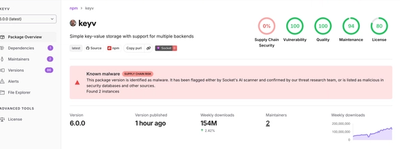
Popular npm packages keyv and cacheable compromised.

Security News
A misconfiguration gave three Anthropic models internet access, and one, believing it was in a simulation, shipped a credential-stealing package to PyPI.