

Product
PHP and Composer Support Is Now in Beta
Socket’s PHP and Composer support is now in Beta for all customers, with PHP reachability analysis generally available.
By Trevor Norris, Benjamin Barslev - Aug 21, 2026
guardrail-mcp
Advanced tools
A deterministic policy firewall for AI agent tool calls — blocks, warns, or allows based on rules you write, not a risk score.
A policy firewall for AI agent tool calls.
Your agent wants to run a shell command, send an email, or move money. Guardrail checks that request against rules you wrote, before it happens, and either lets it through, asks a human, or blocks it — with a plain- English reason every time.
git clone <this repo> && cd agent-guardrail
pip install -r requirements.txt
python3 cli.py check --agent trading-agent-001 --tool wallet.transfer \
--args '{"amount": 9999, "to": "0xabc"}'
Or, once published, pip install guardrail-mcp gives you a guardrail
command directly — same output, no repo checkout required (falls back to
the policy bundled in the package if you don't point --policy at your
own file):
guardrail check --agent trading-agent-001 --tool wallet.transfer \
  --args '{"amount": 9999, "to": "0xabc"}'
{
  "decision": "BLOCK",
  "matched_rules": [
    {"rule": "numeric_cap_exceeded", "severity": "BLOCK",
     "message": "amount=9999.0 exceeds cap 5 for 'wallet.transfer' (unknown agent)"}
  ]
}
That's it — no server, no account, no API key. policies/default.yaml is
the file that decided this; open it and change the numbers to match your
own rules.
Most "AI agent security" projects (including an earlier project of mine) lean on statistical risk scores computed from data nobody can actually verify at build time — wallet age, "reputation," contract "risk" — which either requires paid data feeds you don't have yet, or quietly becomes mock data pretending to be real. Fine for prototyping, dishonest to ship.
Guardrail only makes claims it can back up. Every check is a deterministic rule — a blocklist entry, a regex match, a numeric cap, a rate limit — evaluated against a policy file you write and can audit yourself, backed by a real, persistent audit log (SQLite) you can query. Nothing here pretends to know something it doesn't.
It's also not blockchain-specific. Shell execution, email, HTTP requests, file deletion, database writes, crypto transactions — same engine, same policy file, same rules.
Shown above. No setup, instant feedback while you write rules.
mcp_server.py) — the easy on-ramp, advisoryExposes guardrail_check, guardrail_record_outcome, and
guardrail_agent_history as MCP tools any MCP-compatible agent (Claude
Desktop, Claude Code, custom MCP clients) can call.
{
  "mcpServers": {
    "guardrail": {
      "command": "python3",
      "args": ["/absolute/path/to/agent-guardrail/mcp_server.py"],
      "env": { "GUARDRAIL_POLICY": "/absolute/path/to/agent-guardrail/policies/default.yaml" }
    }
  }
}
Then tell your agent (in its system prompt) to always call
guardrail_check before spending money, deleting data, messaging someone
externally, or running code.
Be clear-eyed about its limit: like any MCP tool, nothing stops the calling model from just not invoking it. This only helps if the agent is instructed to always check first — for a guarantee it can't skip, see #3.
guardrail.decorator.enforce — the real guaranteeWraps the actual Python function that performs a tool's side effect. The check runs in your code, before that function executes — the model never gets a chance to call the real function directly.
from guardrail.decorator import enforce, BlockedActionError

@enforce(engine, tool_name="send_email")
def send_email(agent_id: str, to: str, subject: str, body: str):
    ...  # only runs if the decision is ALLOW, or WARN-and-confirmed
Use this if you're building your own agent loop (LangChain, CrewAI, a
custom MCP host, a Slack bot with tool access). Run python3 examples/example_agent_usage.py to see it block a real function call.
on_warn is the hook — Guardrail ships two ready-made implementations:
Local web UI (guardrail/confirmation/web_ui.py) — a tiny built-in
server (stdlib only, no Flask) with Approve/Reject buttons. The wrapped
function blocks until someone clicks one, or times out (fails closed —
timeout means reject, not "allow by default").
from guardrail.confirmation.web_ui import ConfirmationServer

confirmation = ConfirmationServer(port=8787, timeout_seconds=300)
confirmation.start(open_browser=True)

@enforce(engine, tool_name="wallet.transfer", on_warn=confirmation.request_confirmation)
def transfer(...): ...
Try it live: python3 examples/example_web_confirmation.py, then open
http://localhost:8787.
Terminal prompt (guardrail/confirmation/cli_ui.py) — for scripts and
local testing where a browser is overkill:
from guardrail.confirmation.cli_ui import cli_confirm

@enforce(engine, tool_name="wallet.transfer", on_warn=cli_confirm)
def transfer(...): ...
Neither is required — on_warn is just a function (decision) -> bool,
so a Slack message, a ticket, or anything else you already use works too.
Policies are plain YAML — see policies/default.yaml for a real, working
starting point (11 confirmation-gated tools, 10 destructive-pattern
checks, numeric caps, domain rules, rate limits, all commented).
| Rule type | What it checks |
|---|---|
blocked_tools | Tool names that are never allowed |
confirmation_required_tools | Tool names that always produce WARN |
argument_patterns | Regex against the JSON-serialized call arguments — destructive shell commands, SQL, leaked credentials, path traversal, SSRF, force-pushes, regardless of which tool carries them |
numeric_caps | Per-tool numeric field caps, tighter for agents with no history |
domain_rules | Allow/deny lists on a URL or email-recipient field, per tool |
rate_limits | Sliding-window call limits per (agent, tool), backed by SQLite |
No code changes needed to adjust any of this — edit the YAML, restart the process (or the MCP server).
pip install -r requirements.txt
PYTHONPATH=. python3 -m unittest discover -s tests -v
46 tests: rule evaluation, the full engine pipeline (real SQLite-backed
rate limiting and audit persistence), the enforce decorator (proving a
BLOCK genuinely prevents the wrapped function from running), the
hand-rolled MCP server's JSON-RPC handling over an actual stdio pipe, the
confirmation web UI over real HTTP requests against a live server, and a
dedicated suite that checks the shipped policies/default.yaml — not
just synthetic test policies — actually catches what it claims to.
evaluate(), or extend AuditLog to redact specific
fields before persisting.argument_patterns for
whatever your agents actually touch.127.0.0.1 by
design (not exposed on the network), but anyone with local access to
that port can approve/reject. Fine for a single developer's machine;
put it behind your own auth if multiple people share the host.None of these are mocked or faked — they're just not built yet, and they're the honest next steps if you adopt this.
See PUBLISHING.md for a concrete checklist: MCP directories to submit
to, what a listing needs, and what "done" looks like.
guardrail/
    __main__.py            CLI implementation — also the `guardrail` console command
    mcp_server.py            MCP stdio server — also the `guardrail-mcp-server` console command
    core/
        models.py               ActionRequest, RuleMatch, GuardrailDecision (stdlib only)
        policy.py                 Policy loader (the one place PyYAML is used)
    rules.py                    Deterministic rule evaluators
    storage/
        rate_limiter.py           SQLite-backed sliding-window rate limiter
        audit.py                    SQLite-backed persistent audit log
    engine.py                    GuardrailEngine — orchestrates rules + rate limit + audit
    decorator.py                 enforce() — the unbypassable integration point
    confirmation/
        web_ui.py                    Local web UI for human approve/reject (stdlib http.server)
        cli_ui.py                      Terminal-prompt confirmation
    policies/default.yaml           Copy of the default policy bundled into the installed package
policies/default.yaml       Canonical, editable default policy (git-clone workflow)
cli.py                      Thin shim -> guardrail/__main__.py (for `python3 cli.py`)
mcp_server.py                Thin shim -> guardrail/mcp_server.py (for `python3 mcp_server.py`)
pyproject.toml               Package metadata — `pip install .` gives you `guardrail` + `guardrail-mcp-server`
.github/workflows/ci.yml      Runs the test suite + policy validation + package build on every push
examples/
    example_agent_usage.py       Decorator basics
    example_web_confirmation.py    Real browser-based approve/reject, live
tests/                       46 unit tests, all runnable with just PyYAML installed
CONTRIBUTING.md              How to add a rule type, ground rules
CHANGELOG.md                  Version history
PUBLISHING.md                 How to actually get this in front of people
landing/index.html             Static one-page site (open directly or host on GitHub Pages)
FAQs
A deterministic policy firewall for AI agent tool calls — blocks, warns, or allows based on rules you write, not a risk score.
We found that guardrail-mcp demonstrated a healthy version release cadence and project activity because the last version was released less than a year ago. It has 1 open source maintainer collaborating on the project.
Product
Socket’s PHP and Composer support is now in Beta for all customers, with PHP reachability analysis generally available.
Product
Socket is bringing experimental protection to Firefox, scanning 97,000+ extensions in Mozilla's official directory for malware and risky updates.
Research
/Security News
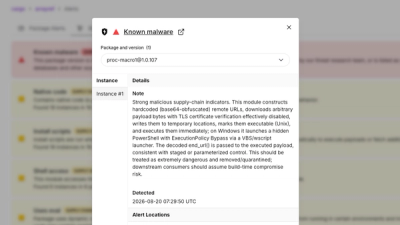
Three compromised Rust crates pulled in a malicious dependency that downloaded and executed cross-platform malware during Cargo builds.