

Company News
AWS Security Hub Adds Socket for Supply Chain Security
Socket is now in the AWS Security Hub Extended plan. Adopt it through AWS, apply committed spend, and block malicious open source packages.
By Feross Aboukhadijeh - Aug 04, 2026
gwsadm-mcp
Advanced tools
MCP server for Google Workspace security auditing — login audit, external sharing, daily brief
English | 日本語
Google Workspace security-audit MCP (Model Context Protocol) server — read-only visibility into account locks, suspicious logins, and external file sharing, built on the Admin SDK Reports API (audit activities).
Named after the admin-console viewpoint (gwsadm = Google Workspace admin),
sibling of boxadm-mcp. This is
not a general-purpose Workspace MCP: it surfaces risk, it never mutates
anything.
| Tool | Description |
|---|---|
health_check | Server version, config path, and per-domain auth probe — call at session start or after a timeout |
login_audit | Reports API login — accounts auto-disabled by Google (account_disabled_*: leaked password, hijacked, spamming), suspicious logins, failure top-N |
suspended_accounts | Directory API — current snapshot of suspended accounts (isSuspended=true); cross-reference against a downstream IdP (e.g. KeyCloak) to find suspended-but-still-enabled accounts |
user_oauth_tokens | Directory API tokens().list — third-party OAuth app grants for one user; a compromise vector login_audit is blind to, since a previously-granted token needs no fresh login. Domain resolved from the username's suffix, with an optional domain override for alias/secondary-domain addresses |
drive_external_sharing | Reports API drive — ACL grants to external addresses or domains (revocations reported separately) and visibility transitions into link/public exposure |
drive_doc_activity | Reports API drive with a server-side doc_id filter — one document's owner, ACL changes, and lifecycle events. Triage companion to drive_external_sharing: the owner (an individual vs. a shared drive's name) disambiguates the shared-drive false-positive class, where files created inside a shared drive propagate member ACLs and read as bulk external sharing |
shared_drive_membership_changes | Reports API drive (shared_drive_membership_change) — who added/removed/re-roled shared-drive members and when, with external classification of the affected member and a client-side drive-name filter |
daily_brief | One-call summary across all configured domains |
daily_brief_start / daily_brief_result | Same as daily_brief, run in the background: start returns a job_id immediately, then poll result(job_id) until done. Use on large tenants where the synchronous call risks the client's ~60s tool-call timeout |
Planned: dlp_events (Reports rules; requires a Workspace edition with DLP),
token_events, admin_events.
Service account with domain-wide delegation (DWD) impersonating an audit-capable admin. Fully non-interactive — no browser, no token refresh rotation — so the server runs unattended (cron, MCP gateway, CI).
Grant all of the following DWD scopes on the same service-account client ID up front, in one setup pass. Adding them one at a time as each tool gets built is how a scope goes missing until the one tool that needed it starts degrading — one place, one pass, avoids the trap:
| Scope | Needed by | Missing it |
|---|---|---|
https://www.googleapis.com/auth/admin.reports.audit.readonly | login_audit, drive_external_sharing, drive_doc_activity, shared_drive_membership_changes, daily_brief* | those tools degrade to a per-domain error |
https://www.googleapis.com/auth/admin.directory.user.readonly | suspended_accounts | that tool degrades to a per-domain error; everything else keeps working |
https://www.googleapis.com/auth/admin.directory.user.security | user_oauth_tokens | that tool degrades to a per-domain error; everything else keeps working |
health_check needs no scope at all to respond: it is the tool to call when
a grant might be missing — it probes each domain and reports the failing
auth in a structured per-domain result instead of failing itself.
suspended_accounts and user_oauth_tokens both operate per configured
domain (Directory domain=/userKey=), unlike the customer-wide Reports
tools — so every domain you want covered (e.g. a separate student domain)
needs its own [domain.*] config section. Note the failure modes differ:
suspended_accounts silently omits an unconfigured domain from its
result, while user_oauth_tokens fails loudly with an unknown-domain error.
# uv
uv pip install gwsadm-mcp

# pip
pip install gwsadm-mcp
Or from source:
git clone https://github.com/shigechika/gwsadm-mcp.git
cd gwsadm-mcp

# uv
uv sync

# pip
pip install -e .
Point GWSADM_CONFIG at an INI file (default ~/.config/gwsadm-mcp/config.ini,
keep it 0600):
[gwsadm]
# optional; defaults to all [domain.*] section names
internal_domains = example.edu, mail.example.edu

[domain.example.edu]
service_account_file = /path/to/service-account.json
subject = audit-admin@example.edu
customer_id = C0xxxxxxx
One [domain.*] section per audited Workspace domain. internal_domains is
the allowlist used to classify sharing targets as internal vs external.
Add to .mcp.json (no env needed when the config lives at the default path;
add "env": { "GWSADM_CONFIG": "..." } only for a non-default location):
{
  "mcpServers": {
    "gwsadm-mcp": {
      "type": "stdio",
      "command": "gwsadm-mcp"
    }
  }
}
Add the same entry to claude_desktop_config.json.
gwsadm-mcp
gwsadm-mcp --version   # Print version and exit
gwsadm-mcp --check     # Config + auth + API smoke for every domain, then exit
gwsadm-mcp             # Start MCP server (STDIO, default)
--check exit codes: 0 success, non-zero on config or auth failure.
capped: true when a window exceeded the page
budget, or when a probe's fetch errored outright (see event_errors) —
partial coverage is never presented as "no findings". The drive scan also
reports capped_events (which eventNames were cut short). Narrow hours
or raise max_pages for full coverage — on a large tenant, term-time
weekdays can produce thousands of change_user_access events/day.visibility=shared_externally is relative to the file owner's
domain, so with multiple internal_domains a cross-internal-domain grant
(e.g. student domain → staff domain) carries it too. External-ness is
therefore judged against internal_domains using the grant's target:
target_user for named grants, target_domain for domain-scoped grants
(e.g. "anyone at partner.edu"; the literal domain "all" means "anyone
with the link" and is judged by visibility instead). risky_visibility_events
counts only transitions into people_with_link / public_on_the_web
(excluding a narrowing from public down to link-only).
untargeted_external_transitions is a residual bucket for transitions into
shared_externally with no target address or domain to classify — it is
not a cross-check for grants missed elsewhere, since domain-scoped grants
are already counted above. external_samples / exposure_samples /
untargeted_samples hold examples of each.event_errors instead of failing the tool.
change_document_visibility and change_document_access_scope report the
same transition as simultaneous sibling events on this API — only the
latter drives classification (the former is fetched for its acl_events
count only), so a domain-scoped grant or a link/public exposure is never
double-counted across the two. This also means the former can no longer
compensate if the latter's own fetch fails: a change_document_access_scope
entry in event_errors sets capped: true for that domain, and its
classification counts for the window are a lower bound even though
change_document_visibility (and thus acl_events) may show data.{"error": ...}).activities().list.git clone https://github.com/shigechika/gwsadm-mcp.git
cd gwsadm-mcp
# uv
uv sync --dev
uv run pytest -v
uv run ruff check .
# pip
python3 -m venv .venv
.venv/bin/pip install -e . && .venv/bin/pip install pytest ruff
.venv/bin/pytest -v
.venv/bin/ruff check .
The unit suite never talks to Google, which is what makes it fast — and also
what makes it blind to a tool that has stopped returning real data.
scripts/smoke_test.py runs every registered tool against the configured
tenant and fails on empty, malformed or error answers:
# uses the same config file as the server (GWSADM_CONFIG)
uv run python scripts/smoke_test.py
uv run python scripts/smoke_test.py --only oauth --traceback
daily_brief_start creates a job inside the
process, which expires on its own.tests/test_smoke_probes.py), so adding a tool forces the question
"how would we know it works?".scripts/smoke_harness.py is the engine and holds no Workspace knowledge: it
is kept identical across the servers that share it, so fix engine bugs once
and sync the file rather than patching this copy.Releases are automated with release-please.
Merging Conventional Commits (feat:, fix:, …)
to main keeps a release PR open with the next version and changelog. Merging
that PR tags vX.Y.Z and publishes a GitHub Release, whose release: published
event triggers the release workflow to build and publish to PyPI and the MCP
Registry. release-please owns the version in gwsadm_mcp/__init__.py and
server.json (do not bump them by hand).
[!IMPORTANT] The release-please workflow should be given a repository secret
RELEASE_PLEASE_TOKEN(a PAT withcontents: write+pull-requests: write). The defaultGITHUB_TOKENcannot create the Release that triggers the downstreamreleaseworkflow (GitHub blocks workflow runs triggered byGITHUB_TOKEN), so without the PAT nothing gets published. The workflow falls back toGITHUB_TOKENwhen the secret is unset so PR CI keeps working on forks.
MIT
FAQs
MCP server for Google Workspace security auditing — login audit, external sharing, daily brief
The pypi package gwsadm-mcp receives a total of 480 weekly downloads. As such, gwsadm-mcp popularity was classified as not popular.
We found that gwsadm-mcp demonstrated a healthy version release cadence and project activity because the last version was released less than a year ago. It has 1 open source maintainer collaborating on the project.
Did you know?

Socket for GitHub automatically highlights issues in each pull request and monitors the health of all your open source dependencies. Discover the contents of your packages and block harmful activity before you install or update your dependencies.
Company News
Socket is now in the AWS Security Hub Extended plan. Adopt it through AWS, apply committed spend, and block malicious open source packages.
Research
/Security News
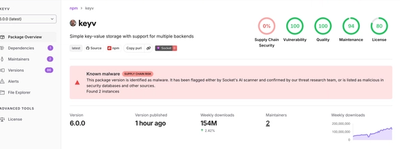
Popular npm packages keyv and cacheable compromised.

Security News
A misconfiguration gave three Anthropic models internet access, and one, believing it was in a simulation, shipped a credential-stealing package to PyPI.