

Company News
AWS Security Hub Adds Socket for Supply Chain Security
Socket is now in the AWS Security Hub Extended plan. Adopt it through AWS, apply committed spend, and block malicious open source packages.
By Feross Aboukhadijeh - Aug 04, 2026
kiln3d
Advanced tools
MCP server + CLI that gives AI agents safe access to 3D printers (Bambu Lab, Creality, Prusa Link, Elegoo, Moonraker/Klipper, OctoPrint, Duet, USB) — 892 MCP capabilities for AI-driven print workflows
Describe it or draw it. Kiln makes it real.
Kiln turns a conversation with an AI agent into a printed object. One install, any printer, start to finish — design, slice, queue, monitor, and fulfill 3D print jobs through a unified MCP (Model Context Protocol) server and CLI.
An agent can go from intent to physical object with zero human intervention:
Agent: "Print this sensor mount"
→ Kiln validates the file
→ Checks printer readiness
→ Uploads G-code
→ Starts print
→ Monitors progress
→ Reports completion
# From PyPI
pip install kiln3d

# From source (development)
pip install -e ".[dev]"
OS-specific walkthrough (Windows, WSL 2, Linux) at kiln3d.com/install.
# Option A: Environment variables
export KILN_PRINTER_TYPE=octoprint
export KILN_PRINTER_HOST=http://octopi.local
export KILN_PRINTER_API_KEY=your_api_key

# Option B: CLI auth (saves to ~/.kiln/config.yaml)
kiln auth --name my-printer --host http://octopi.local --type octoprint --api-key YOUR_KEY
# CLI
kiln status
kiln print model.gcode

# MCP Server
kiln serve
Add to ~/.config/Claude/claude_desktop_config.json:
{
  "mcpServers": {
    "kiln": {
      "command": "kiln",
      "args": ["serve"],
      "env": {
        "KILN_PRINTER_TYPE": "octoprint",
        "KILN_PRINTER_HOST": "http://octopi.local",
        "KILN_PRINTER_API_KEY": "your_api_key"
      }
    }
  }
}
Full documentation: kiln3d.com/docs.
Eight backends. The name in backticks is the KILN_PRINTER_TYPE value.
| Backend | Transport | Printers |
|---|---|---|
Bambu Lab (bambu) | LAN MQTT + FTPS | X1C, X1E, P1S, P1P, P2S, A1, A1 Mini, A2L, H2S |
Creality (creality) | Moonraker HTTP API (port-probed) | K1, K1C, K1 Max, Ender-3 V3 / V3 KE, CR-10 SE; K2 family and Hi where Fluidd/Moonraker is present. Marlin-era Enders use serial or octoprint |
Prusa Link (prusalink) | Prusa Link HTTP API | MK4, XL, Mini+ |
Elegoo (elegoo) | SDCP over WebSocket | Centauri Carbon and other SDCP machines. Neptune 4 and OrangeStorm Giga run Klipper — use moonraker for those |
Moonraker / Klipper (moonraker) | Moonraker HTTP API | Any Klipper printer — Voron, Rat Rig V-Core 3, Sovol SV07, QIDI X-Plus 3 |
OctoPrint (octoprint) | OctoPrint REST API | Any OctoPrint-connected printer |
Duet / RepRapFirmware (duet) | RepRapFirmware HTTP (RRF 2 and 3) | Duet 2 WiFi/Ethernet, Duet 3, and the machines built around them |
Direct USB (usb) | Marlin G-code over USB serial | Any Marlin printer — Ender 3, Prusa MK3S, CR-10 |
Two backends need an extra: pip install 'kiln3d[elegoo]' and pip install 'kiln3d[usb]'. The rest work with a plain install. Bambu printers need LAN
Mode and Developer Mode turned on plus a current access code (printer screen →
Settings → Network); a restarted printer issues a new code and the old one
stops working.
The full searchable list of tuned printer profiles is at kiln3d.com/printers.
--json output for agent consumptionFeatures marked (Pro) need a paid tier — kiln3d.com/pricing.
AI Agent (Claude, GPT, custom)
    |
    | CLI or MCP (Model Context Protocol)
    v
+------------------------------------------+
|                   Kiln                   |
|     design, validate, slice, monitor     |
+------------------------------------------+
    |
    | one PrinterAdapter interface, eight backends
    v
Your printer (see Supported Printers above)
Tools are written against that one interface rather than once per printer.
Backends differ in what the hardware exposes, so PrinterCapabilities
reports what a given machine actually supports.
pip install -e ".[dev]"
cd kiln && python3 -m pytest tests/ -v
AGPL-3.0-or-later. Commercial licensing is available for companies that need proprietary use — see kiln3d.com/pricing.
FAQs
MCP server + CLI that gives AI agents safe access to 3D printers (Bambu Lab, Creality, Prusa Link, Elegoo, Moonraker/Klipper, OctoPrint, Duet, USB) — 892 MCP capabilities for AI-driven print workflows
We found that kiln3d demonstrated a healthy version release cadence and project activity because the last version was released less than a year ago. It has 1 open source maintainer collaborating on the project.
Did you know?

Socket for GitHub automatically highlights issues in each pull request and monitors the health of all your open source dependencies. Discover the contents of your packages and block harmful activity before you install or update your dependencies.
Company News
Socket is now in the AWS Security Hub Extended plan. Adopt it through AWS, apply committed spend, and block malicious open source packages.
Research
/Security News
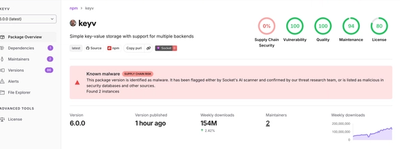
Popular npm packages keyv and cacheable compromised.

Security News
A misconfiguration gave three Anthropic models internet access, and one, believing it was in a simulation, shipped a credential-stealing package to PyPI.