
Research
/Security News
Popular npm Packages in the keyv and Cacheable Namespaces Compromised in Active Supply Chain Attack
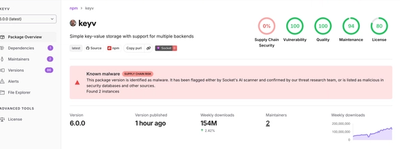
Popular npm packages keyv and cacheable compromised.
By Socket Research Team - Aug 04, 2026
linza-mcp
Advanced tools
Local-first MCP sidecar for agent workspaces, artifacts, review intents, and context export.
It does not change your data. It changes how you see it.
LINZA works with Obsidian vaults, Markdown folders, documents, articles, logs, and drafts. It is useful when there is already too much material and you want to understand the knowledge base, identify its main areas, and teach an agent to navigate it well.




LINZA reads a selected folder, builds a local SQLite database next to it at .linza/linza.db, and gives the agent a working map: which topics exist in the material, which formats repeat, which notes may be related, where cause/effect chains appear, and what may be useful in future sessions.
Source files remain untouched. LINZA does not rewrite notes during indexing, does not turn a raw log into a rule, and does not teach the agent behind your back. It turns hypotheses into short intents - proposed actions with evidence. The user decides, the agent executes.
doctor -> index -> map -> review intents -> teach -> grow preview -> explicit apply
LINZA collects several concrete things that help agents work with a knowledge base:
Folder map How many notes were found, whether the index is fresh, which areas are visible, and which materials are waiting for your review.
Areas Large semantic groups. Their names remain drafts until you accept or rename them.
Material formats Logs, drafts, specifications, research notes, cases, rules, and other recurring forms found in the folder.
Relations Possible neighborhoods, hierarchy, cause/effect, and routes between nodes. LINZA should show not only how documents are related, but also why.
Memory for future agents Short candidates: what to remember, when to recall it, what is stale, and what looks uncertain.
Context packs Compact selections for an agent: selected context with sources, relations, and boundaries.
A material format is the user-facing name for a recurring note form. Examples: diagnostic log, decision, article draft, research note, specification.
LINZA first sees only structure: length, headings, lists, links, tables, folders, and recurring signals. That means the first result may have a neutral name: type-001. The user can say: "these are logs". LINZA then stores the mapping type-001 -> logs in .linza.
The internal API keeps the old compatibility keys material_type, type_name, and role. Externally, the documentation and user-facing view say "format" because that is closer to how users actually think about their material.
Important boundary:
.linza;role: logs to YAML is only possible through a separate review intent;LINZA returns information roughly like this:
LINZA is ready

Material:
- 42 notes indexed
- 3 incoming artifacts waiting for review
- service database: .linza/linza.db

Next step:
1. Review discovered areas
2. Accept, rename, or skip 3-5 review intents
3. Nothing is written without a dry-run and explicit apply

Review intent:
Accept material format "diagnostic logs" from 8 examples
Why: similar structure, repeated headings, nearby chunks
What changes: the format name is stored in .linza; Markdown notes do not change
Internally, each intent remains a structure with an ID, evidence, and the data needed to preview the change and then confirm/write it. To you, LINZA returns a ready user-facing view so the agent can show a clear answer instead of JSON.
A good intent always answers the main question: why does LINZA think this? It should include sources, chunks, relation type, confidence, and an honest description of what will change after applying it.
The autonomy model is:
review_next shows review intents in a readable user-facing view.apply_review_items runs dry-run first..linza or to compact YAML, if that write type supports it.teach selects good accepted examples.grow proposes similar intents from those examples and explains selected_rules, the reasons they entered the batch.If you accepted the wrong thing, the approval can be softly revoked:
agent_workspace(action="history")
agent_workspace(action="revoke_approval", approval_id=17, dry_run=false)
LINZA does not delete the old record and does not try to automatically roll back YAML. It marks the approval as revoked, stops using it as an active example, and keeps a trace in history.
python -m pip install linza-mcp
If you need LINZA to read PDFs directly:
python -m pip install "linza-mcp[pdf]"
The regular install is already enough for Markdown, TXT, JSON, DOCX, and XLSX. [pdf] adds the local PDF extractor pypdf.
LINZA works with any Markdown folder: an Obsidian vault, a project workspace, or a separate folder with documents.
In the examples below, replace /absolute/path/to/workspace-or-vault with your own path.
Claude Desktop, Cursor, OpenCode, and other MCP clients usually use this format:
{
  "mcpServers": {
    "linza": {
      "command": "linza-mcp",
      "env": {
        "LINZA_VAULT": "/absolute/path/to/workspace-or-vault"
      }
    }
  }
}
VS Code / Copilot MCP uses the servers key:
{
  "servers": {
    "linza": {
      "type": "stdio",
      "command": "linza-mcp",
      "env": {
        "LINZA_VAULT": "/absolute/path/to/workspace-or-vault"
      }
    }
  }
}
LINZA_VAULT is not required for startup: without it, the server uses ./vault. For real work, an explicit folder is better.
linza-mcp --version
After connecting, ask the agent:
Check LINZA with agent_workspace(action="doctor").
Index the folder and show the first 3-5 review intents.
LINZA can start and show tools without an embedding server. Embeddings are needed for semantic search, topic maps, and relation suggestions.
The simplest local path is LM Studio:
text-embedding-granite-embedding-278m-multilingual, nomic-embed-text-v1.5, or another suitable model.http://127.0.0.1:1234/v1.Example LM Studio variables:
$env:LINZA_EMBED_PROVIDER="lmstudio"
$env:LINZA_EMBED_URL="http://127.0.0.1:1234/v1"
$env:LINZA_EMBED_MODEL="your-embedding-model-name"
Supported providers:
lmstudio - recommended local mode;ollama - local mode through Ollama;openai - any OpenAI-compatible endpoint with /embeddings.If you change provider, model, or dimension, run a full reindex. LINZA checks the embedding signature and stops graph/search workflows if the sidecar is stale or contains mixed vector spaces.
By default, LINZA shows only 7 MCP tools. That is enough for normal work: check status, index the folder, search, read a file, view counters, diagnose the vault, and guide the agent through agent_workspace.
| Tool | Purpose |
|---|---|
agent_workspace | One entry point for diagnostics, map, ingest, review, teaching, growth, relations, memory, and context export |
guide_next_steps | Show the next safe step in plain language |
index_all | Index the Markdown folder into .linza/linza.db |
search | Semantic and lexical search |
read_file | Read an exact Markdown file |
get_stats | Quick service database counters |
scan_vault | Folder diagnostic without writing |
Low-level tools are implementation details and are available through agent_workspace, so the 7-tool set is a full mode.
agent_workspace Modes| Action | Mode |
|---|---|
doctor | Check whether LINZA is ready and what is missing |
map | Build a workspace map without writing |
teach | Select strong accepted examples for learning |
grow | Show or apply growth from accepted examples; dry-run by default |
review_next | Show the next review intents; vault intents use rq-*, artifact and workspace intents use aw-* |
apply_review_items | Show or apply exact selected IDs; dry-run by default |
history | Show accepted and revoked approvals |
revoke_approval | Softly revoke an approval without deleting history |
ingest_artifacts | Store pasted or extracted material in the sidecar |
analyze_inbox | Find events, memory candidates, and knowledge fragments in artifacts |
connect | Explain a possible relation between two notes or nodes |
search_memory | Search reviewed memory and artifact context |
export_context | Build a compact context pack for another agent |
record_trace | Store structured traces of agent work, not raw chain-of-thought |
analyze_trace | Analyze a stored trace for review |
review_calibr | Review calibration lessons derived from traces |
For development and audit, a separate low-level mode remains available. Full tool description: Tool Catalog.
LINZA can accept material that has not yet become a note:
.md, .txt, .json;.docx, .xlsx;.pdf, if pypdf or PyPDF2 is installed.LINZA does not browse the web by itself. The agent uses its browser, web-fetch tool, or connector, extracts readable text, and passes it to LINZA as an artifact, for example source_kind="web_article" or source_kind="browser_capture".
Imported text is treated as material for analysis, not as an instruction for the agent. This is the prompt-injection boundary: instructions inside an article, log, chat, or PDF are not executed. Memory, rules, and YAML appear only after review.
LINZA is a local review-gated sidecar.
| Action | Writes To | Changes Note Text? |
|---|---|---|
| Indexing, analysis, search | .linza/linza.db | No |
| Raw artifacts | .linza/linza.db | No |
| Material format name | .linza/linza.db | No |
domains or role in YAML | Only compact YAML after review | No |
| Hierarchy, causal links, memory, calibration lessons | .linza/linza.db | No |
| Reports | .linza/reports | No |
| Context packs | .linza/context-packs | No |
write_file | Markdown file only on explicit request | Can create/replace a file, dry-run by default |
Additional rules:
review_next writes nothing;apply_review_items is dry-run by default;history shows what was accepted and what was revoked;revoke_approval softly revokes an approval: history remains, but active learning and graph helpers ignore it;map, teach, grow, and connect stop if source files changed after indexing.The repository includes a portable operator skill:
agent-pack/skills/linza-operator/SKILL.md
agent-pack/skills/linza-operator/references/workflows.md
agent-pack/skills/linza-operator/references/safety-policy.md
agent-pack/skills/linza-operator/references/tool-audience.md
It explains to an agent how to start with doctor, when to show review intents, how to work with pages through an external browser/web-fetch tool, and why apply actions must first go through dry-run and exact IDs only.
LINZA is alpha. The main safety contract should remain stable: indexing, artifact import, search, map, and grow preview do not rewrite source note bodies. Low-level advanced tools and internal code boundaries may still change while the server is being polished.
Run the full test suite:
python -m unittest discover -s tests
| Variable | Required for startup? | Description |
|---|---|---|
LINZA_VAULT | No | Path to the Markdown folder; defaults to ./vault |
LINZA_EMBED_PROVIDER | No | lmstudio for the recommended local mode; also openai and ollama |
LINZA_EMBED_URL | No | Embeddings API URL; defaults to http://127.0.0.1:1234/v1 |
LINZA_EMBED_MODEL | No | Embedding model; set before semantic indexing/search |
LINZA_EMBED_KEY | No | Optional key for an OpenAI-compatible embeddings API |
LINZA_BRIDGE_THRESHOLD | No | Semantic bridge threshold; default 0.55 |
LINZA_MAX_BRIDGE_PAIRS | No | Maximum note pairs for semantic bridge rebuilds; default 1000000, 0 disables the guard |
LINZA_DEFAULT_PROFILE | No | Base search profile name; default general |
LINZA_LANGUAGE | No | Language for hints and review route in guide_next_steps: auto, ru, en |
MIT License (c) 2026 Semiotronika
Cosines are computed. Syntax changes. Semantics remains.
FAQs
Local-first MCP sidecar for agent workspaces, artifacts, review intents, and context export.
The pypi package linza-mcp receives a total of 76 weekly downloads. As such, linza-mcp popularity was classified as not popular.
We found that linza-mcp demonstrated a healthy version release cadence and project activity because the last version was released less than a year ago. It has 1 open source maintainer collaborating on the project.
Did you know?

Socket for GitHub automatically highlights issues in each pull request and monitors the health of all your open source dependencies. Discover the contents of your packages and block harmful activity before you install or update your dependencies.
Research
/Security News
Popular npm packages keyv and cacheable compromised.

Security News
A misconfiguration gave three Anthropic models internet access, and one, believing it was in a simulation, shipped a credential-stealing package to PyPI.

Security News
/Company News
Socket has joined the new Composer and Packagist sponsorship program as a launch sponsor, supporting the team that keeps PHP's package ecosystem secure.