
Research
/Security News
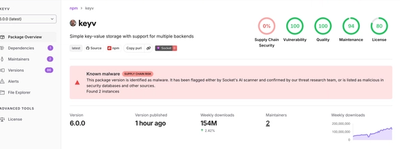
Popular npm Packages in the keyv and Cacheable Namespaces Compromised in Active Supply Chain Attack
Popular npm packages keyv and cacheable compromised.
By Socket Research Team - Aug 04, 2026
mcp-chainladder
Advanced tools
Model Context Protocol server for actuarial chain-ladder reserving — exposes triangle math, Mack stochastic stats, and diagnostics as Claude tools.



Actuarial chain-ladder reserving for Claude. A Model Context Protocol server that hands Claude the tools to compute IBNR, project ultimates, run Mack (1993) stochastic error estimates, check Mack (1994) model assumptions, and parse loss triangles from CSV — all from a natural- language conversation.
Calculation only — not actuarial advice. This is a mechanical chain-ladder calculator. Selection of data, factors, tails, and exclusions, and the interpretation of stochastic error measures, require professional actuarial judgement.
Eight tools, exposed over MCP. Claude picks the right one when you ask a question; you don't have to call them by name.
| Tool | When Claude reaches for it |
|---|---|
compute_chain_ladder | "What's the IBNR on this triangle?" — the workhorse |
project_triangle | "What does the full projected triangle look like?" |
mack_stochastic | "What's the uncertainty on the total reserve?" |
mack_diagnostics | "Are there outliers or trend issues?" |
parse_csv_triangle | "Run the chain ladder on this CSV file" |
to_incremental | "Show me the incremental development pattern" |
to_cumulative | "Cumulate these incremental values" |
sample_triangle | "Show me a working example" — quick demo |
All numerical conventions match the Mack 1993 and Mack 1994 papers; results are stable to ~1e-12 against hand calculation on the textbook 10×10 triangle.
pipx install mcp-chainladder
# or, to run on demand without installing:
uvx mcp-chainladder
Python 3.10 or newer; no other runtime dependencies beyond the official MCP SDK.
Edit ~/Library/Application Support/Claude/claude_desktop_config.json
(macOS) or %APPDATA%\Claude\claude_desktop_config.json (Windows):
{
  "mcpServers": {
    "chainladder": {
      "command": "uvx",
      "args": ["mcp-chainladder"]
    }
  }
}
Quit and reopen Claude Desktop. The triangle tools appear under the 🔌 icon in any conversation.
For Cursor / Cline / Continue / Zed — same mcpServers block, each app
has its own config file location (their docs walk you through it).
Me: I have a paid-loss triangle at ~/Desktop/motor_2026Q1.csv.
    Run the chain ladder and tell me the IBNR.

Claude: [calls parse_csv_triangle, then compute_chain_ladder]
        Loaded a 10×10 cumulative triangle. Using volume-weighted
        factors:
          • Total paid to date: 49,458,000 USD
          • Total ultimate:     65,883,400 USD
          • Total IBNR:         16,425,400 USD
        Selected factors trend from 1.879 at the front of the
        triangle down to 1.002 at the tail.
Me: Same triangle — any reason not to trust the projection?

Claude: [calls mack_diagnostics]
        Three flags worth a look:
        • Inflation trend: slope 0.053, p ≈ 1e-12 — STRONG evidence
          link ratios are drifting upward across accident years.
          This violates Mack's homogeneity assumption; consider
          weighting recent years more.
        • Calendar-year: Z = 0.0, p = 1.0 — no diagonal effect.
        • Independence: Z = -0.35, p = 0.73 — no obvious dependence
          across development columns.
        • Outliers: 0 cells exceed |2σ|.

        The inflation finding is the one to act on.
Me: Drop the link ratio at AY 3, dev period 2→3. What changes?

Claude: [calls compute_chain_ladder with excluded=[[2, 1]]]
        Excluding (AY 3, 2→3):
          • Volume factor at 2→3 moves from 1.331 to 1.328
          • Total IBNR moves from 16,425 to 16,389 (−36)
          • Mack SE total moves from ±354.6 to ±348.2
        Net: small enough to be a "robustness check passes" rather
        than a finding.
Each tool returns a JSON object (or a 2-D list, in the case of
project_triangle/to_incremental/to_cumulative). Claude reads the
descriptions and types directly from the server — you don't need to
memorise the shapes — but here's the cheat sheet.
compute_chain_ladder(triangle, selected_factors?, tail?, excluded?)End-to-end chain ladder.
| Field returned | Meaning |
|---|---|
volume_factors[j] | All-year volume-weighted age-to-age factor for transition j→j+1 |
simple_factors[j] | Unweighted average of individual link ratios |
selected_factors[j] | The factor set actually used to project (defaults to volume) |
individual_factors[i][j] | Per-row link ratio C[i,j+1] / C[i,j]; null where the pair is unobserved |
cdf[j] | Cumulative dev factor to ultimate; cdf[-1] == tail |
latest_diagonal[i] | Most recent observed value per AY |
ultimates[i] | Projected ultimate per AY |
ibnr[i] | Ultimate − Latest per AY |
total_* | Sums of the three above |
n_acc, n_dev | Triangle dimensions |
mack_stochastic(triangle, selected_factors, excluded?)Mack (1993) distribution-free standard errors. Returns σ̂²_j per dev period (tail-rule backfilled when only one observation), SE & CV per row, and SE_total / CV_total including cross-row covariance per eq. 5.15.
mack_diagnostics(triangle, selected_factors, excluded?, outlier_threshold?)Returns standardised residuals, outliers (|r| > threshold, default
2.0), the calendar-year sign test, Spearman independence test across
adjacent dev columns, and the inflation slope of mean log-link-ratio
against accident-year index.
p-value bands to translate to plain English:
p < 0.005 → strong evidence
p < 0.05  → significant
p < 0.10  → borderline
p ≥ 0.10  → no evidence
parse_csv_triangle(path)Reads a CSV from disk, treats blank / NA / NaN / N/A / − cells as unobserved, strips embedded thousand-separator commas, and skips header / metadata rows. Returns the triangle + dimensions + the absolute path read (useful for the assistant to confirm what it loaded).
project_triangle(triangle, selected_factors)Fills the lower-right of the triangle with chain-ladder projections.
Returns a fully-rectangular list[list[float]] (no nulls). NaN where
a row has no observation to project forward from.
to_incremental(cumulative) / to_cumulative(incremental)Two conversions. Unobserved cells stay unobserved; the inverse on observed cells is exact.
sample_triangle()Returns the textbook 10×10 cumulative paid triangle. Use as a
self-check: pass it to compute_chain_ladder and you should get
Paid 49,458 / Ultimate 65,883 / IBNR 16,425.
[
    # AY 1 — fully developed
    [1000, 1855, 2423, 2988, 3335, 3483, 3552, 3603, 3624, 3631],
    # AY 2 — observed through dev 9
    [1113, 2103, 2774, 3422, 3844, 4010, 4090, 4148, 4172, None],
    # …
    # AY 10 — only the first observation
    [2640, None, None, None, None, None, None, None, None, None]
]
None (or JSON null) for unobserved cellsnullpipx install --editable mcp-chainladder
pytest -q
Tests pin every public tool against the textbook triangle's well-known parity values to ~1e-9.
The free tier covers all 8 tools listed above. Pro unlocks
additional methods + bulk workflows, gated by a local license file
at ~/.chainladder/license (or wherever $CHAINLADDER_LICENSE_FILE
points).
Pro licenses are currently for internal and testing purposes only — not open to the public. No purchase channel is available at this time. The Pro tools are listed below for reference and will continue to return
pro_license_requiredfor external users.
| Pro tool | What it does |
|---|---|
pro_license_status | Inspect current license state (free to call) |
interpret_diagnostics | Mack tests with verdict labels + plain-English summaries + recommended actions |
sensitivity_analysis | Drop each link ratio one-at-a-time and rank by IBNR impact |
tail_extrapolation | Fit exponential + inverse-power tail models, recommend best fit |
bornhuetter_ferguson | BF reserving method with side-by-side CL comparison |
compare_methods | Run CL + BF in one call, report deltas + largest divergence |
generate_pdf_report (coming v1.2) | Full 5-page actuarial PDF — cover / triangle / factors / results / 3D loss surface |
batch_csv_processing (coming v1.2) | Fold the chain ladder over a directory of CSV triangles |
cape_cod, mack_bf (coming v1.3) | Additional reserving methods, all returning side-by-side comparisons |
{
  "product":  "mcp-chainladder-pro",
  "owner":    "alice@example.com",
  "expires":  null,
  "key":      "CL-PRO-1A2B3C4D",
  "signature": "…"
}
Drop it at ~/.chainladder/license (the file's directory must exist;
the server doesn't create it). Pro tools immediately respond as
unlocked the next time Claude calls them.
When the license is missing or expired, every Pro tool returns
{"error": "pro_license_required", "status": {...}} instead of
computing — Claude reads the status and points you to the upgrade
URL. The free-tier tools always work regardless of license state.
MIT. See LICENSE.
Built on top of the open-source Chain Ladder for macOS app, which exposes the same math through a native UI.
FAQs
Model Context Protocol server for actuarial chain-ladder reserving — exposes triangle math, Mack stochastic stats, and diagnostics as Claude tools.
We found that mcp-chainladder demonstrated a healthy version release cadence and project activity because the last version was released less than a year ago. It has 1 open source maintainer collaborating on the project.
Did you know?

Socket for GitHub automatically highlights issues in each pull request and monitors the health of all your open source dependencies. Discover the contents of your packages and block harmful activity before you install or update your dependencies.
Research
/Security News
Popular npm packages keyv and cacheable compromised.

Security News
A misconfiguration gave three Anthropic models internet access, and one, believing it was in a simulation, shipped a credential-stealing package to PyPI.

Security News
/Company News
Socket has joined the new Composer and Packagist sponsorship program as a launch sponsor, supporting the team that keeps PHP's package ecosystem secure.