
Research
/Security News
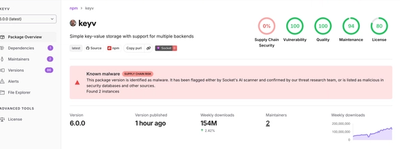
Popular npm Packages in the keyv and Cacheable Namespaces Compromised in Active Supply Chain Attack
Popular npm packages keyv and cacheable compromised.
By Socket Research Team - Aug 04, 2026
mcp-ksef-pl
Advanced tools
MCP server for Polish electronic invoicing — KSeF FA(3)/FA(2) and Peppol BIS 3.0/EN 16931




A Python MCP server providing tools for Polish electronic invoicing compliant with KSeF (FA(2)) and Peppol BIS Billing 3.0 / EN 16931. It enables AI agents (Claude, IDEs) to generate, validate, and submit invoices to the Krajowy System e-Faktur (KSeF), as well as validate Polish tax identifiers (NIP and REGON).
This package is built on mcp-einvoicing-core, the shared base library for European e-invoicing MCP servers. It provides an OAuth2 HTTP client, token cache, data models, logging utilities, and an exception hierarchy.
mcp-einvoicing-core is installed automatically as a dependency, no additional step is required.
The server acts as an intelligent communication interface between the AI agent and the KSeF platform and the Peppol network:
[ ERP System / Application ] <--> [ MCP Server ] <--> [ KSeF (MF) / Peppol Network ]
          ^                           |
          |                           v
   [ AI Agent (Claude) ] <--- (FA(2) / EN 16931)
| Tool | Description |
|---|---|
generate_fa3_invoice | Generates a KSeF-compliant FA(3) XML invoice (required for KSeF API v2 submissions) |
generate_fa2_invoice | Generates a KSeF-compliant FA(2) XML invoice (legacy format, read-only use) |
validate_fa3_invoice | Validates FA(3) XML: XSD validation and FA(3)-specific business rules |
validate_fa2_invoice | Validates FA(2) XML: XSD validation (if the schema is available) and business rules |
parse_fa2_invoice | Parses FA(2) XML into a structured dictionary |
| Tool | Description |
|---|---|
submit_invoice_to_ksef | Submits an FA(3) invoice to the KSeF platform and returns a reference number |
get_ksef_invoice_status | Retrieves the processing status of an invoice by its reference number |
search_ksef_invoices | Searches invoices in KSeF by date range and direction (seller/buyer) |
| Tool | Description |
|---|---|
validate_polish_nip | Validates a NIP (10-digit tax identification number) using a checksum algorithm |
validate_polish_regon | Validates a REGON (9- or 14-digit registry number) using a checksum algorithm |
| Tool | Description |
|---|---|
generate_peppol_invoice | Generates a UBL 2.1 invoice compliant with Peppol BIS Billing 3.0 / EN 16931 |
pip install mcp-ksef-pl
Or without prior installation using uvx:
uvx mcp-ksef-pl
git clone https://github.com/cmendezs/mcp-ksef-pl.git
cd mcp-ksef-pl
uv sync --all-extras
| Variable | Default | Description |
|---|---|---|
KSEF_ENVIRONMENT | test | KSeF environment: production, test, or demo |
KSEF_SESSION_TOKEN | — | KSeF session token (obtained through the challenge-response flow with MF) |
KSEF_NIP | — | NIP of the entity submitting invoices |
KSEF_TIMEOUT | 30 | HTTP request timeout in seconds |
KSeF API v2 uses a multi-step challenge/redeem flow to issue an AccessToken. This MCP server accepts an already-obtained token and cannot automate the signing step (it requires a qualified electronic signature).
Account setup. Register at the KSeF portal: https://ksef.mf.gov.pl/. Select the target environment (test or production). The test environment is at https://ksef-test.mf.gov.pl/.
Request a challenge. Call the KSeF API to obtain a challenge XML envelope:
curl -s https://ksef-test.mf.gov.pl/api/online/Session/AuthorisationChallenge \
  -H "Accept: application/json" \
  -d '{"contextIdentifier": {"type": "onip", "identifier": "YOUR_NIP"}}' \
  -H "Content-Type: application/json"
The response contains a challenge string and a timestamp.
Sign the challenge. Build an <InitSessionTokenRequest> XML envelope containing the challenge, then sign it with your qualified e-signature. Accepted signing tools:
podpis.gov.pl (government signing portal)Example using xmlsec1 with a PKCS#12 certificate:
# Build the challenge XML (template at specs/przyklad-wyzwania.xml)
xmlsec1 --sign --pkcs12 your-cert.p12 --pwd "password" \
  --output signed-challenge.xml challenge-template.xml
Submit the signed challenge. POST the signed XML to obtain an AccessToken:
curl -s https://ksef-test.mf.gov.pl/api/online/Session/AuthoriseXades \
  -H "Content-Type: application/octet-stream" \
  --data-binary @signed-challenge.xml
The response contains sessionToken.token (the AccessToken) and sessionToken.context.referenceNumber.
Set the token. Export the token for this MCP server:
export KSEF_SESSION_TOKEN="<the AccessToken from step 4>"
The token is valid for approximately 2 hours from issuance (per MF documentation). After expiry, repeat steps 2-4.
specs/ksef-v2-fa3-migration-announcement-20250630.pdfAdd the following configuration to your claude_desktop_config.json file:
{
  "mcpServers": {
    "ksef-pl": {
      "command": "uvx",
      "args": ["mcp-ksef-pl"],
      "env": {
        "KSEF_ENVIRONMENT": "test",
        "KSEF_SESSION_TOKEN": "<your-ksef-session-token>",
        "KSEF_NIP": "<your-nip>"
      }
    }
  }
}
Cursor supports MCP servers via stdio. Add the configuration to:
~/.cursor/mcp.json.cursor/mcp.json{
"mcpServers": {
"ksef-pl": {
"command": "uvx",
"args": ["mcp-ksef-pl"],
"env": {
"KSEF_ENVIRONMENT": "test",
"KSEF_SESSION_TOKEN": "<your-ksef-session-token>",
"KSEF_NIP": "<your-nip>"
}
}
}
}
Reload the Cursor window (Ctrl+Shift+P → Reload Window) after saving changes.
Kiro supports MCP servers through a dedicated configuration file:
~/.kiro/settings/mcp.json.kiro/settings/mcp.json{
"mcpServers": {
"ksef-pl": {
"command": "uvx",
"args": ["mcp-ksef-pl"],
"env": {
"KSEF_ENVIRONMENT": "test",
"KSEF_SESSION_TOKEN": "<your-ksef-session-token>",
"KSEF_NIP": "<your-nip>"
},
"disabled": false,
"autoApprove": []
}
}
}
Security tip: instead of entering the token directly, use the syntax
"KSEF_SESSION_TOKEN": "${KSEF_SESSION_TOKEN}", as Kiro resolves shell environment variables at startup.
The official FA(2) and FA(3) XSD schemas ship inside the package (src/mcp_ksef_pl/schemas/)
and are loaded automatically via importlib.resources — no manual download or configuration
is required. validate_fa2_invoice and validate_fa3_invoice run full XSD validation out
of the box for every installation.
# Run unit tests
uv run pytest tests/ -v
| Country | Server |
|---|---|
| 🌍 Global | mcp-einvoicing-core |
| 🇧🇪 Belgium | mcp-einvoicing-be |
| 🇧🇷 Brazil | mcp-nfe-br |
| 🇫🇷 France | mcp-facture-electronique-fr |
| 🇩🇪 Germany | mcp-einvoicing-de |
| 🇮🇹 Italy | mcp-fattura-elettronica-it |
| 🇵🇱 Poland | mcp-ksef-pl |
| 🇪🇸 Spain | mcp-facturacion-electronica-es |
This project is distributed under the Apache 2.0 license. See the LICENSE file for details.
Project maintained by cmendezs. For questions about the KSeF or Peppol implementation, open an Issue.
FAQs
MCP server for Polish electronic invoicing — KSeF FA(3)/FA(2) and Peppol BIS 3.0/EN 16931
The pypi package mcp-ksef-pl receives a total of 73 weekly downloads. As such, mcp-ksef-pl popularity was classified as not popular.
We found that mcp-ksef-pl demonstrated a healthy version release cadence and project activity because the last version was released less than a year ago. It has 1 open source maintainer collaborating on the project.
Did you know?

Socket for GitHub automatically highlights issues in each pull request and monitors the health of all your open source dependencies. Discover the contents of your packages and block harmful activity before you install or update your dependencies.
Research
/Security News
Popular npm packages keyv and cacheable compromised.

Security News
A misconfiguration gave three Anthropic models internet access, and one, believing it was in a simulation, shipped a credential-stealing package to PyPI.

Security News
/Company News
Socket has joined the new Composer and Packagist sponsorship program as a launch sponsor, supporting the team that keeps PHP's package ecosystem secure.