

Company News
AWS Security Hub Adds Socket for Supply Chain Security
Socket is now in the AWS Security Hub Extended plan. Adopt it through AWS, apply committed spend, and block malicious open source packages.
By Feross Aboukhadijeh - Aug 04, 2026
mcp-memex
Advanced tools
Every Claude Code session starts without knowing what you built last time - which files you changed, what decisions you made, what broke. You re-explain. Claude re-reads. You start over.
memex keeps a structured log of every session. Claude reads it at the start of the next one.
No cloud. No LLM extraction. No cost per save. Just local SQLite and one command to install.
# with uv
uvx mcp-memex install
# with pip
pip install mcp-memex
memex install
Restart Claude Code. That's it.
Each entry has structure - not a blob of text:
mem_save(
    task="Replaced JWT auth with session cookies",
    files=["src/auth.py", "src/middleware.py"],
    decisions=["Session cookies over JWT - simpler, no token refresh needed"],
    warnings=["Redis required - app won't start without REDIS_URL set"],
    tags=["auth", "sessions"]
)
Claude calls mem_save when it finishes something meaningful. You can also just tell it: "save what we just did."
=== memex: session context (db: my_project.db) ===

--- Recent (2) ---
[1] #4 - 2026-06-14T10:32
  Task      : Replaced JWT auth with session cookies
  Files     : src/auth.py, src/middleware.py
  Decision  : Session cookies over JWT - simpler, no token refresh needed
  Warning   : Redis required - app won't start without REDIS_URL set
  Tags      : auth, sessions

[2] #3 - 2026-06-13T15:10
  Task      : Added rate limiting to /api/login
  Files     : src/middleware.py
  Warning   : Rate limiter is in-memory per process - resets on restart
  Tags      : auth, rate-limiting
Claude calls mem_load automatically at the start of every session. It returns the most recent entries plus any entries that match what you're working on - by keyword and by file path.
You don't need to be inside Claude to look at your history:
memex status                     # entry count, DB size, top tags
memex list                       # recent entries for this project
memex list --tag auth            # filter by tag
memex list --since 7d            # entries from the last 7 days
memex list --since 2026-06-01 --until 2026-06-15  # date range
memex search "rate limit"        # full-text search
memex version                    # print installed version
Turn your history into portable, human-browsable notes - one .md file per
entry, with [[wikilinks]] connecting related entries and files, plus tags as
#hashtags. Works in Obsidian or any tool that understands [[links]]:
memex export ./my-project-notes/
Entries that share a tag or a touched file are cross-linked under a Related section, so you can navigate your project history as a graph.
| Tool | What it does |
|---|---|
mem_load | Called at session start - returns recent + relevant entries |
mem_save | Saves a structured entry after meaningful work |
mem_update | Patches specific fields of an existing entry (keeps id and timestamp) |
mem_search | Full-text search across all entries |
mem_list | Lists entries, optionally filtered by tag |
mem_delete | Removes a stale entry by id |
CLAUDE.md is for static project documentation - architecture, conventions, how to run tests. It doesn't change much and it isn't session-aware.
memex captures what's changing session to session: what you built yesterday, the decision you made this morning, the warning you discovered an hour ago. It's the difference between "here's the project" and "here's what happened last time."
memex install writes Claude's instructions into .claude/CLAUDE.local.md - a file Claude Code loads automatically without touching your project's own CLAUDE.md.
Each project gets its own SQLite database at ~/.memex/<project>.db based on the working directory. Sessions from different projects never mix.
Set these in the MCP env block in ~/.claude.json if you need to override defaults:
| Variable | Default | Description |
|---|---|---|
MEMEX_DIR | ~/.memex | Where DBs are stored |
MEMEX_GLOBAL | 0 | Set to 1 to share one DB across all projects |
MEMEX_RECENT | 5 | Max recent entries loaded per session |
MEMEX_MATCHED | 5 | Max FTS-matched entries loaded per session |
memex remove
pip uninstall mcp-memex
Memory DBs are kept at ~/.memex/ - delete that directory manually if you want to wipe everything.
mcp package (installed automatically)MIT
FAQs
Persistent session memory for Claude Code — local SQLite, no LLMs, no network
The pypi package mcp-memex receives a total of 23 weekly downloads. As such, mcp-memex popularity was classified as not popular.
We found that mcp-memex demonstrated a healthy version release cadence and project activity because the last version was released less than a year ago. It has 1 open source maintainer collaborating on the project.
Did you know?

Socket for GitHub automatically highlights issues in each pull request and monitors the health of all your open source dependencies. Discover the contents of your packages and block harmful activity before you install or update your dependencies.
Company News
Socket is now in the AWS Security Hub Extended plan. Adopt it through AWS, apply committed spend, and block malicious open source packages.
Research
/Security News
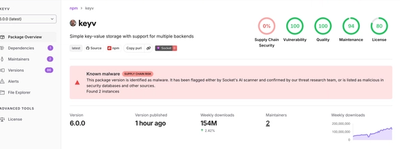
Popular npm packages keyv and cacheable compromised.

Security News
A misconfiguration gave three Anthropic models internet access, and one, believing it was in a simulation, shipped a credential-stealing package to PyPI.