

Company News
AWS Security Hub Adds Socket for Supply Chain Security
Socket is now in the AWS Security Hub Extended plan. Adopt it through AWS, apply committed spend, and block malicious open source packages.
By Feross Aboukhadijeh - Aug 04, 2026
mcp-trust
Advanced tools


Check before you connect. A neutral, public danger grade for the MCP servers your AI agents rely on.
Live: mcp-trust.vercel.app
Not yet published to PyPI. Install from source using the Quickstart below.
mcp-trust runs as a read-only MCP server so an agent can check a server's
danger grade before connecting — it serves a baked snapshot of real,
sandboxed grades, so no database or network is needed.
mcp-trust mcp-serve          # from a source/dev install (works today)
uvx mcp-trust mcp-serve      # once published to PyPI
| Tool | Description |
|---|---|
list_servers | Every graded MCP server with its A-F grade, transparency, and danger score. |
check_server | Full grade, risk dimensions, and findings for one server by slug. |
get_methodology | How the A-F grade and transparency axis are computed, plus the honesty model. |
Connecting an MCP server hands it influence over what your agent does. Tool poisoning, prompt injection, over-broad permissions, and rug-pull tool mutations are documented attack classes -- and today there's no quick way to vet a server before you wire it in. MCP Trust Registry scans public MCP servers and gives each one a single readable danger grade (A-F), a separate transparency signal, and the findings behind them.
Think OSV.dev / Socket.dev / haveibeenpwned, scoped to MCP servers.
uv (used for dependency management and running the project)register a server -> scan via engine -> derive grade -> persist -> serve at a stable URL
The registry does not reimplement vulnerability detection. It orchestrates a
pluggable scan engine -- the shipping backend wraps the public
mcp-audits (>=2.1) package -- and owns the
catalog, the public trust-grade normalization, persistence, and the lookup API.
git clone https://github.com/saagpatel/mcp-trust.git && cd mcp-trust
uv pip install -e ".[dev]"      # core + dev deps (runs on the built-in StubEngine)
mcp-trust seed                  # load the seed catalog
mcp-trust scan mcp-reference-time   # scan a catalog server, print its grade
mcp-trust check mcp-reference-time  # look up the latest stored grade
mcp-trust serve                 # serve the API on http://127.0.0.1:8000
For real scanning install the engine extra and select it:
uv pip install -e ".[dev,engine]"
MCP_TRUST_ENGINE=mcpaudit mcp-trust scan mcp-reference-time
Scanning launches the server's process. For untrusted servers, isolate execution in a locked-down container (no network, read-only fs, dropped caps, resource limits):
MCP_TRUST_ENGINE=mcpaudit MCP_TRUST_SANDBOX=docker mcp-trust scan mcp-reference-time
The default is no sandbox (safe only for servers you trust).
| Method | Path | Purpose |
|---|---|---|
GET | / | web -- public catalog page (grade + transparency per server) |
GET | /ui/servers/{slug} | web -- server detail page + README badge-embed snippet |
GET | /healthz | liveness |
GET | /servers | catalog + latest grade per server (JSON) |
GET | /servers/{slug} | full latest scan record + metadata (JSON) |
POST | /servers/{slug}/scan | operator scan trigger; public deployments disable this route |
GET | /servers/{slug}/badge.json | shields.io-compatible README badge |
Every server has two orthogonal signals: a danger grade (A-F) and a transparency level (high/medium/low, from annotation coverage). Automated grades are not endorsements, certifications, or claims that a server is malicious. A low grade on a low-transparency server means "cannot verify safe," not "known dangerous."
HTTP scan triggering is fail-closed by default. Public deployments should set
MCP_TRUST_PUBLIC_READONLY=1, which makes POST /servers/{slug}/scan return
403 before any engine can run. Operator scans should normally run through the
CLI against the persistent registry DB, not through public traffic.
For local API demos with the deterministic StubEngine, set
MCP_TRUST_ALLOW_UNAUTHENTICATED_STUB_SCANS=1. Do not set that in public.
Token-gated API scan triggering is still available for private operator surfaces
by setting MCP_TRUST_SCAN_TOKEN and passing it as Authorization: Bearer <token> or X-MCP-Trust-Scan-Token.
Set MCP_TRUST_RECEIPTS_DIR=/data/mcp-trust/receipts during real scan runs to
archive a JSON receipt for each scan and store its portable artifact filename in
report_ref.
Live at mcp-trust.vercel.app as a statically
generated catalog, regenerated from the local registry. The bundled launch
snapshot contains 19 real mcp-audits grades from network-off Docker sandbox
scans, including four reviewed Registry-derived no-auth sandboxed entries.
Every grade is labeled by provenance, so demo/stub data can never read as a
real scan, and an unscanned server never shows a letter grade. The current
production deployment is the 19-server static catalog.
The static front door is the low-ops launch path (see
DEPLOY-VERCEL.md); a weekly launchd job under
deploy/launchd/ re-scans, rebuilds, and optionally
redeploys (deploy is opt-in). The live FastAPI service + VM path remains
documented in DEPLOY-VM.md as an alternative. See
SPEC.md for the full contract and LAUNCH-GATE.md
for launch history.
uv.lock is intentionally committed to the repository to ensure reproducible
installs across environments. When adding or updating dependencies, commit the
updated uv.lock alongside your pyproject.toml changes.
MIT
FAQs
A neutral public trust registry for MCP servers — check before you connect.
We found that mcp-trust demonstrated a healthy version release cadence and project activity because the last version was released less than a year ago. It has 1 open source maintainer collaborating on the project.
Did you know?

Socket for GitHub automatically highlights issues in each pull request and monitors the health of all your open source dependencies. Discover the contents of your packages and block harmful activity before you install or update your dependencies.
Company News
Socket is now in the AWS Security Hub Extended plan. Adopt it through AWS, apply committed spend, and block malicious open source packages.
Research
/Security News
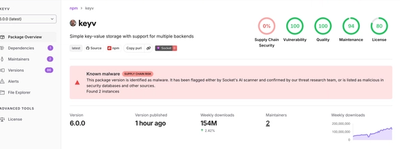
Popular npm packages keyv and cacheable compromised.

Security News
A misconfiguration gave three Anthropic models internet access, and one, believing it was in a simulation, shipped a credential-stealing package to PyPI.