

Security News
The AI Industry Is Betting on Open Weights
An open letter signed by 50 companies, from NVIDIA and Microsoft to Mistral and Hugging Face, urges Washington not to restrict open weight AI.
By Sarah Gooding - Jul 27, 2026
mrmustard
Advanced tools
Affected versions:





Mr Mustard is a differentiable simulator with a sophisticated built-in optimizer, that operates seamlessly across phase space and Fock space. It is built on top of an agnostic autodiff interface, to allow for plug-and-play backends (numpy by default).
Mr Mustard supports:
numpy as default)XPTensor for seamless symplectic algebra (experimental)Converting phase space objects to Fock space can be numerically unstable due to accumulating floating point errors. To resolve this, the conversion can be performed with extended-precision arithmetic. To use this feature, an installation of Julia is required (version 1.9.3 recommended).
When installing MrMustard via devcontainer, Julia and its required packages are automatically installed.
When installing MrMustard via poetry install or pip install, the required Julia packages have to be installed manually as follows:
julia --project="julia_pkg" -e "using Pkg; Pkg.instantiate()"
MakeFile, the required Julia packages are automatically installed only if Julia was previously installed by the user.The lab module contains things you'd find in a lab: states, transformations, measurements, circuits. States can be used at the beginning of a circuit as well as at the end, in which case a state is interpreted as a measurement (a projection onto that state). Transformations are usually parametrized and map states to states. The action on states is differentiable with respect to the state and to the gate parameters.
Here are a few examples of states and gates:
import numpy as np
from mrmustard.lab import *

vac = Vacuum(num_modes=2)        # 2-mode vacuum state
coh = Coherent(x=0.1, y=-0.4)    # coh state |alpha> with alpha = 0.1 - 0.4j
sq  = SqueezedVacuum(r=0.5)      # squeezed vacuum state
g   = Gaussian(num_modes=2)      # 2-mode Gaussian state with zero means
fock4 = Fock(4)                  # fock state |4>

D  = Dgate(x=1.0, y=-0.4)         # Displacement by 1.0 along x and -0.4 along y
S  = Sgate(r=0.5)                 # Squeezer with r=0.5
R  = Rgate(angle=0.3)             # Phase rotation by 0.3
A  = Amplifier(gain=2.0)          # noisy amplifier with 200% gain
L  = Attenuator(0.5)              # pure loss channel with 50% transmissivity
N  = AdditiveNoise(noise=0.1)     # additive noise with noise level 0.1

BS = BSgate(theta=np.pi/4)          # 50/50 beam splitter
S2 = S2gate(r=0.5)                  # two-mode squeezer
MZ = MZgate(phi_a=0.3, phi_b=0.1)   # Mach-Zehnder interferometer
I  = Interferometer(8)              # 8-mode interferometer
L  = Attenuator(0.5)                # pure lossy channel with 50% transmissivity
A  = Amplifier(gain=2.0, nbar=1.0)  # noisy amplifier with 200% gain
The repr of single-mode states shows the Wigner function:
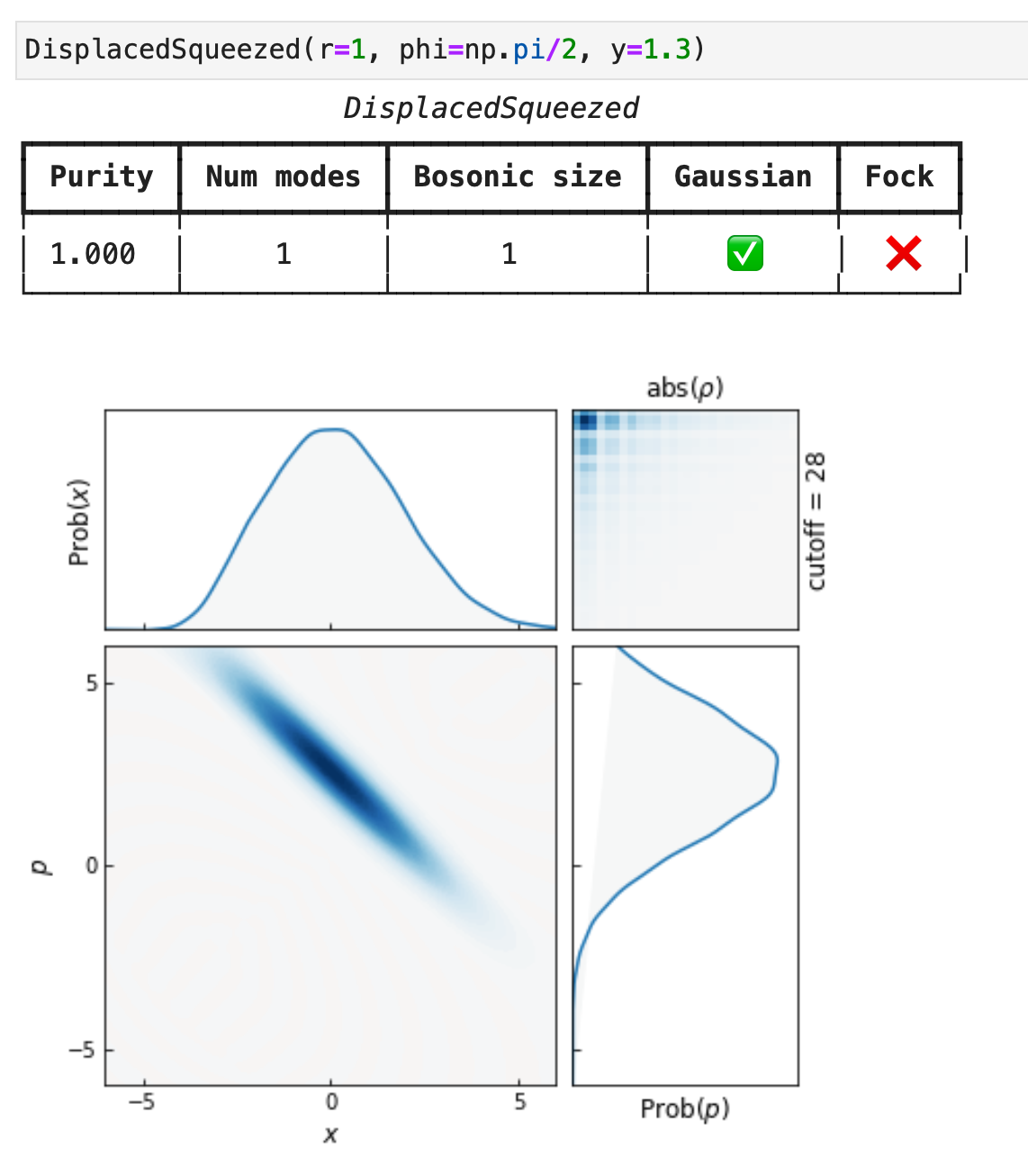
cat_amps = Coherent(2.0).ket([20]) + Coherent(-2.0).ket([20])
cat_amps = cat_amps / np.linalg.norm(cat_amps)
cat = State(ket=cat_amps)
cat
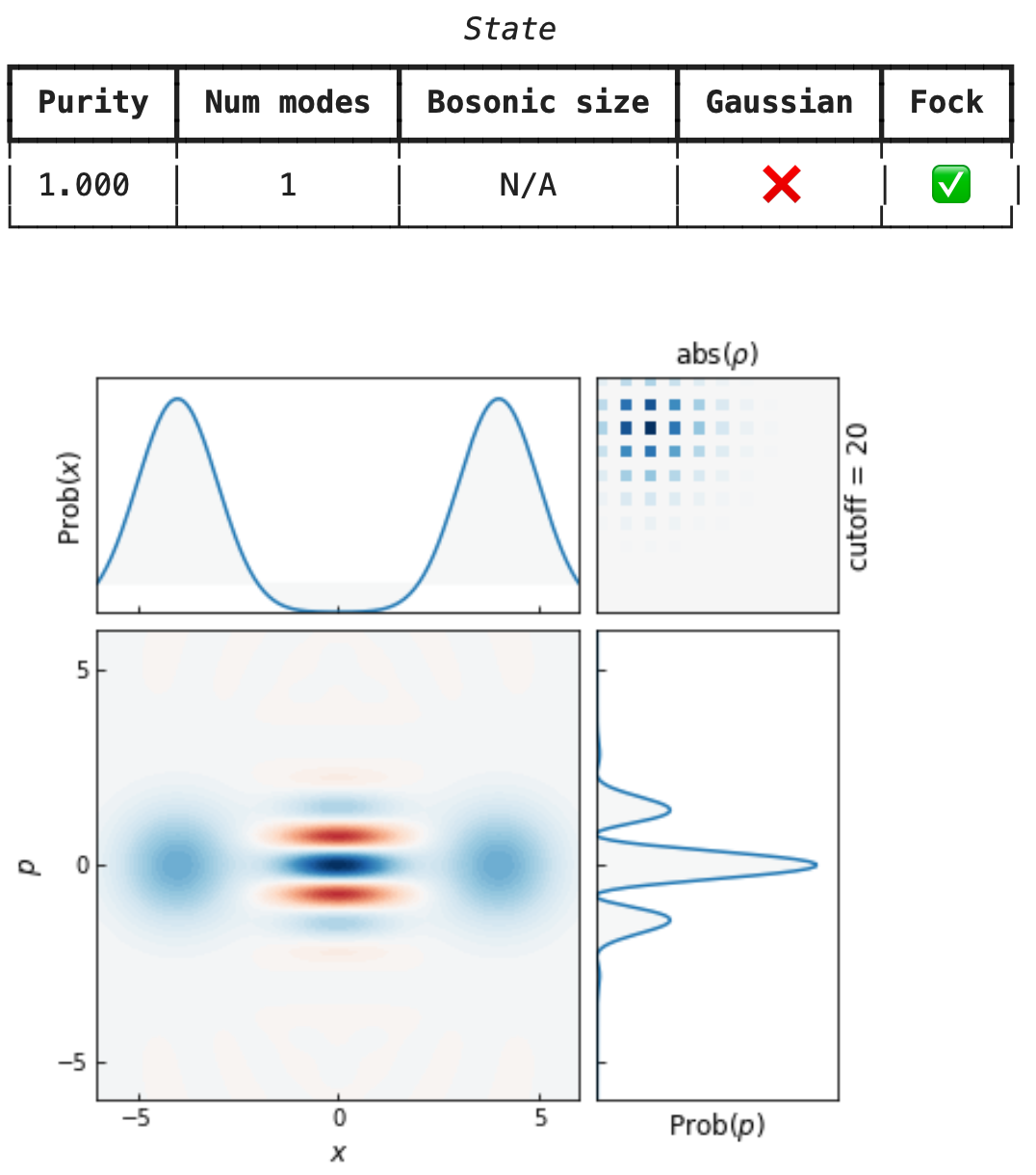
States (even those in Fock representation) are always compatible with gates:
cat >> Sgate(0.5) # squeezed cat
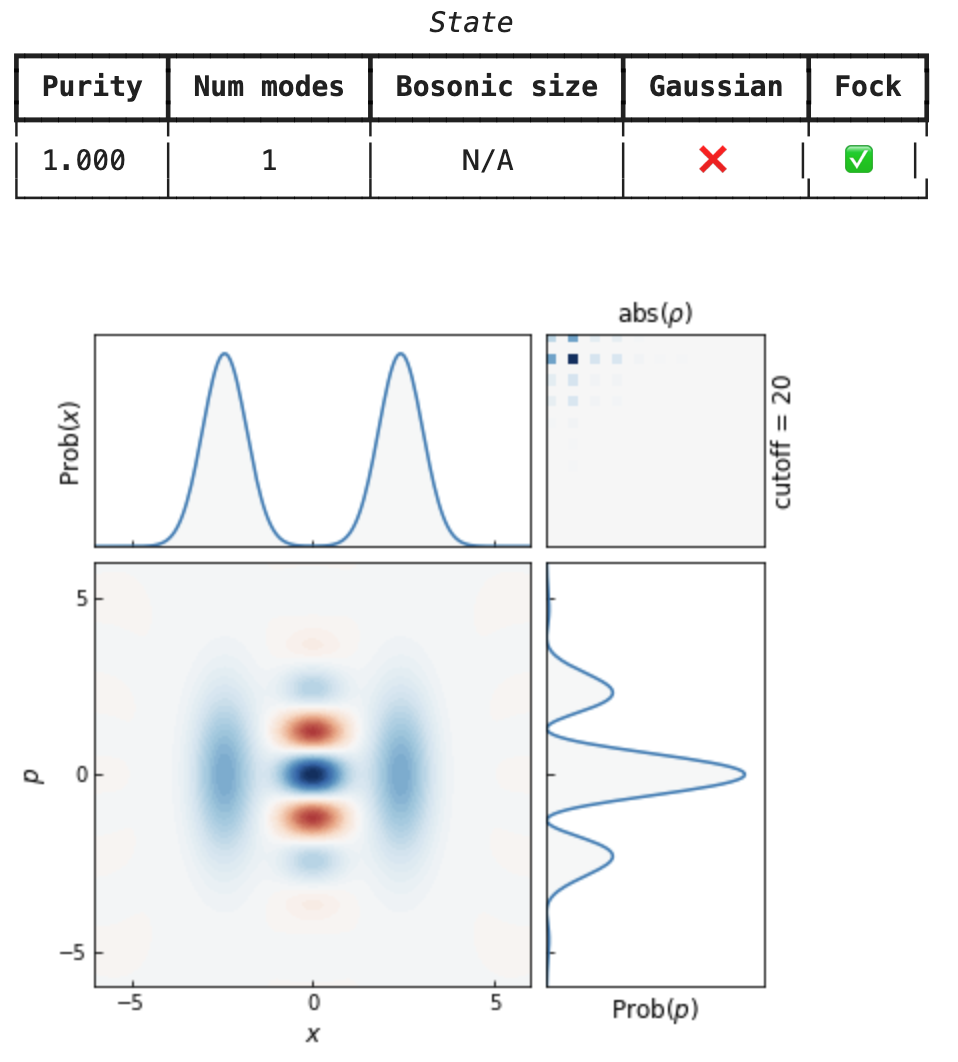
>>Applying gates to states looks natural, thanks to python's right-shift operator >>:
displaced_squeezed = Vacuum(1) >> Sgate(r=0.5) >> Dgate(x=1.0)
If you want to apply a gate to specific modes, use the getitem format. Here are a few examples:
D = Dgate(y=-0.4)
S = Sgate(r=0.1, phi=0.5)
state = Vacuum(2) >> D[1] >> S[0]  # displacement on mode 1 and squeezing on mode 0

BS = BSgate(theta=1.1)
state = Vacuum(3) >> BS[0,2]  # applying a beamsplitter to modes 0 and 2
state = Vacuum(4) >> S[0,1,2]  # applying the same Sgate in parallel to modes 0, 1 and 2 but not to mode 3
When chaining just gates with the right-shift >> operator, we create a circuit:
X8 = Sgate(r=[1.0] * 4) >> Interferometer(4)
output = Vacuum(4) >> X8

# lossy X8
noise = lambda: np.random.uniform(size=4)
X8_noisy = (Sgate(r=0.9 + 0.1*noise(), phi=0.1*noise())
                >> Attenuator(0.89 + 0.01*noise())
                >> Interferometer(4)
                >> Attenuator(0.95 + 0.01*noise())
               )

# 2-mode Bloch Messiah decomposition
bloch_messiah = Sgate(r=[0.1,0.2]) >> BSgate(theta=-0.1, phi=2.1) >> Dgate(x=[0.1, -0.4])
my_state = Vacuum(2) >> bloch_messiah
In order to perform a measurement, we use the left-shift operator, e.g. coh << sq (think of the left-shift on a state as "closing" the circuit).
leftover = Vacuum(4) >> X8 << SqueezedVacuum(r=10.0, phi=np.pi)[2] # a homodyne measurement of p=0.0 on mode 2
Transformations can also be applied in the dual sense by using the left-shift operator <<:
Attenuator(0.5) << Coherent(0.1, 0.2) == Coherent(0.1, 0.2) >> Amplifier(2.0)
This has the advantage of modelling lossy detectors without applying the loss channel to the state going into the detector, which can be overall faster e.g. if the state is kept pure by doing so.
There are two types of detectors in Mr Mustard. Fock detectors (PNRDetector and ThresholdDetector) and Gaussian detectors (Homodyne, Heterodyne, Generaldyne).
The PNR and Threshold detectors return an array of unnormalized measurement results, meaning that the elements of the array are the density matrices of the leftover systems, conditioned on the outcomes:
results = Gaussian(2) << PNRDetector(efficiency = 0.9, modes = [0])
results[0]  # unnormalized dm of mode 1 conditioned on measuring 0 in mode 0
results[1]  # unnormalized dm of mode 1 conditioned on measuring 1 in mode 0
results[2]  # unnormalized dm of mode 1 conditioned on measuring 2 in mode 0
# etc...
The trace of the leftover density matrices will yield the success probability. If multiple modes are measured then there is a corresponding number of indices:
results = Gaussian(3) << PNRDetector(efficiency = [0.9, 0.8], modes = [0,1])
results[2,3]  # unnormalized dm of mode 2 conditioned on measuring 2 in mode 0 and 3 in mode 1
# etc...
Set a lower settings.PNR_INTERNAL_CUTOFF (default 50) to speed-up computations of the PNR output.
==States support the comparison operator:
>>> bunched = (Coherent(1.0) & Coherent(1.0)) >> BSgate(np.pi/4)
>>> bunched.get_modes(1) == Coherent(np.sqrt(2.0))
True
As well as transformations (gates and circuits):
>>> Dgate(np.sqrt(2)) >> Attenuator(0.5) == Attenuator(0.5) >> Dgate(1.0)
True
States can be joined using the & (and) operator:
Coherent(x=1.0, y=1.0) & Coherent(x=2.0, y=2.0)  # A separable two-mode coherent state

s = SqueezedVacuum(r=1.0)
s4 = s & s & s & s   # four squeezed states
Subsystems can be accessed via get_modes:
joint = Coherent(x=1.0, y=1.0) & Coherent(x=2.0, y=2.0)
joint.get_modes(0)  # first mode
joint.get_modes(1)  # second mode

swapped = joint.get_modes([1,0])
The Fock representation of a State is obtained via .ket(cutoffs) or .dm(cutoffs). For circuits and gates (transformations in general) it's .U(cutoffs) or .choi(cutoffs), if available. The Fock representation is exact and it doesn't break differentiability. This means that one can define cost functions on the Fock representation and backpropagate back to the phase space representation.
# Fock representation of a coherent state
Coherent(0.5).ket(cutoffs=[5])   # ket
Coherent(0.5).dm(cutoffs=[5])    # density matrix

Dgate(x=1.0).U(cutoffs=[15])  # truncated unitary matrix
Dgate(x=1.0).choi(cutoffs=[15])  # truncated choi tensor
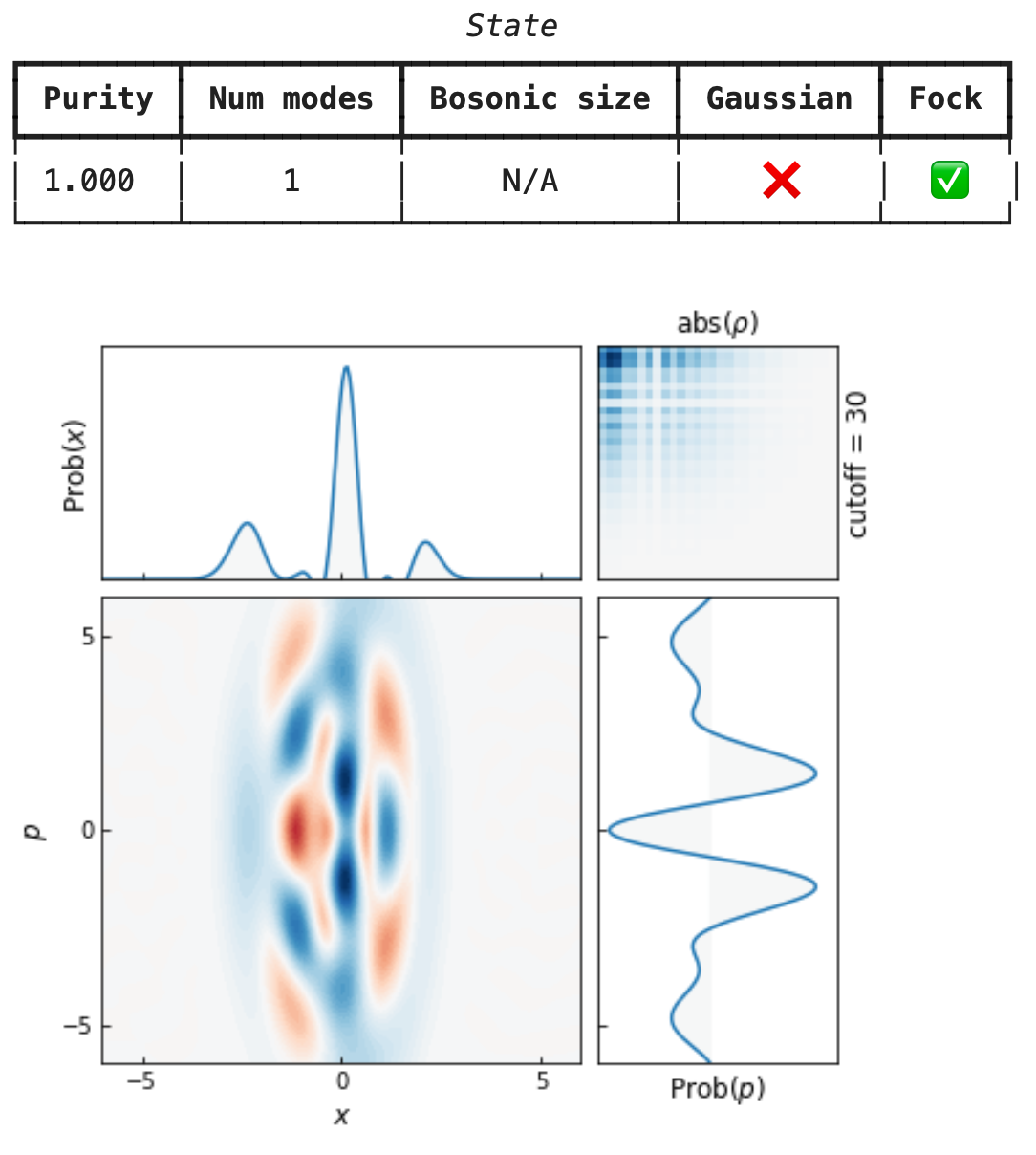
States can be initialized in Fock representation and used as any other state:
my_amplitudes = np.array([0.5, 0.25, -0.5, 0.25, 0.25, 0.5, -0.25] + [0.0]*23)  # notice the buffer
my_state = State(ket=my_amplitudes)
my_state >> Sgate(r=0.5)  # just works
Alternatively,
my_amplitudes = np.array([0.5, 0.25, -0.5, 0.25, 0.25, 0.5, -0.25])  # no buffer
my_state = State(ket=my_amplitudes)
my_state._cutoffs = [42]  # force the cutoff
my_state >> Sgate(r=0.5)  # works too
The physics module contains a growing number of functions that we can apply to states directly. These are made out of the functions that operate on the representation of the state:
The math module is the backbone of Mr Mustard. Mr Mustard comes with a plug-and-play backends through a math interface. You can use it as a drop-in replacement for tensorflow or numpy and your code will be plug-and-play too!
Here's an example where the numpy backend is used.
import mrmustard.math as math

math.cos(0.1)  # numpy
In a different session, we can change the backend to tensorflow.
import mrmustard.math as math
math.change_backend("tensorflow")

math.cos(0.1)  # tensorflow
The mrmustard.training.Optimizer uses Adam underneath the hood for the optimization of Euclidean parameters, a custom symplectic optimizer for Gaussian gates and states and a unitary/orthogonal optimizer for interferometers.
We can turn any simulation in Mr Mustard into an optimization by marking which parameters we wish to be trainable. Let's take a simple example: synthesizing a displaced squeezed state.
from mrmustard import math
from mrmustard.lab import Dgate, Ggate, Attenuator, Vacuum, Coherent, DisplacedSqueezed
from mrmustard.physics import fidelity
from mrmustard.training import Optimizer

math.change_backend("tensorflow")

D = Dgate(x = 0.1, y = -0.5, x_trainable=True, y_trainable=True)
L = Attenuator(transmissivity=0.5)

# we write a function that takes no arguments and returns the cost
def cost_fn_eucl():
    state_out = Vacuum(1) >> D >> L
    return 1 - fidelity(state_out, Coherent(0.1, 0.5))

G = Ggate(num_modes=1, symplectic_trainable=True)
def cost_fn_sympl():
    state_out = Vacuum(1) >> G >> D >> L
    return 1 - fidelity(state_out, DisplacedSqueezed(r=0.3, phi=1.1, x=0.4, y=-0.2))

# For illustration, here the Euclidean optimization doesn't include squeezing
opt = Optimizer(symplectic_lr=0.1, euclidean_lr=0.01)
opt.minimize(cost_fn_eucl, by_optimizing=[D])  # using Adam for D

# But the symplectic optimization always does
opt = Optimizer(symplectic_lr=0.1, euclidean_lr=0.01)
opt.minimize(cost_fn_sympl, by_optimizing=[G,D])  # uses Adam for D and the symplectic opt for G
FAQs
Differentiable quantum Gaussian circuits
The pypi package mrmustard receives a total of 205 weekly downloads. As such, mrmustard popularity was classified as not popular.
We found that mrmustard demonstrated a healthy version release cadence and project activity because the last version was released less than a year ago. It has 2 open source maintainers collaborating on the project.
Did you know?

Socket for GitHub automatically highlights issues in each pull request and monitors the health of all your open source dependencies. Discover the contents of your packages and block harmful activity before you install or update your dependencies.
Security News
An open letter signed by 50 companies, from NVIDIA and Microsoft to Mistral and Hugging Face, urges Washington not to restrict open weight AI.

Security News
/Research
A fake corepack.org site is impersonating the Node.js tool and delivers an infostealer and proxyware to developers who download it.

Research
/Security News
A large-scale campaign abused GitHub Actions in compromised repositories to exploit CVE-2026-41940 in cPanel and WHM and steal server credentials.