

Product
PHP and Composer Support Is Now in Beta
Socket’s PHP and Composer support is now in Beta for all customers, with PHP reachability analysis generally available.
By Trevor Norris, Benjamin Barslev - Aug 21, 2026
neuronscope-cli
Advanced tools
CLI and MCP server for tracing which neurons and attention heads drive a language model's output, built on TransformerLens.


Ask a language model "why did you say that" and get back the actual attention heads and neurons responsible, as JSON, from the command line or from an agent over MCP.

pip install neuronscope-cli
That gets you the neuronscope command. To install from source instead (for development or to
track main):
git clone https://github.com/RudrenduPaul/NeuronScope
cd NeuronScope
pip install -e .
[!NOTE] The first run of any command downloads the requested model from the HuggingFace Hub (
gpt2is about 500MB) and prints two lines to stderr that are expected, not errors: a CPU-fallback notice if you don't have a CUDA GPU, and an unauthenticated-HF-Hub rate-limit notice. Neither one means anything broke.
neuronscope trace gpt2 "The capital of France is Paris. The capital of Japan is" --top-k 5
Real output from this exact command (stderr trimmed to the two expected warnings mentioned above):
Prompt: The capital of France is Paris. The capital of Japan is
Predicted next token: ' Tokyo'
Top attention heads (by direct logit
            attribution)
┏━━━━━━━┳━━━━━━┳━━━━━━━━━━━━━━━━━━━┓
┃ Layer ┃ Head ┃ Logit attribution ┃
┡━━━━━━━╇━━━━━━╇━━━━━━━━━━━━━━━━━━━┩
│     9 │    8 │            4.0679 │
│     8 │   11 │            2.9028 │
│    10 │    7 │           -1.4782 │
│     8 │   10 │           -1.3999 │
│    10 │    0 │            1.1424 │
└───────┴──────┴───────────────────┘
Top MLP neurons (by activation
          magnitude)
┏━━━━━━━┳━━━━━━━━┳━━━━━━━━━━━━┓
┃ Layer ┃ Neuron ┃ Activation ┃
┡━━━━━━━╇━━━━━━━━╇━━━━━━━━━━━━┩
│    10 │     97 │     7.8394 │
│    11 │    611 │     4.6954 │
│    11 │   2997 │     4.6468 │
│    10 │   1793 │     4.5443 │
│     9 │   1460 │     4.4196 │
└───────┴────────┴────────────┘
gpt2 predicts Tokyo correctly, and head L9H8 is the single biggest contributor to that
prediction. Add --json to get the machine-readable version of the same result:
neuronscope trace gpt2 "The capital of France is Paris. The capital of Japan is" --top-k 3 --json
{
  "schema_version": 1,
  "operation": "trace",
  "model": {
    "requested_name": "gpt2",
    "resolved_name": "gpt2",
    "backend": "transformer_lens",
    "device": "cpu",
    "n_layers": 12,
    "n_heads": 12,
    "d_model": 768,
    "d_mlp": 3072
  },
  "prompt": "The capital of France is Paris. The capital of Japan is",
  "predicted_token": " Tokyo",
  "predicted_token_id": 11790,
  "top_neurons": [
    { "layer": 10, "neuron_index": 97, "activation": 7.839381217956543 },
    { "layer": 11, "neuron_index": 611, "activation": 4.695372581481934 },
    { "layer": 11, "neuron_index": 2997, "activation": 4.646785736083984 }
  ],
  "top_heads": [
    { "layer": 9, "head_index": 8, "logit_attribution": 4.067923545837402 },
    { "layer": 8, "head_index": 11, "logit_attribution": 2.9028172492980957 },
    { "layer": 10, "head_index": 7, "logit_attribution": -1.4781968593597412 }
  ]
}
NeuronScope is a CLI and MCP server built on top of TransformerLens. TransformerLens does the actual model loading, hooking, and activation math; NeuronScope adds a stable CLI, a versioned JSON schema, and an MCP server around it, so a script or an agent can ask "which components drove this output" without writing TransformerLens code directly.
trace: runs a prompt through the model and ranks attention heads by direct logit
attribution to the predicted token, and MLP neurons by activation magnitude at the final
prompt position.activations: dumps shape, mean, std, min/max, and the max-activating sequence
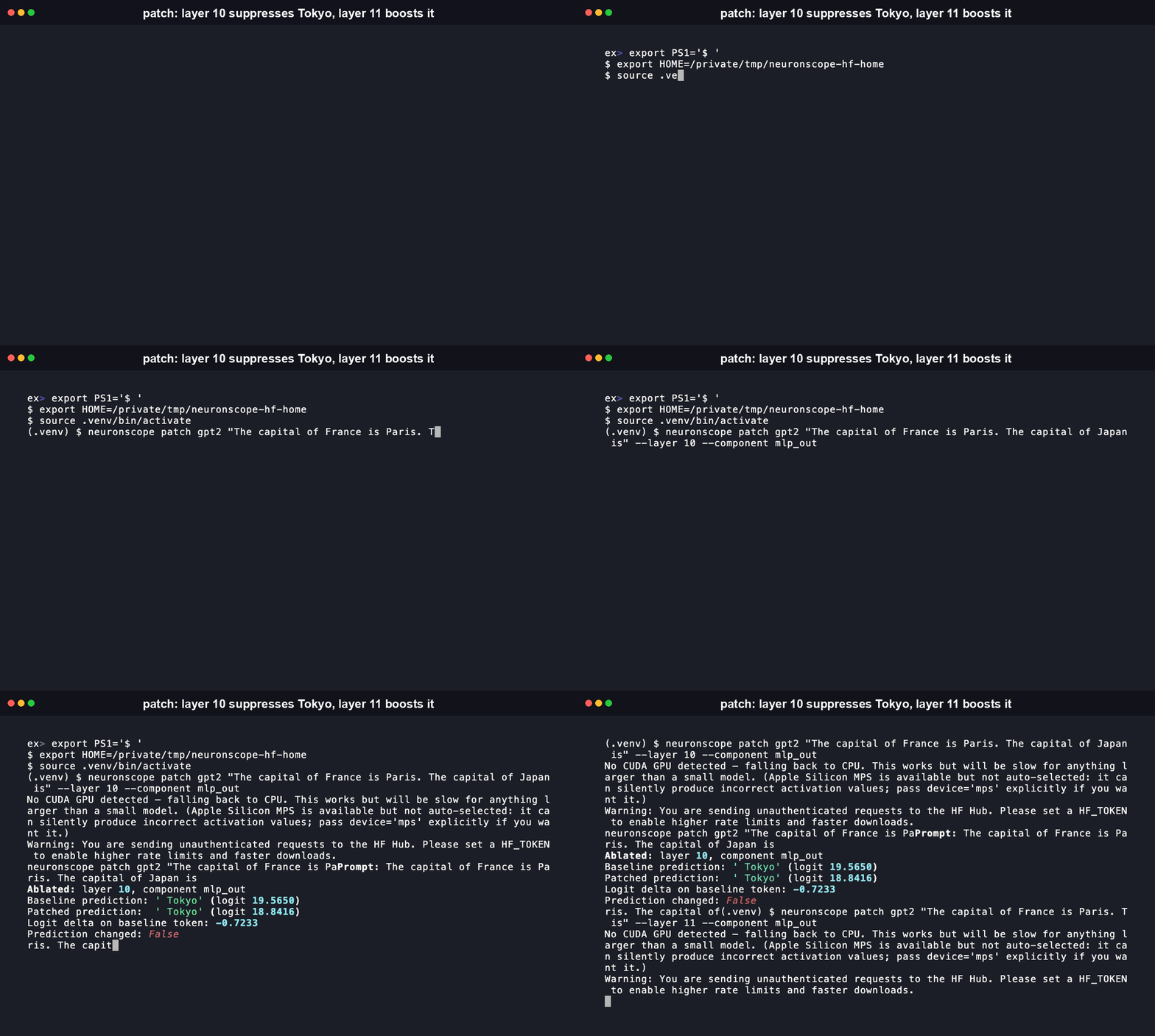
position for every layer's residual stream, MLP neuron activations, and attention pattern.patch: zero-ablates one component (resid_pre, resid_mid, resid_post,
attn_out, mlp_out, or mlp_post) at a given layer and reports how the predicted token
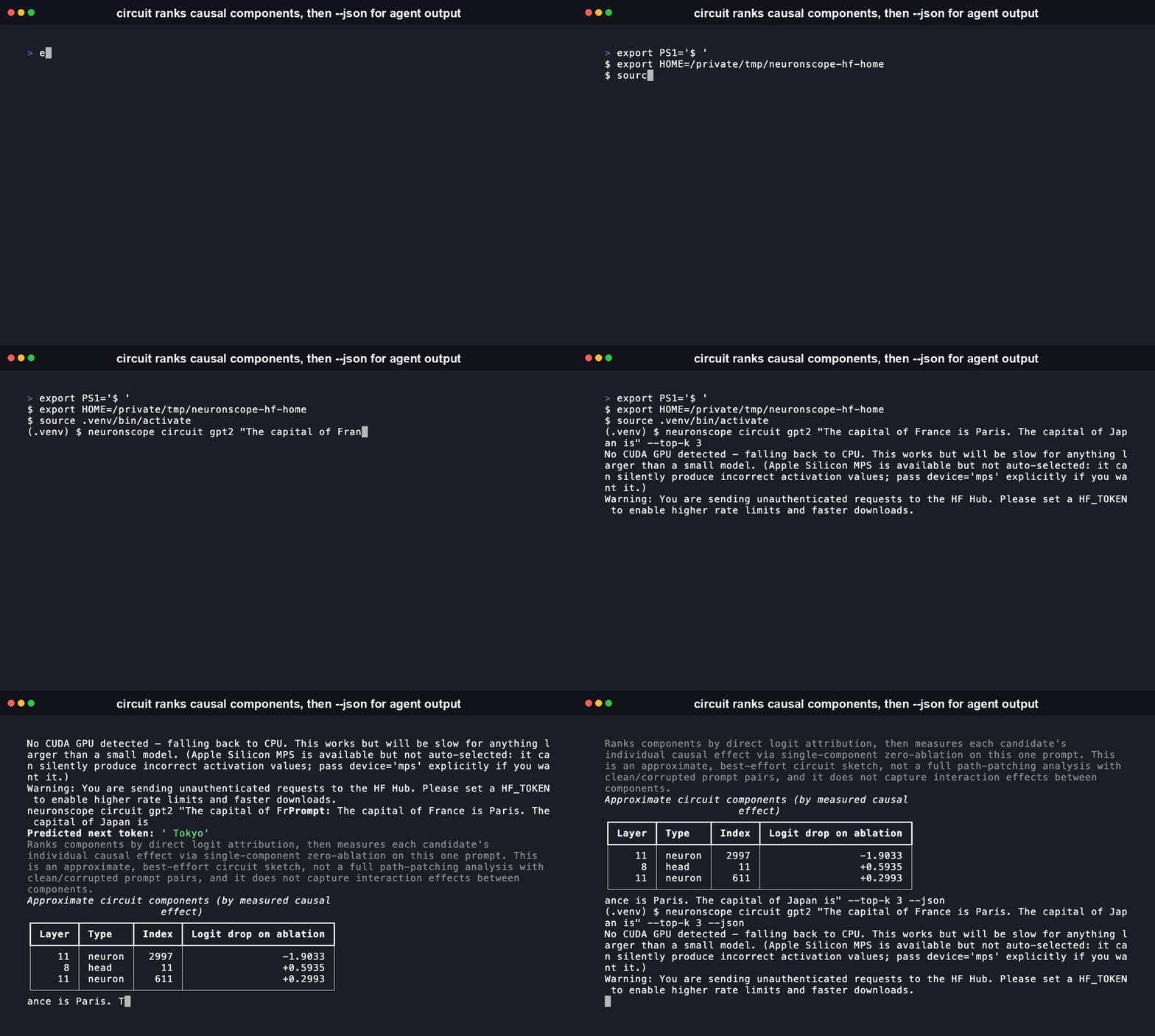
and its logit changed.circuit: a best-effort automated circuit sketch. Ranks candidate heads/neurons by
logit attribution, then measures each one's individual causal effect via single-component
ablation. This is not full path-patching with clean/corrupted prompt pairs and does not
capture interaction effects between components. The --json output says so explicitly in
its method field.--json for a schema_version-stamped document instead of a
table, and the same four operations are exposed as MCP tools returning the identical
shape via .model_dump(), so a CLI call and an MCP tool call produce the same document
for the same input.transformer_lens.HookedTransformer.from_pretrained supports.
Installing neuronscope-cli today pulls TransformerLens 3.6.0, which supports 249
pretrained checkpoints and aliases (OFFICIAL_MODEL_NAMES), covering GPT-2, Pythia,
Llama, Gemma, Qwen, and more. Small models like gpt2 run comfortably on CPU.NeuronScope does not replace TransformerLens, nnsight, SAELens, Anthropic's circuit-tracer, or Neuronpedia. It wraps TransformerLens for one narrower job: fast, scriptable, agent-callable component tracing on a single prompt. It leaves deeper mechanistic work (SAE training, transcoder-based circuit graphs, hosted feature browsing) to those tools.
Every command takes MODEL (any name HookedTransformer.from_pretrained accepts, for
example gpt2 or EleutherAI/pythia-70m) and PROMPT as positional arguments.
| Command | Extra flags | What it does |
|---|---|---|
neuronscope trace MODEL PROMPT | --top-k INTEGER (default 10), --json | Ranks top attention heads (logit attribution) and MLP neurons (activation magnitude) for the predicted next token |
neuronscope activations MODEL PROMPT | --json | Dumps per-layer activation summary stats (residual stream, MLP, attention pattern) |
neuronscope patch MODEL PROMPT | --layer INTEGER (required), --component [resid_pre|resid_mid|resid_post|attn_out|mlp_out|mlp_post] (required), --json | Zero-ablates one component and reports the logit/prediction delta |
neuronscope circuit MODEL PROMPT | --top-k INTEGER (default 10), --json | Best-effort circuit sketch via ranked single-component ablation |
neuronscope mcp-server | none | Starts the MCP server over stdio |
Global: neuronscope --version, neuronscope <command> --help. Exit codes: 0 success,
1 a runtime error (prompt too long for the model's context window, --layer out of range,
etc.), 2 a Click usage error (bad flags), 3 an unsupported model name.
NeuronScope ships a Model Context Protocol server so an AI agent (Claude, Cursor, or any MCP-compatible client) can trace, inspect, ablate, and sketch circuits directly, without a human invoking the CLI by hand.
Install the extra:
pip install "neuronscope-cli[mcp]"
Add it to your MCP client's config (for Claude Desktop, claude_desktop_config.json):
{
  "mcpServers": {
    "neuronscope": {
      "command": "uvx",
      "args": ["--from", "neuronscope-cli", "neuronscope-mcp"]
    }
  }
}
The server exposes four tools, trace, activations, patch, and circuit, each returning
the identical pydantic-model-shaped JSON the CLI's --json flag prints, via .model_dump(), so
an agent calling this server and a script calling the CLI get the same document for the same
input. A real trace call and its response:
trace(model="gpt2", prompt="The capital of France is Paris. The capital of Japan is", top_k=3)

{
  "schema_version": 1,
  "operation": "trace",
  "predicted_token": " Tokyo",
  "predicted_token_id": 11790,
  "top_neurons": [
    { "layer": 10, "neuron_index": 97, "activation": 7.839381217956543 }
  ],
  "top_heads": [
    { "layer": 9, "head_index": 8, "logit_attribution": 4.067923545837402 }
  ]
}
Errors never raise across the tool boundary: every handler catches its exceptions and returns a
structured ErrorResponse dict instead, so a calling agent always gets a parseable result.
[!WARNING] NeuronScope puts no size cap or timeout on model loading or forward passes. If you expose this MCP server somewhere an untrusted agent can call it, put a resource limit around the process (a cgroup,
ulimit, or a container memory/CPU cap) rather than relying on NeuronScope to refuse an oversized request on its own.
Transport is stdio, so there is nothing to host: the MCP client spawns the server as a local
subprocess. Source: neuronscope/mcp_server.py.
.mcp.json in your repo root, or you can
add it with claude mcp add neuronscope -- neuronscope-mcp.claude_desktop_config.json
(~/Library/Application Support/Claude/claude_desktop_config.json on macOS,
%APPDATA%\Claude\claude_desktop_config.json on Windows), under the same
"mcpServers" key.neuronscope mcp-server CLI subcommand still works as a local, non-uvx alternative
that runs the same server over stdio from an existing install.All five of these are real, actively maintained projects doing different jobs. This table compares CLI/JSON-agent-output surface and model coverage, not depth of interpretability research, where TransformerLens, nnsight, SAELens, circuit-tracer, and Neuronpedia are all more mature than NeuronScope. Star counts, release info, and last-push dates below were pulled from each project's GitHub API on 2026-08-03 and will drift over time; check the repos directly for current numbers.
| Project | Stars | Last activity | CLI | Agent-callable structured output | Model coverage |
|---|---|---|---|---|---|
| TransformerLens | 3,750 | v3.6.0 released 2026-07-28, pushed 2026-08-03 | No (Python library) | No | 249 pretrained checkpoints/aliases (its own official list) |
| nnsight | 1,014 | v0.7.0 released 2026-05-05, pushed 2026-07-30 | No (Python library) | No (returns tensors/Python objects) | Any HuggingFace or PyTorch model generically, no fixed list |
circuit-tracer (Anthropic-authored, moved from safety-research/circuit-tracer) | 2,882 | v0.5.2 released 2026-07-18, pushed 2026-07-18 | Yes | JSON attribution-graph export; no MCP server | Fixed transcoder allowlist: Gemma-2 (2B), Gemma-3 (270M-27B), Llama-3.2 (1B), Llama-3.1 (8B Instruct), Qwen-3 (0.6B-14B), GPT-OSS (20B) |
| SAELens | 1,492 | v6.47.0 released 2026-07-28, pushed 2026-07-28 | No (Python library) | No | Any PyTorch model generically; deepest integration is with TransformerLens |
| Neuronpedia | 1,093 | continuously deployed, tag v1.0.795 | No (hosted web app + REST API) | REST API returns JSON; MCP access exists only via an unofficial third-party wrapper, not the official repo | Models loadable through TransformerLens's model table (GPT-2, Gemma-2, Llama, DeepSeek, etc.) |
| NeuronScope (this project) | 1 | this commit | Yes | Yes: --json on every command, plus a native MCP server returning the same schema | Whatever TransformerLens's HookedTransformer.from_pretrained supports: 249 checkpoints/aliases |
The honest differentiation is narrow: NeuronScope is the only one of these with a CLI, a native MCP server, and a versioned JSON schema together in one package, and it's model-agnostic across whatever TransformerLens supports rather than pinned to a fixed transcoder allowlist like circuit-tracer. It is not more capable, more mature, or more widely used than any of these projects.
TransformerLens gives you a Python API for loading a model and running hooked forward passes. That's the right interface for a research notebook. It's the wrong interface for a script that needs a subprocess call and a JSON document back, or for an agent that needs a tool it can call over MCP. NeuronScope exists to be that second interface: the same underlying computation, wrapped so a CLI invocation or an MCP tool call gets back a schema-versioned document instead of a Python object graph.
Is this a replacement for TransformerLens, nnsight, SAELens, circuit-tracer, or Neuronpedia? No. NeuronScope is built directly on TransformerLens and does not do anything TransformerLens itself can't already do at a lower level. It doesn't train SAEs (SAELens), do full path-patching circuit discovery with transcoders (circuit-tracer), give you a Python-native tracing context manager for arbitrary PyTorch models (nnsight), or host a browsable feature database (Neuronpedia). It's a CLI and MCP wrapper around one slice of TransformerLens's functionality.
What models are supported?
Anything transformer_lens.HookedTransformer.from_pretrained supports, which today is 249
checkpoints and aliases spanning GPT-2, Pythia, Llama, Gemma, Qwen, and others. Run
python -c "from transformer_lens.loading_from_pretrained import OFFICIAL_MODEL_NAMES; print(len(OFFICIAL_MODEL_NAMES))"
in your own environment to get the exact count for your installed version, since
TransformerLens adds models over time.
Does it need a GPU?
No. Small models like gpt2 run fine on CPU; that's what the test suite and the quickstart
above run on. Larger models will be slow on CPU. NeuronScope does not auto-select Apple
Silicon's MPS backend even when available, because PyTorch's MPS backend can silently
produce incorrect values for some ops that this project's activation-patching math depends
on being exact. Pass device="mps" explicitly in your own code if you want it anyway.
Is it safe to expose the MCP server to an untrusted agent? Only with resource limits in place. See Known limitations below.
How is NeuronScope different from circuit-tracer, the other CLI tool in this list? circuit-tracer does deeper circuit analysis (full attribution graphs from trained transcoders) but only for a fixed allowlist of models: Gemma-2, Gemma-3, Llama-3.1/3.2, Qwen-3, and GPT-OSS. NeuronScope trades that depth for breadth: it works with any of TransformerLens's 249 supported checkpoints with no transcoder training step, and ships an MCP server so an agent can call it directly. The cost is that NeuronScope does single-component logit attribution and zero-ablation, not transcoder-based path patching.
Does the installed version always match what's on PyPI?
Run neuronscope --version after installing to check. pip install neuronscope-cli pulls
whatever release PyPI has published most recently; the code on this repo's main branch can
be ahead of that between releases. Installing from source (pip install -e .) always tracks
main exactly, including whatever hasn't been released yet.
What license is NeuronScope under, and can I use it commercially?
MIT. You can use, modify, and redistribute it in commercial and closed-source projects,
with attribution and the license notice kept intact. The dependencies it pulls in
(TransformerLens, PyTorch, the mcp package) carry their own licenses; check those
separately if you're redistributing a bundled product rather than just calling
neuronscope-cli as a dependency.
circuit is an approximation. It ranks components by logit attribution and measures
each one's individual causal effect via single-component zero-ablation on one prompt. It
does not do full path-patching with clean/corrupted prompt pairs, and it will not catch
interaction effects between components. The --json output states this in its method
field so a caller doesn't have to trust prose to know the caveat.ulimit, or a
container memory/CPU cap) rather than relying on NeuronScope to refuse an oversized
request on its own.HookedTransformer.from_pretrained is deprecated upstream. TransformerLens 3.6.0
emits a DeprecationWarning pointing at TransformerBridge.boot_transformers as the
replacement. It still works today, and every command shown in this README ran on it, but
NeuronScope's backend hasn't migrated yet. Tracked as an open item; migrating would be a
change inside neuronscope/backends/transformer_lens.py, not a change to any CLI command
or MCP tool signature.Issues and pull requests are welcome. See CONTRIBUTING.md for dev setup, where the code lives, and what a PR needs before it merges. Quick version:
pip install -e ".[dev,mcp]"
pytest -v
CI runs the same suite on Python 3.10, 3.11, and 3.12 on every push and pull request against
main. The suite covers 87% of neuronscope/ (pytest --cov=neuronscope), with the MCP
server's less-exercised paths (specific error branches) the main gap.
MIT. See LICENSE.
FAQs
CLI and MCP server for tracing which neurons and attention heads drive a language model's output, built on TransformerLens.
We found that neuronscope-cli demonstrated a healthy version release cadence and project activity because the last version was released less than a year ago. It has 1 open source maintainer collaborating on the project.
Product
Socket’s PHP and Composer support is now in Beta for all customers, with PHP reachability analysis generally available.

Product
Socket is bringing experimental protection to Firefox, scanning 97,000+ extensions in Mozilla's official directory for malware and risky updates.
Research
/Security News
Three compromised Rust crates pulled in a malicious dependency that downloaded and executed cross-platform malware during Cargo builds.