


Product
PHP and Composer Support Is Now in Beta
Socket’s PHP and Composer support is now in Beta for all customers, with PHP reachability analysis generally available.
By Trevor Norris, Benjamin Barslev - Aug 21, 2026
nexus-browser-mcp
Advanced tools
English | 简体中文


A browser-automation MCP server with event-driven, deterministic snapshots.
Built on Playwright. Drives a browser for LLMs through the Accessibility Tree — navigate, click, type, read, fill forms, manage tabs. Key differences from alternatives (e.g. Playwright MCP):
sleep guessing. A MutationObserver records the last DOM mutation and the browser's own requestAnimationFrame loop decides when the page has been quiet for STABLE_WINDOW_MS (default 800ms) before extracting a snapshot — eliminating "captured mid-animation" races.browser_evaluate disabled by default with unconditional confirmation, JSONL audit log (sensitive-parameter redaction + per-call in/out character metering, so token cost can be reconciled).task_ids, each with its own BrowserContext (no login-state cross-contamination). Idle tasks are reclaimed by TTL; on next use they're rebuilt and the last page is restored automatically.[state change] notice telling the agent exactly what was restored and what was lost — no raw Playwright exceptions leak through.browser_console / browser_errors / browser_network read them incrementally via a since cursor, so the agent can answer "why did nothing happen" instead of guessing.pip install nexus-browser-mcp
# or
uvx nexus-browser-mcp
Two executable entry points are installed: nexus-browser-mcp and nexus-browser. A guaranteed fallback: python -m nexus_browser.server.
Requires playwright and its browser binary:
pip install playwright && playwright install chromium
opencode (~/.config/opencode/opencode.json):
{
  "mcp": {
    "browser": {
      "type": "local",
      "command": ["uvx", "nexus-browser-mcp"],
      "enabled": true
    }
  }
}
Claude Code (.mcp.json, project root):
{
  "mcpServers": {
    "browser": {
      "type": "stdio",
      "command": "uvx",
      "args": ["nexus-browser-mcp"]
    }
  }
}
Pi Coding Agent: reads standard MCP configuration — project .mcp.json or user-global ~/.config/mcp/mcp.json; stdio is the default transport:
{
  "mcpServers": {
    "browser": {
      "command": "uvx",
      "args": ["nexus-browser-mcp"]
    }
  }
}
See docs/INTEGRATE.md for details (Chinese).
By default, isolated mode launches Playwright's bundled Chromium without your cookies/login state. To use your own browser, pick one:
Option A — load your browser profile directly (recommended, simplest)
Use system Chrome with your everyday user data directory (cookies/login/bookmarks included):
BROWSER_CHANNEL=chrome
BROWSER_USER_DATA_DIR="C:\Users\<you>\AppData\Local\Google\Chrome\User Data"
Note: while running against your real User Data, the process owns the browser — launching your own Chrome concurrently will conflict. Prefer a copied profile or a dedicated
--user-data-dir.
Recommended: a tool-dedicated profile (no conflict with your daily browser)
Use BROWSER_CHANNEL=chrome plus a dedicated user data dir (e.g. C:\Users\<you>\.nexus-browser\chrome-profile):
BROWSER_CHANNEL=chrome
BROWSER_USER_DATA_DIR="C:\Users\<you>\.nexus-browser\chrome-profile"
On first use, log in to target sites once in the dedicated Chrome window that pops up when the agent calls a browser tool. Cookies persist in that profile forever after — the agent carries login state while staying fully isolated from your daily browser.
Option B — attach to a running Chrome via CDP
Start chrome --remote-debugging-port=9222 first, then set BROWSER_MODE=cdp.
If the CDP connection fails, the server now fails loudly (no silent fallback to a fresh browser) and tells you to start the debug-port browser first.
Every option can be overridden via BROWSER_-prefixed env vars:
| Variable | Default | Description |
|---|---|---|
BROWSER_MODE | isolated | isolated (fresh isolated browser) / cdp (attach to your Chrome) |
BROWSER_CDP_ENDPOINT | http://localhost:9222 | CDP endpoint |
BROWSER_CHANNEL | "" | System browser channel: chrome/msedge etc. (empty = Playwright bundled Chromium) |
BROWSER_USER_DATA_DIR | "" | User data dir (carries cookies/login). When set, one shared persistent context across tasks. Empty = fresh profile |
BROWSER_HEADLESS | false | Headless mode (isolated only) |
BROWSER_DEFAULT_TIMEOUT_MS | 30000 | Playwright per-operation timeout (navigation etc.) |
BROWSER_TOOL_TIMEOUT_MS | 60000 | Outer timeout guard per tool call (returns ERROR instead of hanging) |
BROWSER_STABLE_WINDOW_MS | 800 | Quiet window: how long without DOM mutations counts as "stable" |
BROWSER_STABLE_REQUIRED | 2 | Consecutive identical snapshots confirming stability (guards non-DOM changes like animations) |
BROWSER_STABLE_TIMEOUT_MS | 3000 | Total stability-wait timeout; degrades gracefully on expiry |
BROWSER_SNAPSHOT_MAX_NODES | 100 | Max nodes per snapshot |
BROWSER_CONTEXT_TTL_SEC | 600 | Idle task auto-reclaim (seconds) |
BROWSER_STREAM_CHAR_CAP | 16000 | Max chars per stream buffer (oldest dropped with a seam marker) |
BROWSER_STREAM_PAGE_CAP | 64000 | Total stream buffer chars per page |
BROWSER_EVENT_MAX_ENTRIES | 500 | Max events (console/exception/request) per page, oldest dropped with a counter |
BROWSER_EVENT_TEXT_CAP | 500 | Per-event text truncation length |
BROWSER_EVENT_HANDLE_MAX | 50 | Recent requests per page keeping a live response handle (for on-demand body reads) |
BROWSER_ALLOW_NETWORK_BODY | false | Allow browser_network_body (response bodies may carry sensitive data) |
BROWSER_NETWORK_BODY_CAP | 4000 | Max chars returned per response body |
BROWSER_TRANSPORT | stdio | stdio / http (streamable-http for remote/multi-client) |
BROWSER_HTTP_HOST | 127.0.0.1 | HTTP bind address; non-localhost requires BROWSER_HTTP_TOKEN (refuses to start otherwise) |
BROWSER_HTTP_PORT | 8817 | HTTP port |
BROWSER_HTTP_TOKEN | "" | Bearer token for HTTP transport |
BROWSER_ALLOW_JS_EXECUTION | false | Allow browser_evaluate (unconditional HITL when enabled) |
BROWSER_HITL_RULES | [] | JSON array of HITL rules, e.g. `[{"action":"click","name_pattern":"pay |
BROWSER_AUDIT_PATH | ~/.nexus-browser/audit.jsonl | Audit log path |
25 tools: browser_navigate, browser_snapshot, browser_click, browser_type, browser_read, browser_screenshot, browser_evaluate, browser_wait, browser_wait_stable, browser_wait_ms, browser_scroll, browser_scroll_to, browser_wait_navigation, browser_dismiss_popup, browser_list_pages, browser_switch_page, observability tools browser_console, browser_errors, browser_network, browser_perf, browser_network_body, plus 4 lifecycle tools: browser_tasks, browser_close_task, browser_list_sessions, browser_close_session.
Observability (debugging): console output, uncaught exceptions and request metadata are buffered per page from creation; browser_errors() returns a merged "JS exceptions + console.error + failed requests" view in one call. All three support a since cursor (omit = continue from last read, 0 = full) and limit paging.
Performance: browser_perf() returns FCP/LCP/CLS/INP, navigation timings and the 5 slowest resources. Response bodies can be fetched on demand with browser_network_body(seq) — off by default (BROWSER_ALLOW_NETWORK_BODY), every call gated by confirmed=true, hard char cap, and the body never enters the audit log.
HITL confirmation closes a loop: any gated call returns CONFIRMATION_REQUIRED once; after the user approves in chat, the agent re-calls with confirmed=true (applies to HITL rules, browser_evaluate, browser_network_body).
Default is stdio (single client). For remote or multi-client use, run a streamable-HTTP server:
BROWSER_TRANSPORT=http BROWSER_HTTP_PORT=8817 nexus-browser-mcp
Each MCP session gets an isolated session_id (isolated contexts per task, as usual). Safety rule: binding a non-localhost address without BROWSER_HTTP_TOKEN refuses to start — an unauthenticated browser-control port is a footgun; with a token set, requests must send Authorization: Bearer <token>.
Streaming content (AI replies etc.): browser_read(wait_stable=true) waits for DOM quiet and reads the full text in one call; browser_read(selector=..., follow=true) tracks incrementally and returns only new content per call (full=true returns the whole buffer). browser_wait_stable / browser_wait_ms provide event-driven and fixed-duration waiting primitives.
Snapshot diff: a repeated browser_snapshot whose tree is node-for-node identical to the last one (refs excluded — Playwright renumbers them per generation) returns a ~120-char [no change] notice instead of the full tree, and previously issued refs remain valid via generation chaining; diff=false forces a full snapshot. Any real change (content, box, attributes) yields the full snapshot — no partial merges, no stale views.
Most tools accept an optional task_id (defaults to a shared default task). See usage guides in docs/ (Chinese).
uv venv
uv pip install -e ".[dev]"
python -m pytest tests -q
ruff check src tests
python -m smokes.test_e2e           # real-browser smoke
python -m smokes.test_e2e_interact  # forms + multi-task smoke
python -m smokes.test_e2e_observability  # console/exception/network observability smoke
MIT
FAQs
事件驱动确定性快照的浏览器操控 MCP 服务器 (Playwright + Accessibility Tree)
The pypi package nexus-browser-mcp receives a total of 400 weekly downloads. As such, nexus-browser-mcp popularity was classified as not popular.
We found that nexus-browser-mcp demonstrated a healthy version release cadence and project activity because the last version was released less than a year ago. It has 1 open source maintainer collaborating on the project.
Product
Socket’s PHP and Composer support is now in Beta for all customers, with PHP reachability analysis generally available.
Product
Socket is bringing experimental protection to Firefox, scanning 97,000+ extensions in Mozilla's official directory for malware and risky updates.
Research
/Security News
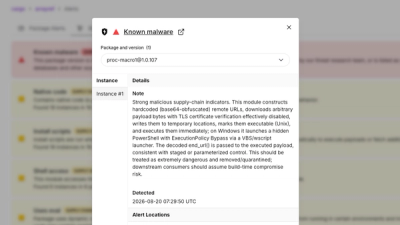
Three compromised Rust crates pulled in a malicious dependency that downloaded and executed cross-platform malware during Cargo builds.