


Company News
Socket Has Acquired Secure Annex
Socket has acquired Secure Annex to expand extension security across browsers, IDEs, and AI tools.
By Feross Aboukhadijeh - Apr 28, 2026
openfga-sdk
Advanced tools
A high performance and flexible authorization/permission engine built for developers and inspired by Google Zanzibar.




This is an autogenerated python SDK for OpenFGA. It provides a wrapper around the OpenFGA API definition.
OpenFGA is an open source Fine-Grained Authorization solution inspired by Google's Zanzibar paper. It was created by the FGA team at Auth0 based on Auth0 Fine-Grained Authorization (FGA), available under a permissive license (Apache-2) and welcomes community contributions.
OpenFGA is designed to make it easy for application builders to model their permission layer, and to add and integrate fine-grained authorization into their applications. OpenFGA’s design is optimized for reliability and low latency at a high scale.
The openfga_sdk is available to be downloaded via PyPI, you can install directly using:
pip3 install openfga_sdk
(you may need to run pip with root permission: sudo pip3 install openfga_sdk)
Then import the package:
import openfga_sdk
The openfga_sdk is also hosted in GitHub, you can install directly using:
pip3 install https://github.com/openfga/python-sdk.git
(you may need to run pip with root permission: sudo pip3 install https://github.com/openfga/python-sdk.git)
Then import the package:
import openfga_sdk
Install via Setuptools.
python setup.py install --user
(or sudo python setup.py install to install the package for all users)
Then import the package:
import openfga_sdk
Learn how to initialize your SDK
We strongly recommend you initialize the OpenFgaClient only once and then re-use it throughout your app, otherwise you will incur the cost of having to re-initialize multiple times or at every request, the cost of reduced connection pooling and re-use, and would be particularly costly in the client credentials flow, as that flow will be preformed on every request.
The
OpenFgaClientwill by default retry API requests up to 3 times on 429 and 5xx errors.
from openfga_sdk import ClientConfiguration, OpenFgaClient


async def main():
    configuration = ClientConfiguration(
        api_url=FGA_API_URL,  # required
        store_id=FGA_STORE_ID,  # optional, not needed when calling `CreateStore` or `ListStores`
        authorization_model_id=FGA_MODEL_ID,  # Optional, can be overridden per request
    )
    # Enter a context with an instance of the OpenFgaClient
    async with OpenFgaClient(configuration) as fga_client:
        api_response = await fga_client.read_authorization_models()
        return api_response
from openfga_sdk import ClientConfiguration, OpenFgaClient
from openfga_sdk.credentials import CredentialConfiguration, Credentials


async def main():
    configuration = ClientConfiguration(
        api_url=FGA_API_URL,  # required
        store_id=FGA_STORE_ID,  # optional, not needed when calling `CreateStore` or `ListStores`
        authorization_model_id=FGA_MODEL_ID,  # Optional, can be overridden per request
        credentials=Credentials(
            method='api_token',
            configuration=CredentialConfiguration(
                api_token=FGA_API_TOKEN,
            )
        )
    )
    # Enter a context with an instance of the OpenFgaClient
    async with OpenFgaClient(configuration) as fga_client:
        api_response = await fga_client.read_authorization_models()
        return api_response
from openfga_sdk import ClientConfiguration, OpenFgaClient
from openfga_sdk.credentials import Credentials, CredentialConfiguration


async def main():
    configuration = ClientConfiguration(
        api_url=FGA_API_URL,  # required
        store_id=FGA_STORE_ID,  # optional, not needed when calling `CreateStore` or `ListStores`
        authorization_model_id=FGA_MODEL_ID,  # Optional, can be overridden per request
        credentials=Credentials(
            method='client_credentials',
            configuration=CredentialConfiguration(
                api_issuer=FGA_API_TOKEN_ISSUER,
                api_audience=FGA_API_AUDIENCE,  # optional, required for Auth0; omit for standard OAuth2
                client_id=FGA_CLIENT_ID,
                client_secret=FGA_CLIENT_SECRET,
                # scopes="read write",  # optional, space-separated OAuth2 scopes
            )
        )
    )
    # Enter a context with an instance of the OpenFgaClient
    async with OpenFgaClient(configuration) as fga_client:
        api_response = await fga_client.read_authorization_models()
        return api_response
Note:
api_issueraccepts either a hostname (e.g.,issuer.fga.example, which defaults tohttps://<hostname>/oauth/token) or a full token endpoint URL (e.g.,https://oauth.fga.example/token). Use the full URL when your OAuth2 provider uses a non-standard token endpoint path.
For OAuth2 providers that use scope instead of audience:
from openfga_sdk import ClientConfiguration, OpenFgaClient
from openfga_sdk.credentials import Credentials, CredentialConfiguration


async def main():
    configuration = ClientConfiguration(
        api_url=FGA_API_URL,  # required
        store_id=FGA_STORE_ID,  # optional
        authorization_model_id=FGA_MODEL_ID,  # optional
        credentials=Credentials(
            method='client_credentials',
            configuration=CredentialConfiguration(
                api_issuer="https://oauth.fga.example/token",  # full token endpoint URL
                client_id=FGA_CLIENT_ID,
                client_secret=FGA_CLIENT_SECRET,
                scopes="email profile",  # space-separated OAuth2 scopes
            )
        )
    )
    async with OpenFgaClient(configuration) as fga_client:
        api_response = await fga_client.read_authorization_models()
        return api_response
You can configure default headers that will be sent with every request by passing them to the ClientConfiguration:
from openfga_sdk import ClientConfiguration, OpenFgaClient


async def main():
    configuration = ClientConfiguration(
        api_url=FGA_API_URL,
        store_id=FGA_STORE_ID,
        authorization_model_id=FGA_MODEL_ID,
        headers={
            "X-Custom-Header": "default-value",
            "X-Request-Source": "my-app",
        },
    )

    async with OpenFgaClient(configuration) as fga_client:
        api_response = await fga_client.read_authorization_models()
        return api_response
You can also send custom headers on a per-request basis by using the options parameter. Per-request headers will override any default headers with the same name.
from openfga_sdk import ClientConfiguration, OpenFgaClient
from openfga_sdk.client.models import ClientCheckRequest


async def main():
    configuration = ClientConfiguration(
        api_url=FGA_API_URL,
        store_id=FGA_STORE_ID,
        authorization_model_id=FGA_MODEL_ID,
    )

    async with OpenFgaClient(configuration) as fga_client:
        # Add custom headers to a specific request
        result = await fga_client.check(
            body=ClientCheckRequest(
                user="user:anne",
                relation="viewer",
                object="document:roadmap",
            ),
            options={
                "headers": {
                    "X-Request-ID": "123e4567-e89b-12d3-a456-426614174000",
                    "X-Custom-Header": "custom-value",  # Overrides default header value
                }
            }
        )
        return result
To run outside of an async context, the project exports a synchronous client
from openfga_sdk.sync that supports all the credential types and calls,
without requiring async/await.
from openfga_sdk.client import ClientConfiguration
from openfga_sdk.sync import OpenFgaClient


def main():
    configuration = ClientConfiguration(
        api_url=FGA_API_URL,  # required
        store_id=FGA_STORE_ID,  # optional, not needed when calling `CreateStore` or `ListStores`
        authorization_model_id=FGA_MODEL_ID,  # optional, can be overridden per request
    )
    # Enter a context with an instance of the OpenFgaClient
    with OpenFgaClient(configuration) as fga_client:
        api_response = fga_client.read_authorization_models()
        return api_response
You need your store id to call the OpenFGA API (unless it is to call the CreateStore or ListStores methods).
If your server is configured with authentication enabled, you also need to have your credentials ready.
Get a paginated list of stores.
# from openfga_sdk.sync import OpenFgaClient

# Initialize the fga_client
# fga_client = OpenFgaClient(configuration)

options = {"page_size": 25, "continuation_token": "eyJwayI6IkxBVEVTVF9OU0NPTkZJR19hdXRoMHN0b3JlIiwic2siOiIxem1qbXF3MWZLZExTcUoyN01MdTdqTjh0cWgifQ=="}
response = await fga_client.list_stores(options)
# response = ListStoresResponse(...)
# response.stores = [Store({"id": "01FQH7V8BEG3GPQW93KTRFR8JB", "name": "FGA Demo Store", "created_at": "2022-01-01T00:00:00.000Z", "updated_at": "2022-01-01T00:00:00.000Z"})]
Create and initialize a store.
# from openfga_sdk import CreateStoreRequest, OpenFgaClient

# Initialize the fga_client
# fga_client = OpenFgaClient(configuration)

body = CreateStoreRequest(
    name = "FGA Demo Store",
)
response = await fga_client.create_store(body)
# response.id = "01FQH7V8BEG3GPQW93KTRFR8JB"
Get information about the current store.
Requires a client initialized with a storeId
# from openfga_sdk import OpenFgaClient

# Initialize the fga_client
# fga_client = OpenFgaClient(configuration)

response = await fga_client.get_store()
# response = Store({"id": "01FQH7V8BEG3GPQW93KTRFR8JB", "name": "FGA Demo Store", "created_at": "2022-01-01T00:00:00.000Z", "updated_at": "2022-01-01T00:00:00.000Z"})
Delete a store.
Requires a client initialized with a storeId
# from openfga_sdk import OpenFgaClient

# Initialize the fga_client
# fga_client = OpenFgaClient(configuration)

response = await fga_client.delete_store()
Read all authorization models in the store.
# from openfga_sdk import OpenFgaClient

# Initialize the fga_client
# fga_client = OpenFgaClient(configuration)

options = {"page_size": 25, "continuation_token": "eyJwayI6IkxBVEVTVF9OU0NPTkZJR19hdXRoMHN0b3JlIiwic2siOiIxem1qbXF3MWZLZExTcUoyN01MdTdqTjh0cWgifQ=="}
response = await fga_client.read_authorization_models(options)
# response.authorization_models = [AuthorizationModel(id='01GXSA8YR785C4FYS3C0RTG7B1', schema_version = '1.1', type_definitions=type_definitions[...], AuthorizationModel(id='01GXSBM5PVYHCJNRNKXMB4QZTW', schema_version = '1.1', type_definitions=type_definitions[...])]
Create a new authorization model.
Note: To learn how to build your authorization model, check the Docs at https://openfga.dev/docs.
Learn more about the OpenFGA configuration language.
You can use the OpenFGA Syntax Transformer to convert between the friendly DSL and the JSON authorization model.
# from openfga_sdk import (
#     Condition, ConditionParamTypeRef, Metadata, ObjectRelation, OpenFgaClient, RelationMetadata,
#     RelationReference, TypeDefinition, Userset, Usersets, WriteAuthorizationModelRequest
# )

# Initialize the fga_client
# fga_client = OpenFgaClient(configuration)

user_type = TypeDefinition(type="user")

document_relations = dict(
    writer=Userset(this=dict()),
    viewer=Userset(
        union=Usersets(
            child=[
                Userset(this=dict()),
                Userset(computed_userset=ObjectRelation(
                    object="",
                    relation="writer",
                )),
            ],
        ),
    ),
)

document_metadata = Metadata(
        relations=dict(
            writer=RelationMetadata(
                directly_related_user_types=[
                    RelationReference(type="user"),
                    RelationReference(type="user", condition="ViewCountLessThan200"),
                ]
            ),
            viewer=RelationMetadata(
                directly_related_user_types=[
                    RelationReference(type="user"),
                ]
            )
        )
)

document_type = TypeDefinition(
    type="document",
    relations=document_relations,
    metadata=document_metadata
)

conditions = dict(
        ViewCountLessThan200=Condition(
            name="ViewCountLessThan200",
            expression="ViewCount < 200",
            parameters=dict(
                ViewCount=ConditionParamTypeRef(
                    type_name="TYPE_NAME_INT"
                ),
                Type=ConditionParamTypeRef(
                    type_name="TYPE_NAME_STRING"
                ),
                Name=ConditionParamTypeRef(
                    type_name="TYPE_NAME_STRING"
                ),
            )
        )
    )

body = WriteAuthorizationModelRequest(
    schema_version="1.1",
    type_definitions=[
        user_type,
        document_type
    ],
    conditions=conditions
)

response = await fga_client.write_authorization_model(body)
# response.authorization_model_id = "01GXSA8YR785C4FYS3C0RTG7B1"
Read a particular authorization model.
# from openfga_sdk import OpenFgaClient

# Initialize the fga_client
# fga_client = OpenFgaClient(configuration)

options = {
    # You can rely on the model id set in the configuration or override it for this specific request
    "authorization_model_id": "01GXSA8YR785C4FYS3C0RTG7B1"
}

response = await fga_client.read_authorization_model(options)
# response.authorization_model =  AuthorizationModel(id='01GXSA8YR785C4FYS3C0RTG7B1', schema_version = '1.1', type_definitions=type_definitions[...])
Reads the latest authorization model (note: this ignores the model id in configuration).
# from openfga_sdk import ClientConfiguration, OpenFgaClient

# Create the cofiguration object
# configuration = ClientConfiguration(
#     ...
#     authorization_model_id = FGA_MODEL_ID,
#     ...
# )

# Initialize the fga_client
# fga_client = OpenFgaClient(configuration)

response = await fga_client.read_latest_authorization_model()
# response.authorization_model =  AuthorizationModel(id='01GXSA8YR785C4FYS3C0RTG7B1', schema_version = '1.1', type_definitions=type_definitions[...])
Reads the list of historical relationship tuple writes and deletes.
# from openfga_sdk import OpenFgaClient
# from openfga_sdk.client.models import ClientReadChangesRequest

# Initialize the fga_client
# fga_client = OpenFgaClient(configuration)

options = {
    # You can rely on the model id set in the configuration or override it for this specific request
    "page_size": "25",
    "continuation_token": "eyJwayI6IkxBVEVTVF9OU0NPTkZJR19hdXRoMHN0b3JlIiwic2siOiIxem1qbXF3MWZLZExTcUoyN01MdTdqTjh0cWgifQ=="
}
body = ClientReadChangesRequest(type="document", start_time="2022-01-01T00:00:00Z")

response = await fga_client.read_changes(body, options)
# response.continuation_token = ...
# response.changes = [TupleChange(tuple_key=TupleKey(object="...",relation="...",user="..."),operation=TupleOperation("TUPLE_OPERATION_WRITE"),timestamp=datetime.fromisoformat("..."))]
Reads the relationship tuples stored in the database. It does not evaluate nor exclude invalid tuples according to the authorization model.
# from openfga_sdk import OpenFgaClient, ReadRequestTupleKey

# Initialize the fga_client
# fga_client = OpenFgaClient(configuration)

# Find if a relationship tuple stating that a certain user is a viewer of certain document
body = ReadRequestTupleKey(
    user="user:81684243-9356-4421-8fbf-a4f8d36aa31b",
    relation="viewer",
    object="document:0192ab2a-d83f-756d-9397-c5ed9f3cb69a",
)

response = await fga_client.read(body)
# response = ReadResponse({"tuples": [Tuple({"key": TupleKey({"user":"...","relation":"...","object":"..."}), "timestamp": datetime.fromisoformat("...") })]})
# from openfga_sdk import OpenFgaClient, ReadRequestTupleKey

# Initialize the fga_client
# fga_client = OpenFgaClient(configuration)

# Find all relationship tuples where a certain user has a relationship as any relation to a certain document
body = ReadRequestTupleKey(
    user="user:81684243-9356-4421-8fbf-a4f8d36aa31b",
    object="document:0192ab2a-d83f-756d-9397-c5ed9f3cb69a",
)

response = await fga_client.read(body)
# response = ReadResponse({"tuples": [Tuple({"key": TupleKey({"user":"...","relation":"...","object":"..."}), "timestamp": datetime.fromisoformat("...") })]})
# from openfga_sdk import OpenFgaClient, ReadRequestTupleKey

# Initialize the fga_client
# fga_client = OpenFgaClient(configuration)

# Find all relationship tuples where a certain user is a viewer of any document
body = ReadRequestTupleKey(
    user="user:81684243-9356-4421-8fbf-a4f8d36aa31b",
    relation="viewer",
    object="document:",
)

response = await fga_client.read(body)
# response = ReadResponse({"tuples": [Tuple({"key": TupleKey({"user":"...","relation":"...","object":"..."}), "timestamp": datetime.fromisoformat("...") })]})
# from openfga_sdk import OpenFgaClient, ReadRequestTupleKey

# Initialize the fga_client
# fga_client = OpenFgaClient(configuration)

# Find all relationship tuples where any user has a relationship as any relation with a particular document
body = ReadRequestTupleKey(
    object="document:0192ab2a-d83f-756d-9397-c5ed9f3cb69a",
)

response = await fga_client.read(body)
# response = ReadResponse({"tuples": [Tuple({"key": TupleKey({"user":"...","relation":"...","object":"..."}), "timestamp": datetime.fromisoformat("...") })]})
# from openfga_sdk import OpenFgaClient, ReadRequestTupleKey

# Initialize the fga_client
# fga_client = OpenFgaClient(configuration)

# Read all stored relationship tuples
body = ReadRequestTupleKey()

response = await api_instance.read(body)
# response = ReadResponse({"tuples": [Tuple({"key": TupleKey({"user":"...","relation":"...","object":"..."}), "timestamp": datetime.fromisoformat("...") })]})
Create and/or delete relationship tuples to update the system state.
By default, write runs in a transaction mode where any invalid operation (deleting a non-existing tuple, creating an existing tuple, one of the tuples was invalid) or a server error will fail the entire operation.
# from openfga_sdk import OpenFgaClient, RelationshipCondition
# from openfga_sdk.client.models import ClientTuple, ClientWriteRequest

# Initialize the fga_client
# fga_client = OpenFgaClient(configuration)

options = {
    # You can rely on the model id set in the configuration or override it for this specific request
    "authorization_model_id": "01GXSA8YR785C4FYS3C0RTG7B1"
}
body = ClientWriteRequest(
    writes=[
        ClientTuple(
            user="user:81684243-9356-4421-8fbf-a4f8d36aa31b",
            relation="viewer",
            object="document:0192ab2a-d83f-756d-9397-c5ed9f3cb69a",
            condition=RelationshipCondition(
              name='ViewCountLessThan200',
              context=dict(
                  Name='Roadmap',
                  Type='Document',
              ),
            ),
        ),
        ClientTuple(
            user="user:81684243-9356-4421-8fbf-a4f8d36aa31b",
            relation="viewer",
            object="document:0192ab2d-d36e-7cb3-a4a8-5d1d67a300c5",
        ),
    ],
    deletes=[
        ClientTuple(
            user="user:81684243-9356-4421-8fbf-a4f8d36aa31b",
            relation="writer",
            object="document:0192ab2a-d83f-756d-9397-c5ed9f3cb69a",
        ),
    ],
)

response = await fga_client.write(body, options)
Convenience write_tuples and delete_tuples methods are also available.
The SDK will split the writes into separate requests and send them sequentially to avoid violating rate limits.
# from openfga_sdk import OpenFgaClient, RelationshipCondition
# from openfga_sdk.client.models import ClientTuple, ClientWriteRequest, WriteTransactionOpts

# Initialize the fga_client
# fga_client = OpenFgaClient(configuration)

options = {
    # You can rely on the model id set in the configuration or override it for this specific request
    "authorization_model_id": "01GXSA8YR785C4FYS3C0RTG7B1",
    "transaction": WriteTransactionOpts(
        disabled=True,
        max_parallel_requests=10, # Maximum number of requests to issue in parallel
        max_per_chunk=1, # Maximum number of requests to be sent in a transaction in a particular chunk
    )
}
body = ClientWriteRequest(
    writes=[
        ClientTuple(
            user="user:81684243-9356-4421-8fbf-a4f8d36aa31b",
            relation="viewer",
            object="document:0192ab2a-d83f-756d-9397-c5ed9f3cb69a",
        ),
        ClientTuple(
            user="user:81684243-9356-4421-8fbf-a4f8d36aa31b",
            relation="viewer",
            object="document:0192ab2d-d36e-7cb3-a4a8-5d1d67a300c5",
            condition=RelationshipCondition(
              name='ViewCountLessThan200',
              context=dict(
                  Name='Roadmap',
                  Type='Document',
              ),
            ),
        ),
    ],
    deletes=[
        ClientTuple(
            user="user:81684243-9356-4421-8fbf-a4f8d36aa31b",
            relation="writer",
            object="document:0192ab2a-d83f-756d-9397-c5ed9f3cb69a",
        ),
    ],
)

response = await fga_client.write(body, options)
OpenFGA v1.10.0+ supports conflict options for write operations to handle duplicate writes and missing deletes gracefully.
Example: Ignore duplicate writes and missing deletes
# from openfga_sdk import OpenFgaClient
# from openfga_sdk.client.models import ClientTuple, ClientWriteRequest
# from openfga_sdk.client.models.write_conflict_opts import (
#     ClientWriteRequestOnDuplicateWrites,
#     ClientWriteRequestOnMissingDeletes,
#     ConflictOptions,
# )

options = {
    "authorization_model_id": "01GXSA8YR785C4FYS3C0RTG7B1",
    "conflict": ConflictOptions(
        on_duplicate_writes=ClientWriteRequestOnDuplicateWrites.IGNORE, # Available options: ERROR, IGNORE
        on_missing_deletes=ClientWriteRequestOnMissingDeletes.IGNORE, # Available options: ERROR, IGNORE
    )
}

body = ClientWriteRequest(
    writes=[
        ClientTuple(
            user="user:81684243-9356-4421-8fbf-a4f8d36aa31b",
            relation="viewer",
            object="document:0192ab2a-d83f-756d-9397-c5ed9f3cb69a",
        ),
    ],
    deletes=[
        ClientTuple(
            user="user:81684243-9356-4421-8fbf-a4f8d36aa31b",
            relation="writer",
            object="document:0192ab2a-d83f-756d-9397-c5ed9f3cb69a",
        ),
    ],
)

response = await fga_client.write(body, options)
Check if a user has a particular relation with an object.
# from openfga_sdk import OpenFgaClient
# from openfga_sdk.client import ClientCheckRequest

# Initialize the fga_client
# fga_client = OpenFgaClient(configuration)

options = {
    # You can rely on the model id set in the configuration or override it for this specific request
    "authorization_model_id": "01GXSA8YR785C4FYS3C0RTG7B1"
}
body = ClientCheckRequest(
    user="user:81684243-9356-4421-8fbf-a4f8d36aa31b",
    relation="writer",
    object="document:0192ab2a-d83f-756d-9397-c5ed9f3cb69a",
    context=dict(
        ViewCount=100
    ),
)

response = await fga_client.check(body, options)
# response.allowed = True
Similar to check, but instead of checking a single user-object relationship, accepts a list of relationships to check. Requires OpenFGA version 1.8.0 or greater.
Note: The order of
batch_checkresults is not guaranteed to match the order of the checks provided. Usecorrelation_idto pair responses with requests.
# from openfga_sdk import OpenFgaClient
# from openfga_sdk.client.models import (
#   ClientTuple,
#   ClientBatchCheckItem,
#   ClientBatchCheckRequest,
# )
# Initialize the fga_client
# fga_client = OpenFgaClient(configuration)

options = {
    # You can rely on the model id set in the configuration or override it for this specific request
    "authorization_model_id": "01GXSA8YR785C4FYS3C0RTG7B1"
}
checks = [ClientBatchCheckItem(
    user="user:81684243-9356-4421-8fbf-a4f8d36aa31b",
    relation="viewer",
    object="document:0192ab2a-d83f-756d-9397-c5ed9f3cb69a",
    contextual_tuples=[  # optional
        ClientTuple(
            user="user:81684243-9356-4421-8fbf-a4f8d36aa31b",
            relation="editor",
            object="document:0192ab2a-d83f-756d-9397-c5ed9f3cb69a",
        ),
    ],
    context=dict(
        ViewCount=100
    )
), ClientBatchCheckItem(
    user="user:81684243-9356-4421-8fbf-a4f8d36aa31b",
    relation="admin",
    object="document:0192ab2a-d83f-756d-9397-c5ed9f3cb69a",
    contextual_tuples=[  # optional
        ClientTuple(
            user="user:81684243-9356-4421-8fbf-a4f8d36aa31b",
            relation="editor",
            object="document:0192ab2a-d83f-756d-9397-c5ed9f3cb69a",
        ),
    ]
), ClientBatchCheckItem(
    user="user:81684243-9356-4421-8fbf-a4f8d36aa31b",
    relation="creator",
    object="document:0192ab2a-d83f-756d-9397-c5ed9f3cb69a",
), ClientBatchCheckItem(
    user="user:81684243-9356-4421-8fbf-a4f8d36aa31b",
    relation="deleter",
    object="document:0192ab2a-d83f-756d-9397-c5ed9f3cb69a",
)]

response = await fga_client.batch_check(ClientBatchCheckRequest(checks=checks), options)
# response.result = [{
#   allowed: false,
#   correlation_id: "de3630c2-f9be-4ee5-9441-cb1fbd82ce75",
#   tuple: {
#     user: "user:81684243-9356-4421-8fbf-a4f8d36aa31b",
#     relation: "viewer",
#     object: "document:0192ab2a-d83f-756d-9397-c5ed9f3cb69a",
#     contextual_tuples: [{
#       user: "user:81684243-9356-4421-8fbf-a4f8d36aa31b",
#       relation: "editor",
#       object: "document:0192ab2a-d83f-756d-9397-c5ed9f3cb69a"
#     }],
#    context=dict(
#        ViewCount=100
#    )
#   }
# }, {
#   allowed: false,
#   correlation_id: "6d7c7129-9607-480e-bfd0-17c16e46b9ec",
#   tuple: {
#     user: "user:81684243-9356-4421-8fbf-a4f8d36aa31b",
#     relation: "admin",
#     object: "document:0192ab2a-d83f-756d-9397-c5ed9f3cb69a",
#     contextual_tuples: [{
#       user: "user:81684243-9356-4421-8fbf-a4f8d36aa31b",
#       relation: "editor",
#       object: "document:0192ab2a-d83f-756d-9397-c5ed9f3cb69a"
#     }]
#   }
# }, {
#   allowed: false,
#   correlation_id: "210899b9-6bc3-4491-bdd1-d3d79780aa31",
#   tuple: {
#     user: "user:81684243-9356-4421-8fbf-a4f8d36aa31b",
#     relation: "creator",
#     object: "document:0192ab2a-d83f-756d-9397-c5ed9f3cb69a",
#   },
#   error: {
#       input_error: "validation_error",
#       message: "relation 'document#creator' not found"
#   }
# }, {
#   allowed: true,
#   correlation_id: "55cc1946-9fc3-4710-bd40-8fe2687ed8da",
#   request: {
#     user: "user:81684243-9356-4421-8fbf-a4f8d36aa31b",
#     relation: "deleter",
#     object: "document:0192ab2a-d83f-756d-9397-c5ed9f3cb69a",
#   }},
# ]
If you are using an OpenFGA version less than 1.8.0, you can use client_batch_check,
which calls check in parallel. It will return allowed: false if it encounters an error, and will return the error in the body.
If 429s or 5xxs are encountered, the underlying check will retry up to 3 times before giving up.
# from openfga_sdk import OpenFgaClient
# from openfga_sdk.client import ClientCheckRequest
# from openfga_sdk.client.models import ClientTuple
# Initialize the fga_client
# fga_client = OpenFgaClient(configuration)

options = {
    # You can rely on the model id set in the configuration or override it for this specific request
    "authorization_model_id": "01GXSA8YR785C4FYS3C0RTG7B1"
}
body = [ClientCheckRequest(
    user="user:81684243-9356-4421-8fbf-a4f8d36aa31b",
    relation="viewer",
    object="document:0192ab2a-d83f-756d-9397-c5ed9f3cb69a",
    contextual_tuples=[  # optional
        ClientTuple(
            user="user:81684243-9356-4421-8fbf-a4f8d36aa31b",
            relation="editor",
            object="document:0192ab2a-d83f-756d-9397-c5ed9f3cb69a",
        ),
    ],
    context=dict(
        ViewCount=100
    )
), ClientCheckRequest(
    user="user:81684243-9356-4421-8fbf-a4f8d36aa31b",
    relation="admin",
    object="document:0192ab2a-d83f-756d-9397-c5ed9f3cb69a",
    contextual_tuples=[  # optional
        ClientTuple(
            user="user:81684243-9356-4421-8fbf-a4f8d36aa31b",
            relation="editor",
            object="document:0192ab2a-d83f-756d-9397-c5ed9f3cb69a",
        ),
    ]
), ClientCheckRequest(
    user="user:81684243-9356-4421-8fbf-a4f8d36aa31b",
    relation="creator",
    object="document:0192ab2a-d83f-756d-9397-c5ed9f3cb69a",
), ClientCheckRequest(
    user="user:81684243-9356-4421-8fbf-a4f8d36aa31b",
    relation="deleter",
    object="document:0192ab2a-d83f-756d-9397-c5ed9f3cb69a",
)]

response = await fga_client.client_batch_check(body, options)
# response.responses = [{
#   allowed: false,
#   request: {
#     user: "user:81684243-9356-4421-8fbf-a4f8d36aa31b",
#     relation: "viewer",
#     object: "document:0192ab2a-d83f-756d-9397-c5ed9f3cb69a",
#     contextual_tuples: [{
#       user: "user:81684243-9356-4421-8fbf-a4f8d36aa31b",
#       relation: "editor",
#       object: "document:0192ab2a-d83f-756d-9397-c5ed9f3cb69a"
#     }],
#    context=dict(
#        ViewCount=100
#    )
#   }
# }, {
#   allowed: false,
#   request: {
#     user: "user:81684243-9356-4421-8fbf-a4f8d36aa31b",
#     relation: "admin",
#     object: "document:0192ab2a-d83f-756d-9397-c5ed9f3cb69a",
#     contextual_tuples: [{
#       user: "user:81684243-9356-4421-8fbf-a4f8d36aa31b",
#       relation: "editor",
#       object: "document:0192ab2a-d83f-756d-9397-c5ed9f3cb69a"
#     }]
#   }
# }, {
#   allowed: false,
#   request: {
#     user: "user:81684243-9356-4421-8fbf-a4f8d36aa31b",
#     relation: "creator",
#     object: "document:0192ab2a-d83f-756d-9397-c5ed9f3cb69a",
#   },
#   error: <FgaError ...>
# }, {
#   allowed: true,
#   request: {
#     user: "user:81684243-9356-4421-8fbf-a4f8d36aa31b",
#     relation: "deleter",
#     object: "document:0192ab2a-d83f-756d-9397-c5ed9f3cb69a",
#   }},
# ]
Expands the relationships in userset tree format.
# from openfga_sdk import OpenFgaClient
# from openfga_sdk.client.models import ClientExpandRequest

# Initialize the fga_client
# fga_client = OpenFgaClient(configuration)

options = {
    # You can rely on the model id set in the configuration or override it for this specific request
    "authorization_model_id": "01GXSA8YR785C4FYS3C0RTG7B1"
}
body = ClientExpandRequest(
    relation="viewer",
    object="document:0192ab2a-d83f-756d-9397-c5ed9f3cb69a",
)

response = await fga_client.expand(body. options)
# response = ExpandResponse({"tree": UsersetTree({"root": Node({"name": "document:0192ab2a-d83f-756d-9397-c5ed9f3cb69a#viewer", "leaf": Leaf({"users": Users({"users": ["user:81684243-9356-4421-8fbf-a4f8d36aa31b", "user:f52a4f7a-054d-47ff-bb6e-3ac81269988f"]})})})})})
List the objects of a particular type a user has access to.
# from openfga_sdk import OpenFgaClient
# from openfga_sdk.client.models import ClientListObjectsRequest, ClientTuple

# Initialize the fga_client
# fga_client = OpenFgaClient(configuration)

options = {
    # You can rely on the model id set in the configuration or override it for this specific request
    "authorization_model_id": "01GXSA8YR785C4FYS3C0RTG7B1"
}
body = ClientListObjectsRequest(
    user="user:81684243-9356-4421-8fbf-a4f8d36aa31b",
    relation="viewer",
    type="document",
    contextual_tuples=[  # optional
        ClientTuple(
            user="user:81684243-9356-4421-8fbf-a4f8d36aa31b",
            relation="writer",
            object="document:0192ab2d-d36e-7cb3-a4a8-5d1d67a300c5",
        ),
    ],
    context=dict(
        ViewCount=100
    )
)

response = await fga_client.list_objects(body)
# response.objects = ["document:0192ab2a-d83f-756d-9397-c5ed9f3cb69a"]
List the objects of a particular type a user has access to, using the streaming API.
# from openfga_sdk import OpenFgaClient
# from openfga_sdk.client.models import ClientListObjectsRequest

# Initialize the fga_client
# fga_client = OpenFgaClient(configuration)

results = []

documents = ClientListObjectsRequest(
    type="document",
    relation="writer",
    user="user:81684243-9356-4421-8fbf-a4f8d36aa31b",
)

async for response in fga_client.streamed_list_objects(request):
    results.append(response)

# results = ["document:...", ...]
List the relations a user has on an object.
# from openfga_sdk import OpenFgaClient
# from openfga_sdk.client.models import ClientListRelationsRequest

# Initialize the fga_client
# fga_client = OpenFgaClient(configuration)

options = {
    # You can rely on the model id set in the configuration or override it for this specific request
    "authorization_model_id": "01GXSA8YR785C4FYS3C0RTG7B1"
}
body = ClientListRelationsRequest(
    user="user:81684243-9356-4421-8fbf-a4f8d36aa31b",
    object="document:0192ab2a-d83f-756d-9397-c5ed9f3cb69a",
    relations=["can_view", "can_edit", "can_delete", "can_rename"],
    contextual_tuples=[  # optional
        ClientTuple(
            user="user:81684243-9356-4421-8fbf-a4f8d36aa31b",
            relation="writer",
            object="document:0192ab2d-d36e-7cb3-a4a8-5d1d67a300c5",
        ),
    ],
    context=dict(
        ViewCount=100
    )
)

response = await fga_client.list_relations(body, options)

# response.relations = ["can_view", "can_edit"]
List the users who have a certain relation to a particular type.
from openfga_sdk import OpenFgaClient
from openfga_sdk.models.fga_object import FgaObject
from openfga_sdk.client.models import ClientTuple
from openfga_sdk.client.models.list_users_request import ClientListUsersRequest

configuration = ClientConfiguration(
    api_url=FGA_API_URL,
    # ...
)

async with OpenFgaClient(configuration) as api_client:
    options = {
        "authorization_model_id": "01GXSA8YR785C4FYS3C0RTG7B1"
    }

    request = ClientListUsersRequest(
        object=FgaObject(type="document", id="2021-budget"),
        relation="can_read",
        user_filters=[
            UserTypeFilter(type="user"),
            UserTypeFilter(type="team", relation="member"),
        ],
        context={},
        contextual_tuples=[
            ClientTuple(
                user="user:81684243-9356-4421-8fbf-a4f8d36aa31b",
                relation="editor",
                object="folder:product",
            ),
            ClientTuple(
                user="folder:product",
                relation="parent",
                object="document:0192ab2a-d83f-756d-9397-c5ed9f3cb69a",
            ),
        ],
    )

    response = await api_client.list_users(request, options)

    # response.users = [{object: {type: "user", id: "81684243-9356-4421-8fbf-a4f8d36aa31b"}}, {userset: { type: "user" }}, ...]
Read assertions for a particular authorization model.
# from openfga_sdk import OpenFgaClient

# Initialize the fga_client
# fga_client = OpenFgaClient(configuration)

options = {
    # You can rely on the model id set in the configuration or override it for this specific request
    "authorization_model_id": "01GXSA8YR785C4FYS3C0RTG7B1"
}

response = await fga_client.read_assertions(options)
Update the assertions for a particular authorization model.
# from openfga_sdk import OpenFgaClient
# from openfga_sdk.client.models import ClientAssertion

# Initialize the fga_client
# fga_client = OpenFgaClient(configuration)

options = {
    # You can rely on the model id set in the configuration or override it for this specific request
    "authorization_model_id": "01GXSA8YR785C4FYS3C0RTG7B1"
}

body = [ClientAssertion(
    user="user:81684243-9356-4421-8fbf-a4f8d36aa31b",
    relation="viewer",
    object="document:0192ab2a-d83f-756d-9397-c5ed9f3cb69a",
    expectation=True,
)]

response = await fga_client.write_assertions(body, options)
In certain cases you may want to call other APIs not yet wrapped by the SDK. You can do so by using the execute_api_request method available on the OpenFgaClient. It allows you to make raw HTTP calls to any OpenFGA endpoint by specifying the HTTP method, path, body, query parameters, and path parameters, while still honoring the client configuration (authentication, telemetry, retries, and error handling).
For streaming endpoints (e.g. streamed-list-objects), use execute_streamed_api_request instead. It returns an AsyncIterator (or Iterator in the sync client) that yields one parsed JSON object per chunk.
This is useful when:
# Call a custom endpoint using path parameters
response = await fga_client.execute_api_request(
    operation_name="CustomEndpoint",        # For telemetry/logging
    method="POST",
    path="/stores/{store_id}/custom-endpoint",
    path_params={"store_id": FGA_STORE_ID},
    body={
        "user": "user:bob",
        "action": "custom_action",
        "resource": "resource:123",
    },
    query_params={
        "page_size": 20,
    },
)

# Access the response data
if response.status == 200:
    result = response.json()
    print(f"Response: {result}")
# Get a list of stores with query parameters
stores_response = await fga_client.execute_api_request(
    operation_name="ListStores",
    method="GET",
    path="/stores",
    query_params={
        "page_size": 10,
        "continuation_token": "eyJwayI6...",
    },
)

stores = stores_response.json()
print("Stores:", stores)
# Stream objects visible to a user
async for chunk in fga_client.execute_streamed_api_request(
    operation_name="StreamedListObjects",
    method="POST",
    path="/stores/{store_id}/streamed-list-objects",
    path_params={"store_id": FGA_STORE_ID},
    body={
        "type": "document",
        "relation": "viewer",
        "user": "user:anne",
        "authorization_model_id": FGA_MODEL_ID,
    },
):
    # Each chunk has the shape {"result": {"object": "..."}} or {"error": {...}}
    if "result" in chunk:
        print(chunk["result"]["object"])  # e.g. "document:roadmap"
Path parameters are specified in the path using {param_name} syntax and must all be provided explicitly via path_params (URL-encoded automatically):
response = await fga_client.execute_api_request(
    operation_name="GetAuthorizationModel",
    method="GET",
    path="/stores/{store_id}/authorization-models/{model_id}",
    path_params={
        "store_id": "your-store-id",
        "model_id": "your-model-id",
    },
)
If a network request fails with a 429 or 5xx error from the server, the SDK will automatically retry the request up to 3 times with a minimum wait time of 100 milliseconds between each attempt.
To customize this behavior, create a RetryParams object and assign values to the max_retry and min_wait_in_ms constructor parameters. max_retry determines the maximum number of retries (up to 15), while min_wait_in_ms sets the minimum wait time between retries in milliseconds.
Apply your custom retry values by passing the object to the ClientConfiguration constructor's retry_params parameter.
from openfga_sdk import ClientConfiguration, OpenFgaClient
from openfga_sdk.configuration import RetryParams
from os import environ

async def main():
    # Configure the client with custom retry settings
    config = ClientConfiguration(
        api_url=environ.get("FGA_API_URL"),
        retry_params=RetryParams(max_retry=3, min_wait_in_ms=250)
    )

    # Create a client instance and read authorization models
    async with OpenFgaClient(config) as client:
        return await client.read_authorization_models()
The SDK provides comprehensive error handling with detailed error information and convenient helper methods.
Key features:
[write], [check])is_validation_error(), is_retryable(), etc.)from openfga_sdk.exceptions import ApiException
try:
await client.write([tuple])
except ApiException as e:
print(f"Error: {e}") # [write] HTTP 400 type 'invalid_type' not found (validation_error) [request-id: abc-123]
if e.is_validation_error():
print(f"Validation error: {e.error_message}")
elif e.is_retryable():
print(f"Temporary error - retrying... (Request ID: {e.request_id})")
| Class | Method | HTTP request | Description |
|---|---|---|---|
| OpenFgaApi | batch_check | POST /stores/{store_id}/batch-check | Send a list of `check` operations in a single request |
| OpenFgaApi | check | POST /stores/{store_id}/check | Check whether a user is authorized to access an object |
| OpenFgaApi | create_store | POST /stores | Create a store |
| OpenFgaApi | delete_store | DELETE /stores/{store_id} | Delete a store |
| OpenFgaApi | expand | POST /stores/{store_id}/expand | Expand all relationships in userset tree format, and following userset rewrite rules. Useful to reason about and debug a certain relationship |
| OpenFgaApi | get_store | GET /stores/{store_id} | Get a store |
| OpenFgaApi | list_objects | POST /stores/{store_id}/list-objects | List all objects of the given type that the user has a relation with |
| OpenFgaApi | list_stores | GET /stores | List all stores |
| OpenFgaApi | list_users | POST /stores/{store_id}/list-users | List the users matching the provided filter who have a certain relation to a particular type. |
| OpenFgaApi | read | POST /stores/{store_id}/read | Get tuples from the store that matches a query, without following userset rewrite rules |
| OpenFgaApi | read_assertions | GET /stores/{store_id}/assertions/{authorization_model_id} | Read assertions for an authorization model ID |
| OpenFgaApi | read_authorization_model | GET /stores/{store_id}/authorization-models/{id} | Return a particular version of an authorization model |
| OpenFgaApi | read_authorization_models | GET /stores/{store_id}/authorization-models | Return all the authorization models for a particular store |
| OpenFgaApi | read_changes | GET /stores/{store_id}/changes | Return a list of all the tuple changes |
| OpenFgaApi | streamed_list_objects | POST /stores/{store_id}/streamed-list-objects | Stream all objects of the given type that the user has a relation with |
| OpenFgaApi | write | POST /stores/{store_id}/write | Add or delete tuples from the store |
| OpenFgaApi | write_assertions | PUT /stores/{store_id}/assertions/{authorization_model_id} | Upsert assertions for an authorization model ID |
| OpenFgaApi | write_authorization_model | POST /stores/{store_id}/authorization-models | Create a new authorization model |
This SDK supports producing metrics that can be consumed as part of an OpenTelemetry setup. For more information, please see the documentation
See CONTRIBUTING for details.
This project is licensed under the Apache-2.0 license. See the LICENSE file for more info.
The code in this repo was auto generated by OpenAPI Generator from a template based on the python legacy template, licensed under the Apache License 2.0.
FAQs
A high performance and flexible authorization/permission engine built for developers and inspired by Google Zanzibar.
We found that openfga-sdk demonstrated a healthy version release cadence and project activity because the last version was released less than a year ago. It has 0 open source maintainers collaborating on the project.
Did you know?

Socket for GitHub automatically highlights issues in each pull request and monitors the health of all your open source dependencies. Discover the contents of your packages and block harmful activity before you install or update your dependencies.
Company News
Socket has acquired Secure Annex to expand extension security across browsers, IDEs, and AI tools.

Research
/Security News
Socket is tracking cloned Open VSX extensions tied to GlassWorm, with several updated from benign-looking sleepers into malware delivery vehicles.
Product
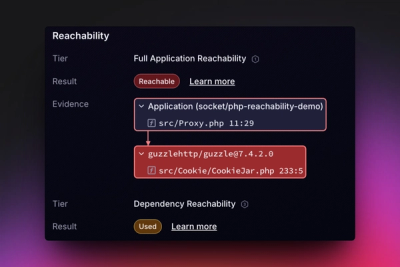
Reachability analysis for PHP is now available in experimental, helping teams identify which vulnerabilities are actually exploitable.