

Company News
AWS Security Hub Adds Socket for Supply Chain Security
Socket is now in the AWS Security Hub Extended plan. Adopt it through AWS, apply committed spend, and block malicious open source packages.
By Feross Aboukhadijeh - Aug 04, 2026
pbirb-mcp
Advanced tools




An MCP server for editing Power BI Report Builder paginated reports (.rdl)
through Claude (Desktop, CLI, or any MCP client). Forty-plus tools cover the
gaps that otherwise force hand-written XML: dataset filters, headers and
footers, body composition, groupings, sorting, row visibility, conditional
expressions, styling, page setup, advanced parameters, and embedded images.
The server speaks JSON-RPC 2.0 over stdio. It opens an .rdl from disk,
mutates it in place via lxml, validates structure, and writes atomically — a
failed save never leaves a half-written report or scrubs the original.
Pre-1.0. The tool surface — tool names, inputSchema, output shapes, error
semantics — is the contract. While on 0.x, MINOR releases may include a
small breaking change with a migration note in
CHANGELOG.md; after v1.0, breaking changes require MAJOR.
See CONTRIBUTING.md for the full bump rules
adapted from SemVer for an MCP tool surface.
Pin to a MINOR while on 0.x (e.g. pbirb-mcp~=0.1) if your prompts
depend on specific tool names or schemas.
The simplest path is uv + PyPI — no clone, no venv, no install step:
uvx pbirb-mcp
uvx fetches the package into a throwaway environment, runs the
pbirb-mcp console script, and exits. The MCP server speaks JSON-RPC
over stdio, so any MCP client (Claude Desktop, Claude Code, etc.) can
spawn it directly.
For local development against this codebase instead:
git clone https://github.com/mafaq229/pbirb-mcp
cd pbirb-mcp
uv venv .venv
uv pip install --python .venv/bin/python -e ".[dev]"
Verify the binary works:
printf '{"jsonrpc":"2.0","id":1,"method":"initialize","params":{}}\n' \
  | .venv/bin/pbirb-mcp
You should see a single JSON-RPC response with protocolVersion,
capabilities.tools, and serverInfo.name = "pbirb-mcp".
Edit ~/Library/Application Support/Claude/claude_desktop_config.json (macOS)
or %APPDATA%\Claude\claude_desktop_config.json (Windows):
{
  "mcpServers": {
    "pbirb": {
      "command": "uvx",
      "args": ["pbirb-mcp"],
      "env": {
        "PBIRB_MCP_LOG_LEVEL": "INFO",
        "PBIRB_MCP_LOG_FILE": "/tmp/pbirb-mcp.log"
      }
    }
  }
}
Restart Claude Desktop. The hammer icon should show pbirb and the 40+ tools
listed below.
For development against a local checkout, swap the args for
["--from", "/absolute/path/to/pbirb-mcp", "pbirb-mcp"] so uvx runs
your working tree instead of the published version.
claude mcp add pbirb -- uvx pbirb-mcp
Or add to .mcp.json at the workspace root:
{
  "mcpServers": {
    "pbirb": {
      "command": "uvx",
      "args": ["pbirb-mcp"]
    }
  }
}
In any chat, ask the model:
Open
~/path/to/some-report.rdland tell me what datasets and parameters it has.
The model should call describe_report, get_datasets, and get_parameters
and summarise the result. If it doesn't, your client probably hasn't loaded
the server — check the client's MCP debug log.
The recommended flow is read first, then edit by name. Every mutating
tool addresses elements by their RDL Name attribute (Tablix name,
Textbox name, ReportParameter name, DataSet name) — never by index.
Indices break across multi-step edits.
A typical session:
You:    Bind the existing report at ~/Reports/sales.rdl to the Finance
        workspace's "FY26 Sales" dataset, change the body DAX to a date-
        ranged query, and add a header with a logo and a parameter line.

Claude: → describe_report(path=…)
        → set_datasource_connection(name="PBIDataset",
              workspace_url="Finance", dataset_name="FY26 Sales")
        → update_dataset_query(dataset_name="MainDataset",
              dax_body="EVALUATE FILTER('Sales',
                'Sales'[OrderDate] >= @DateFrom &&
                'Sales'[OrderDate] <= @DateTo)")
        → add_query_parameter(dataset_name="MainDataset",
              name="DateFrom",
              value_expression="=Parameters!DateFrom.Value")
        → add_query_parameter(dataset_name="MainDataset",
              name="DateTo",
              value_expression="=Parameters!DateTo.Value")
        → add_embedded_image(name="Logo",
              mime_type="image/png", image_path="~/brand/logo.png")
        → set_page_header(height="0.75in",
              print_on_first_page=True, print_on_last_page=True)
        → add_header_image(name="HeaderLogo",
              image_source="Embedded", value="Logo",
              top="0in", left="0in", width="1in", height="0.5in")
        → add_header_textbox(name="DateLine",
              text='="From: " & Parameters!DateFrom.Value & "  To: "
                    & Parameters!DateTo.Value',
              top="0.1in", left="1.2in", width="4in", height="0.25in")
Open the resulting .rdl in Report Builder; the change is visible in the
designer and renders in Preview against the bound dataset.
42 tools, grouped by RDL concern. Every tool takes a path argument
(absolute path to the .rdl); the rest of the schema is in tools/list
output and visible to the LLM at registration time.
The "what's in this report?" tools. Always the first calls when planning a multi-step edit.
| Tool | Returns |
|---|---|
describe_report | Top-level inventory: data sources, datasets, parameters, tablixes, page setup |
get_datasets | Full DAX command text, fields, query parameters, dataset filters |
get_parameters | Report parameters with data type, prompt, and flags (multi-value, hidden, nullable, allow-blank) |
get_tablixes | Tablix layout: columns, row/column groups, sort expressions, filters, visibility |
list_tablix_filters | Filters on a tablix in document order with stable indices |
list_embedded_images | Embedded image names + MIME types |
| Tool | What it edits |
|---|---|
set_datasource_connection | Repoint a <DataSource> at a Power BI XMLA endpoint. DataProvider=SQL (the AS provider id). |
update_dataset_query | Replace <DataSet>/<Query>/<CommandText> with a DAX expression |
add_query_parameter | Append <QueryParameter> (e.g. =Parameters!DateFrom.Value) |
update_query_parameter | Change the value expression of an existing query parameter |
remove_query_parameter | Drop a query parameter (and clean up empty <QueryParameters>) |
| Tool | What it edits |
|---|---|
add_tablix_filter | Append a <Filter>. Operators: Equal, NotEqual, GreaterThan, In, Between, Like, TopN, ... |
remove_tablix_filter | Remove by ordinal index from list_tablix_filters |
add_row_group | Wrap the current row hierarchy in a new outer group + insert a header row |
remove_row_group | Inverse of add_row_group |
set_group_sort | Replace <SortExpressions> on a group |
set_group_visibility | Set <Visibility> on a group's TablixMember |
set_detail_row_visibility | Set <Visibility> on the Details group |
set_row_height | Set <Height> on the Nth body row |
| Tool | What it edits |
|---|---|
set_page_setup | Page dimensions, margins, columns. All fields optional. |
set_page_orientation | Swap PageHeight/PageWidth to match Portrait or Landscape. Idempotent. |
Same set of operations for each region, each accepts named items so follow-up edits don't drift on indices.
| Tool | What it edits |
|---|---|
set_page_header / set_page_footer | Section height + PrintOnFirstPage / PrintOnLastPage |
add_header_textbox / add_footer_textbox | Append a Textbox (static text or =expression) |
add_header_image / add_footer_image | Append an Image (External URL, Embedded name, or Database expression) |
remove_header_item / remove_footer_item | Remove by name; tidies empty <ReportItems> |
| Tool | What it edits |
|---|---|
add_body_textbox | Append a Textbox to <Body>/<ReportItems> |
add_body_image | Append an Image to the body |
remove_body_item | Remove a named Textbox / Image / Tablix from the body |
Single-call inserts of common report items, programmatically built and appended to the body.
| Tool | What it builds |
|---|---|
insert_tablix_from_template | A basic Tablix mirroring the fixture's shape — header row with the column name as a static label, detail row binding to =Fields!<column>.Value. One column per requested field. |
insert_chart_from_template | A basic Column chart: single category axis grouped by category_field, single Y series =Sum(Fields!<value_field>.Value). Change <Type> post-insert (Bar / Line / Pie / etc.). |
| Tool | What it edits |
|---|---|
set_textbox_style | Routes properties to the right nested <Style> node automatically: box-level (BackgroundColor, Border, VerticalAlign), paragraph-level (TextAlign), run-level (FontFamily, FontSize, FontWeight, Color, Format) |
set_alternating_row_color | Zebra-stripe a tablix's detail row with BackgroundColor=IIf(RowNumber(Nothing) Mod 2, "<a>", "<b>") |
| Tool | What it edits |
|---|---|
set_element_visibility | Set <Visibility> on any named ReportItem (Tablix, Textbox, Image, Rectangle, Subreport, Chart). Group / detail-row visibility have their own tools. |
| Tool | What it edits |
|---|---|
set_parameter_available_values | Static <ParameterValues> list (strings or {value, label} dicts) or <DataSetReference> to a lookup dataset |
set_parameter_default_values | Static <Values> list or <DataSetReference> (defaults take ValueField only — defaults are values, not display strings) |
update_parameter_advanced | Toggle the four boolean flags: multi_value, hidden, allow_null (writes <Nullable>), allow_blank |
RDL has no <DependsOn> element — cascading is inferred from
=Parameters!X.Value references in a lookup dataset's <QueryParameters>.
To wire parameter B to depend on parameter A:
set_parameter_available_values(name="B", source="query", query_dataset="LookupB", ...)add_query_parameter(dataset_name="LookupB", name="@A", value_expression="=Parameters!A.Value")Report Builder figures out the dependency graph by parsing those expressions.
| Tool | What it edits |
|---|---|
add_embedded_image | Read a real file off disk, base64-encode it, store under <EmbeddedImages> |
list_embedded_images | Names + MIME types |
remove_embedded_image | Remove by name; tidies empty <EmbeddedImages> |
Reference an embedded image with
add_*_image(image_source="Embedded", value="<image-name>").
set_datasource_connection writes the canonical form:
Data Source=powerbi://api.powerbi.com/v1.0/myorg/<workspace>;Initial Catalog=<dataset>
workspace_url accepts a bare workspace name (Finance) or a full
powerbi:// URL — the tool detects the latter and avoids double-prefixing.
DataProvider is set to SQL (the Analysis Services provider id RDL uses
for PBI XMLA, despite the misleading name).
DAX bodies are accepted verbatim — pbirb-mcp doesn't parse DAX, so the
user (or Report Builder at preview time) is the source of truth for syntax.
Empty bodies are rejected up front because Report Builder loads them but
errors at preview, which is a worse signal than a clear ValueError here.
PBI paginated reports do not carry <CommandType> for DAX (unlike
SSRS where you'd set CommandType=StoredProcedure); these tools never
emit it.
pre-commit is in the [dev] extras. After a fresh checkout:
uv pip install --python .venv/bin/python -e ".[dev]"
.venv/bin/pre-commit install                # one-time — installs the git hook
.venv/bin/pre-commit run --all-files        # one-time — clean any drift
After the hook is installed, every git commit runs ruff format +
ruff check (with --fix) + the fast pytest suite. If lint or tests
fail the commit is aborted; fix and re-stage before retrying.
To run individual hooks ad-hoc:
.venv/bin/pre-commit run ruff --all-files
.venv/bin/pre-commit run ruff-format --all-files
.venv/bin/pre-commit run pytest-fast --all-files
The full config lives in .pre-commit-config.yaml. Ruff settings
(line length, rule selection, per-file ignores) live under
[tool.ruff*] in pyproject.toml.
Power BI Report Builder is a free Microsoft-distributed Windows app:
https://www.microsoft.com/en-us/download/details.aspx?id=105942
Open any .rdl produced by pbirb-mcp directly in Report Builder. The
"opens cleanly with no upgrade prompt" check is the actual integration
test — the unit tests verify schema correctness, but lxml will
round-trip XML that Report Builder's deserialiser still rejects (we hit
this twice in the chart-template work; both fixes are documented in the
git history).
pbirb-mcp/
├── pbirb_mcp_server.py         # Entry point (logging + main())
├── pbirb_mcp/
│   ├── server.py               # JSON-RPC stdio dispatch
│   ├── tools.py                # Tool registry — wires ops into the server
│   ├── core/
│   │   ├── document.py         # RDLDocument: open/save (lxml), atomic write
│   │   ├── xpath.py            # Namespace-aware XPath helpers
│   │   ├── ids.py              # Stable element addressing
│   │   └── schema.py           # Structural + opt-in XSD validation
│   ├── ops/
│   │   ├── reader.py           # describe / get_datasets / get_params / get_tablixes
│   │   ├── datasource.py       # PBI XMLA connection authoring
│   │   ├── dataset.py          # DAX body + query parameters
│   │   ├── tablix.py           # Filters, groupings, sort, visibility, height
│   │   ├── page.py             # Page setup + orientation
│   │   ├── header_footer.py    # Page header / footer authoring
│   │   ├── body.py             # Body textboxes / images / removal
│   │   ├── templates.py        # Chart + tablix snippet builders
│   │   ├── styling.py          # set_textbox_style + alternating row color
│   │   ├── visibility.py       # Element-level visibility
│   │   ├── parameters.py       # Available / default values, advanced flags
│   │   └── embedded_images.py  # Base64 image embedding
│   └── schemas/                # (Empty — drop the official RDL XSD here for opt-in XSD validation)
└── tests/
    ├── fixtures/
    │   └── pbi_paginated_minimal.rdl  # Hand-tuned to match Report Builder's emitted style
    └── test_*.py               # 270+ tests — every commit's tool plus round-trip invariants
xml.etree. Round-trip fidelity is a feature, not
polish. Report Builder reads what's on disk; formatting drift causes
silent corruption.tablix_name + group_name,
not column_index: 2. Indices break across multi-step edits.RDLDocument.save_as writes to <path>.tmp then renames.
A failure mid-write never leaves a half-written report.tests/test_document.py's test_round_trip_byte_identical_to_fixture.
A no-op open → save → reopen produces a byte-identical file.<?xml version="1.0" encoding="utf-8"?> uses double quotes, not
lxml's default single quotes. Fixed in RDLDocument.save_as via a
manual declaration.<Tag /> with a space, not <Tag/>. Fixed via
a post-process regex.rd: prefix
(http://schemas.microsoft.com/SQLServer/reporting/reportdesigner)
carries designer metadata Report Builder relies on. Don't strip it;
preserve prefixes.MustUnderstand="df" on <Report> unless you also
declare xmlns:df=....<ChartCategoryAxes> / <ChartValueAxes> hold <ChartAxis>
children directly — there is no <ChartCategoryAxis> /
<ChartValueAxis> wrapper.<ChartMember> requires a <Label> child, even an empty one.<DataSet><Query><CommandText>EVALUATE ...</CommandText></Query></DataSet>.
No <CommandType> element for DAX (unlike SSRS).Two environment variables control the logger:
| Variable | Default | Purpose |
|---|---|---|
PBIRB_MCP_LOG_LEVEL | WARNING | DEBUG / INFO / WARNING / ERROR |
PBIRB_MCP_LOG_FILE | stderr | Path to a log file; otherwise logs go to stderr (where Claude Desktop captures them in its MCP debug pane) |
PBIRB_MCP_LOG_LEVEL=DEBUG PBIRB_MCP_LOG_FILE=/tmp/pbirb-mcp.log pbirb-mcp
.venv/bin/python -m pytest tests/ -v
The suite is fast (~0.3s for 270+ tests) so re-run on every change.
printf '%s\n' \
  '{"jsonrpc":"2.0","id":1,"method":"initialize","params":{}}' \
  '{"jsonrpc":"2.0","id":2,"method":"tools/list"}' \
  | .venv/bin/pbirb-mcp
For an end-to-end sanity check, drive an actual mutation against a copy of the bundled fixture:
SCRATCH=$(mktemp -d)/r.rdl
cp tests/fixtures/pbi_paginated_minimal.rdl "$SCRATCH"
.venv/bin/python -c "
from pbirb_mcp.ops.dataset import update_dataset_query
update_dataset_query(path='$SCRATCH', dataset_name='MainDataset',
    dax_body=\"EVALUATE TOPN(10, 'Sales')\")
print('Wrote', '$SCRATCH')
"
Open the resulting file in Power BI Report Builder. Manual verification
that an .rdl opens cleanly is the actual integration test — the unit
tests catch schema-level mistakes, but only Report Builder catches
deserialiser nits.
tests/test_*.py.pbirb_mcp/ops/*.py module (or create a
new one).pbirb_mcp/tools.py with a clear description and
strict inputSchema.The commit-by-commit history shows the pattern in practice.
CHANGELOG.md tracks every release in Keep a Changelog format. Releases are also published as GitHub Releases and to PyPI.
Versions follow SemVer adapted for an MCP tool surface — see CONTRIBUTING.md § Versioning.
PRs welcome. CONTRIBUTING.md covers dev setup, the hard rules (tests-first, lxml only, stable IDs, atomic save, byte-identity round-trip, smoke in Report Builder), the SemVer-for-MCP bump table, and the PR review checklist.
Bug reports and tool proposals: please use the issue templates. For security issues, see SECURITY.md. All participants are expected to follow the Code of Conduct.
The existing bethmaloney/rdl-mcp server pioneered the MCP-over-RDL pattern but is scoped to SSRS: column metadata, basic parameter management, stored-procedure swap. Power BI paginated reports use the same RDL 2016 schema as SSRS, but:
MustUnderstand attributes cause
silent corruption or "this report needs to be upgraded" prompts.pbirb-mcp is built around lxml so a no-op edit produces a byte-identical
file, addresses every element by stable name (never index), and treats
"opens cleanly in Report Builder" as the actual integration test.
mcp-name: io.github.mafaq229/pbirb-mcp
FAQs
MCP server for editing Power BI Report Builder paginated reports (RDL)
The pypi package pbirb-mcp receives a total of 24 weekly downloads. As such, pbirb-mcp popularity was classified as not popular.
We found that pbirb-mcp demonstrated a healthy version release cadence and project activity because the last version was released less than a year ago. It has 1 open source maintainer collaborating on the project.
Did you know?

Socket for GitHub automatically highlights issues in each pull request and monitors the health of all your open source dependencies. Discover the contents of your packages and block harmful activity before you install or update your dependencies.
Company News
Socket is now in the AWS Security Hub Extended plan. Adopt it through AWS, apply committed spend, and block malicious open source packages.
Research
/Security News
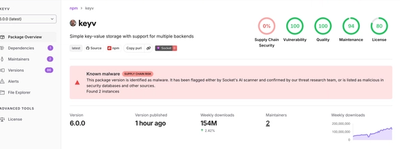
Popular npm packages keyv and cacheable compromised.

Security News
A misconfiguration gave three Anthropic models internet access, and one, believing it was in a simulation, shipped a credential-stealing package to PyPI.