

Company News
AWS Security Hub Adds Socket for Supply Chain Security
Socket is now in the AWS Security Hub Extended plan. Adopt it through AWS, apply committed spend, and block malicious open source packages.
By Feross Aboukhadijeh - Aug 04, 2026
pbix-lineage
Advanced tools
Universal lineage graph for Power BI (.pbix) files, from physical source to report display.
Universal lineage graph for Power BI (.pbix) files: from physical source to the field displayed in a report visual.
source (HTTP, OData, SQL, file...) --> Power Query (M)
    --> column / calculated column --> measure (DAX)
        --> field displayed in a report visual
The graph is a standard networkx.DiGraph, natively bidirectional: trace a visual back to its source (upstream), or list everything a source feeds (downstream).
pbixray (used here) extracts the data model (tables, DAX, Power Query, schema) but says nothing about where each column or measure ends up displayed — that lives in a separate, undocumented part of the file (Report/Layout). pbix-lineage connects both into one traversable graph.
pip install pbix-lineage
# or
uv add pbix-lineage
from pbix_lineage import LineageGraphBuilder, upstream, downstream, print_tree, find_nodes

graph = LineageGraphBuilder().build("my_report.pbix")

find_nodes(graph, "customer_name")
# -> ['column::DIM_CUSTOMER::customer_name']

print_tree(graph, "visual_field::my_report.pbix::Page1::16::customer_name", direction="upstream")
print_tree(graph, "source::odata::example.com/odata/", direction="downstream")
from pbix_lineage import export_graphml, export_nodes_csv, export_edges_csv, graph_summary

graph_summary(graph)                       # {'query': 70, 'column': 183, ...}
export_graphml(graph, "lineage.graphml")   # opens in Gephi / yEd
export_nodes_csv(graph, "nodes.csv")
export_edges_csv(graph, "edges.csv")
Source detection (pbix_lineage.sources) relies only on native M function names (Web.Contents, OData.Feed, Sql.Database, Folder.Files, SharePoint.Files, Excel.Workbook, AnalysisServices.Database, ...) — never a specific system or domain. Adding a new source type is one config entry in MFunctionSourceDetector.DEFAULT_PATTERNS, no other code touched.
The package also exposes a FastAPI app, mounted as an MCP server via FastMCP (FastMCP.from_fastapi): every route becomes an MCP tool automatically.
uv sync --extra api
uv run pbix-lineage    # starts on http://127.0.0.1:8080
POST /graphs, /search, /upstream, /downstream, /tree, /export, GET /graphs.http://127.0.0.1:8080/mcp/: same operations as tools (build_graph, search_nodes, get_upstream, get_downstream, get_lineage_tree, export_graph, list_loaded_graphs), plus a lineage_guidance prompt.PBIX_LINEAGE_HOST (default 0.0.0.0), PBIX_LINEAGE_PORT (default 8080).Each .pbix is parsed once and cached in memory (LineageGraphCache, framework-agnostic).
server.json describes this server for registry.modelcontextprotocol.io. After replacing votre-org with your GitHub account everywhere:
uv build && uv publish          # publish the package to PyPI first
mcp-publisher login github
mcp-publisher publish --dry-run
mcp-publisher publish
The registry verifies PyPI ownership via the <!-- mcp-name: ... --> marker at the top of this README. The name in server.json, this marker, and your authenticated GitHub namespace must all match.
| Module | Responsibility |
|---|---|
models.py | Node/edge types and shared data structures |
sources.py | Physical source detection (agnostic, configurable) |
pbix_model.py | Adapter isolating the rest of the code frompbixray |
dax.py | DAX reference parsing (Table[Field] / [Field]) |
mquery.py | Dependencies between Power Query queries (table-level) |
layout.py | Parsing of the internalReport/Layout format |
graph_builder.py | Orchestrator: builds thenetworkx.DiGraph |
navigation.py | Upstream/downstream traversal, search, export |
api/schemas.py | Pydantic request/response models |
api/service.py | Graph cache, framework-agnostic |
api/app.py | FastAPI app + MCP mount (FastMCP) |
let ... in query.http) instead of the exact consumer connector (odata, etc.).[MeasureName]) are resolved same-table first, then globally; homonyms across tables resolve to the first match.uv sync --extra dev
uv run pytest # BDD tests (pytest-bdd) under tests/features/*.feature
uv build # produces dist/*.whl and dist/*.tar.gz
MIT
FAQs
Universal lineage graph for Power BI (.pbix) files, from physical source to report display.
We found that pbix-lineage demonstrated a healthy version release cadence and project activity because the last version was released less than a year ago. It has 1 open source maintainer collaborating on the project.
Did you know?

Socket for GitHub automatically highlights issues in each pull request and monitors the health of all your open source dependencies. Discover the contents of your packages and block harmful activity before you install or update your dependencies.
Company News
Socket is now in the AWS Security Hub Extended plan. Adopt it through AWS, apply committed spend, and block malicious open source packages.
Research
/Security News
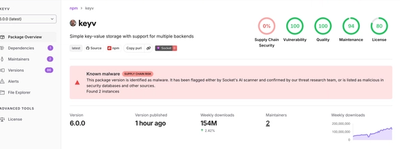
Popular npm packages keyv and cacheable compromised.

Security News
A misconfiguration gave three Anthropic models internet access, and one, believing it was in a simulation, shipped a credential-stealing package to PyPI.