

Product
PHP and Composer Support Is Now in Beta
Socket’s PHP and Composer support is now in Beta for all customers, with PHP reachability analysis generally available.
By Trevor Norris, Benjamin Barslev - Aug 21, 2026
polypack-mcp
Advanced tools

Persistent, adaptive memory for MCP clients.
An MCP server that exposes Polypack as persistent adaptive memory. MCP-specific tools live here; the database remains an independent dependency.
The simplest installation is from PyPI:
python3 -m pip install 'polypack-mcp[polypack]'
For one MCP client, use the default stdio server configuration. For Claude and Codex sharing the same durable memory, install once and create a long-running user service:
polypack-mcp setup --store ~/.local/share/polypack-mcp
This starts a stateless Streamable HTTP server at http://127.0.0.1:8765/mcp/, restarts it after a
failure, and prints client configuration snippets. The setup command uses
systemd --user; on systems without systemd, start the server directly:
polypack-mcp --transport streamable-http --port 8765 --store ~/.local/share/polypack-mcp
In shared Streamable HTTP mode, configure both clients with the URL. Do not configure them
with a command and --store, since that starts two processes competing for
the same durable store.
Codex (~/.codex/config.toml):
[mcp_servers.polypack]
  url = "http://127.0.0.1:8765/mcp/"
Claude Desktop:
{
  "mcpServers": {
    "polypack": { "url": "http://127.0.0.1:8765/mcp/" }
  }
}
The Debian package installs and starts a system-level polypack-mcp service
automatically. It runs as the dedicated polypack user, stores data in
/var/lib/polypack-mcp, and exposes the same local Streamable HTTP endpoint:
sudo apt install ./polypack-mcp_<version>_amd64.deb
After installation, point Claude and Codex at
http://127.0.0.1:8765/mcp/. The default port can be changed in
/etc/default/polypack-mcp, followed by a service restart. The service can be
managed with:
sudo systemctl status polypack-mcp
sudo systemctl restart polypack-mcp
The PyPI installation remains user-managed and uses polypack-mcp setup to
create a per-user service instead.
RPM-based distributions can install the matching .rpm asset from the
GitHub release:
sudo dnf install ./polypack-mcp-<version>-1.x86_64.rpm
The RPM package provides the same systemd service, store location, localhost Streamable HTTP endpoint, and Python 3.12 requirement as the Debian package.
pip install -e '.[polypack]'
polypack-mcp --store ./polypack-data
The server exposes nine focused tools: memory_store, memory_recall,
memory_context, memory_feedback, memory_suppress, memory_supersede,
memory_consolidate, memory_link, and graph_query. It also publishes context,
active-memory, schema, stats, and agent workflow guidance resources under
polypack://.
Memory classes are entity, episodic, procedural, and semantic. Store
project or user preferences as procedural memories; preference is not a
separate memory class.
When using a durable Polypack store, mutating operations checkpoint immediately and the server flushes the store during shutdown.
Retrieval tools return {items, metadata}. Metadata includes candidate and
excluded counts, context matches, score components, fallback behavior, the
retrieval version, and selection statistics. memory_context uses estimated
tokens (ceil(content characters / 4), minimum one) as its token_budget.
An item is never returned if it would exceed the remaining budget; budgets less
than or equal to zero are rejected. Context is a soft preference: matching
memories are preferred and unscoped global memories may be used as fallback.
Pass strict_context: true for isolation. An empty isolated result reports
reason: "no_context_match" and the searched context.
memory_recall can optionally hydrate related graph memories in the same call:
{
  "query": "identity cache fix",
  "context": "cross-agent",
  "include_neighbors": true,
  "edge_types": ["RESPONDS_TO"],
  "depth": 2,
  "neighbor_limit": 3,
  "limit": 20,
  "token_budget": 4000
}
Neighbor traversal is opt-in and bounded. limit caps the total response and
neighbor_limit caps hydrated neighbors; metadata reports
moreNeighborsAvailable when additional eligible neighbors were found. Neighbor
items include their distance and connecting relationship metadata. Use
memory_link with the default
RESPONDS_TO relationship for handoffs, reviews, and fixes that address an
earlier memory. Graph edges are authoritative for relationships; use
graph_query(operation="relationship_diagnostics") to find legacy
provenance.responds_to values that are not backed by edges. See
polypack://help/workflow for the agent-facing workflow.
Feedback is activation feedback: useful=true reinforces a memory and
useful=false provides negative retrieval feedback. Responses expose activation
before and after plus whether learned weights changed. Supersession and
consolidation materialize SUPERSEDES, SUPERSEDED_BY, and
CONSOLIDATED_FROM graph edges.
Pass --store to open a durable Polypack directory. Without it, the server uses
the in-memory reference backend, which is convenient for smoke tests.
The polypack extra requires polypack-db>=3.3.1 and uses its native
ActivationEngine.working_memory selector for context assembly.
pip install -e '.[dev]'
pytest
The test suite includes an MCP client/server protocol smoke test covering tool discovery, memory storage, recall, and resource reads.
FAQs
MCP server exposing Polypack as persistent adaptive memory
We found that polypack-mcp demonstrated a healthy version release cadence and project activity because the last version was released less than a year ago. It has 1 open source maintainer collaborating on the project.
Product
Socket’s PHP and Composer support is now in Beta for all customers, with PHP reachability analysis generally available.
Product
Socket is bringing experimental protection to Firefox, scanning 97,000+ extensions in Mozilla's official directory for malware and risky updates.
Research
/Security News
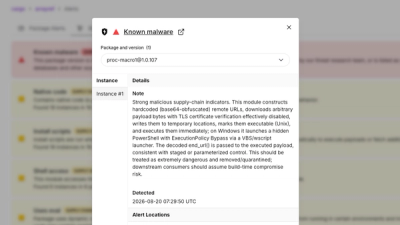
Three compromised Rust crates pulled in a malicious dependency that downloaded and executed cross-platform malware during Cargo builds.