
Research
/Security News
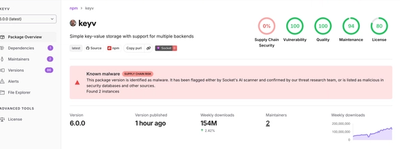
Popular npm Packages in the keyv and Cacheable Namespaces Compromised in Active Supply Chain Attack
Popular npm packages keyv and cacheable compromised.
By Socket Research Team - Aug 04, 2026
preprint-fulltext
Advanced tools
CLI + MCP toolkit that retrieves full text of bioRxiv/medRxiv/arXiv preprints as structured sections — grounding LLM/agent scientific reasoning and deep research — and builds embedding-ready corpora.
Retrieve the full text of bioRxiv / medRxiv / arXiv preprints as clean, structured, embedding-ready data — from a CLI, a Python library, or an MCP server.
preprint-fulltext turns a DOI (or a search) into structured sections
(abstract / introduction / methods / results / discussion), a single JSON/Markdown
document, or a chunked JSONL/Parquet corpus ready for embeddings and RAG. openRxiv
text-and-data-mining (TDM) compliance is enforced structurally, not left to the user.
"Embedding-ready" means the output is clean, section-aware, token-bounded chunks — ready to feed to your embedding model. Computing embeddings is an optional last step you own; this tool does not bundle an embedding model.
Preprint full text is scattered across incompatible channels: Europe PMC serves JATS
XML for the open-access subset, the openRxiv S3 buckets hold the authoritative
.meca corpus (requester-pays), OpenAlex is a catalog with n-gram-only full-text
search, and the bioRxiv/medRxiv websites render HTML. preprint-fulltext unifies
them behind one canonical data model and one shared JATS parser, so you get the
same structured output no matter where a document came from.
SKILL.md) that need to pull a preprint's
full text or search the literature mid-task.Language models and agents reason far more reliably over a paper's methods and results
than over its abstract alone — most scientific claims, protocols, quantities, and caveats
live in the body. preprint-fulltext gives Claude, Codex, and other agents that body as
clean, section-labeled, provenance- and license-tagged text, which is the substrate for
grounded scientific reasoning and deep research:
Because every Section/Chunk carries its kind (methods / results / …), source, and
license, an agent can cite precisely (which section of which paper/version) and stay
within-license while it reasons. Full text is retrieval, not memorization: the model
grounds its reasoning in the primary source instead of recalling a possibly-stale summary.
get <id> — one preprint's full text as structured JSON or Markdown. bioRxiv/
medRxiv route Europe PMC → S3 (opt-in HTML fallback); arXiv ids route to arXiv's
LaTeXML full text (native HTML → ar5iv). Latest version by default; --version selects one.search / discover — keyword, title, abstract, or author search across Europe PMC,
OpenAlex, and arXiv; topic/category/date discovery.ingest — resumable, incremental bulk ingestion from the openRxiv S3 buckets
into a chunked corpus (JSONL or Parquet) with a sidecar manifest.pip install preprint-fulltext # CLI + Python library + MCP server
pip install "preprint-fulltext[parquet,openalex]" # + Parquet output, pyalex
The MCP server is built in — no extra install and no third-party MCP framework. It's a
small, self-contained JSON-RPC 2.0 stdio server, so preprint-fulltext-mcp works out of the
box with only the core dependencies.
Set a contact email for the Europe PMC / OpenAlex polite pools (recommended), and an OpenAlex API key if you use OpenAlex (required by OpenAlex since 2026-02-13):
export CONTACT_EMAIL="you@example.org"
export OPENALEX_API_KEY="..."            # only needed for OpenAlex discover/search
# Structured full text for one preprint (Europe PMC → S3 router)
preprint-fulltext get 10.1101/2024.01.15.575000 --markdown

# Accepts a DOI, a doi.org URL, or a bioRxiv/medRxiv content URL
preprint-fulltext get https://www.biorxiv.org/content/10.64898/2026.06.13.731750v1.full --html --markdown

# Versions: the DOI resolves to the latest version by default; --version selects one
preprint-fulltext get 10.64898/2026.01.29.702557 --version 1 --source html --markdown

# arXiv: id, arxiv.org URL, or 10.48550/arXiv.* DOI — routed to arXiv LaTeXML full text
preprint-fulltext get arXiv:1706.03762 --markdown
preprint-fulltext get https://arxiv.org/abs/2401.10515 --markdown

# Search: keyword, title, or author (add --source arxiv to search arXiv)
preprint-fulltext search "cortical interneurons" -n 20
preprint-fulltext search "Fezf2" --field title
preprint-fulltext search "Min Dai" --field author
preprint-fulltext search "diffusion model" --field title --source arxiv

# Discover by topic + date window (OpenAlex)
preprint-fulltext discover --query "spatial transcriptomics" --since 2025-01 -n 100

# Bulk corpus from S3 (requester-pays; needs AWS credentials)
preprint-fulltext ingest corpus.jsonl --source s3 --server biorxiv --since 2025-06

# A free, no-AWS corpus of the open-access (CC) subset via Europe PMC
preprint-fulltext ingest corpus.jsonl --source europepmc --query "long covid"
get emits a FullText document (JSON) or Markdown (--markdown). search /
discover stream one SearchHit per line (JSONL). ingest writes one Chunk per
line plus a <out>_manifest.jsonl audit/resume sidecar.
1. Read one paper's methods/results as text.
preprint-fulltext get 10.64898/2026.01.29.702557 --markdown > paper.md
# -> # Title / ## Abstract / ## Introduction / ## Methods / ## Results / ## Discussion
2. Build an embedding-ready corpus on a topic (free, no AWS).
# CC/open-access subset via Europe PMC — one Chunk per JSONL line
preprint-fulltext ingest cortex.jsonl --source europepmc --query "cortical interneurons" -n 500
# cortex.jsonl          -> {doi, version, chunk_id, section_kind, text, token_count, license, ...}
# cortex_manifest.jsonl -> one row per preprint (doi, version, license, n_chunks, status)
3. Build the complete corpus for a month from S3 (requester-pays).
export AWS_PROFILE=...           # needs AWS credentials; ~$0.09/GB
preprint-fulltext ingest 2025-06.jsonl --source s3 --server both --since 2025-06 --format parquet
# resumable: rerun after an interruption and it skips finished preprints (no duplicates)
4. Find papers by author or title, then fetch.
preprint-fulltext search "Min Dai" --field author -n 20 > hits.jsonl
preprint-fulltext get "$(head -1 hits.jsonl | python -c 'import sys,json;print(json.load(sys.stdin)["doi"])')" --markdown
5. Give a coding agent literature access — run preprint-fulltext-mcp and point your
agent at it (see skills/preprint-fulltext/SKILL.md).
from preprint_fulltext.pipeline.router import Router

result = Router().get_fulltext("10.1101/2024.01.15.575000")
if result.fulltext:
    for section in result.fulltext.sections:
        print(section.kind, section.title)

from preprint_fulltext.core.chunk import chunk_fulltext
chunks = chunk_fulltext(result.fulltext)   # embedding-ready Chunk records
preprint-fulltext-mcp # stdio MCP server
mcp-name: io.github.genecell/preprint-fulltext
Exposes search_preprints, get_fulltext, get_metadata, and resolve. Bulk
ingestion is intentionally not an MCP tool (it is long-running and incurs
requester-pays cost). See skills/preprint-fulltext/SKILL.md
for agent-facing usage.
| Verb | Default source | Notes |
|---|---|---|
get | auto (Europe PMC → S3, or arXiv) | bioRxiv/medRxiv: EPMC (CC/OA subset) → S3 (complete, needs AWS creds), --html opt-in fallback. arXiv ids → arXiv LaTeXML full text (native HTML → ar5iv). |
search | Europe PMC | Real relevance ranking; --source openalex|arxiv. |
discover | OpenAlex | 250M+ works, OA locations, topic/date; --source arxiv. |
ingest | S3 (or Europe PMC) | S3 = complete corpus; Europe PMC = free CC subset. arXiv bulk is out of scope (use arXiv's own S3 LaTeX bucket). |
Via environment variables (prefixed PREPRINT_FULLTEXT_ or the bare names below),
a .env file, or a preprint-fulltext.toml:
| Setting | Default | Purpose |
|---|---|---|
CONTACT_EMAIL | – | Polite-pool identity for Europe PMC / OpenAlex |
OPENALEX_API_KEY | – | Required by OpenAlex since 2026-02-13 |
AWS_REGION | us-east-1 | Region for the requester-pays openRxiv buckets |
PREPRINT_FULLTEXT_CACHE_DIR | ~/.cache/preprint-fulltext | Content-addressed cache |
PREPRINT_FULLTEXT_CHUNK_TOKENS | 512 | Max tokens per chunk |
PREPRINT_FULLTEXT_CHUNK_OVERLAP | 64 | Token overlap within a section |
Corpora are for the operator's own text/data mining under the openRxiv TDM terms.
preprint-fulltext does not re-host or redistribute preprint full text. Every
FullText/Chunk carries its license; the export gate has two modes:
--redistribution): works whose license permits redistribution
pass unchanged; all others are degraded to a link-back stub (metadata + URL,
no body text). Unknown/ambiguous licenses are treated as non-redistributable.pip install -e ".[dev]"
pytest # offline suite (HTTP mocked with respx, S3 with moto)
ruff check preprint_fulltext/
Live tests are opt-in (they hit the real public APIs — Europe PMC, arXiv, and the bioRxiv/medRxiv JSON API):
PREPRINT_FULLTEXT_LIVE=1 CONTACT_EMAIL=you@example.org pytest -m live   # EPMC / arXiv / medRxiv / versions
PREPRINT_FULLTEXT_LIVE_S3=1 pytest -m live_s3    # requester-pays S3 (small; needs AWS creds)
The same live smoke runs in CI on demand (Actions → live-smoke) and weekly, to catch
upstream API drift; the default test workflow stays fully offline.
Agent docs (AGENTS.md, llms.txt, .cursor/rules/…, .github/copilot-instructions.md)
are generated from skills/preprint-fulltext/SKILL.md:
python scripts/build_agent_docs.py
Min Dai — dai@broadinstitute.org (Gord Fishell Lab, Harvard Medical School / Broad Institute). Issues and pull requests welcome at https://github.com/genecell/preprint-fulltext.
BSD-3-Clause (see LICENSE). This covers the software only —
retrieved preprint content remains under its author-selected license.
FAQs
CLI + MCP toolkit that retrieves full text of bioRxiv/medRxiv/arXiv preprints as structured sections — grounding LLM/agent scientific reasoning and deep research — and builds embedding-ready corpora.
We found that preprint-fulltext demonstrated a healthy version release cadence and project activity because the last version was released less than a year ago. It has 1 open source maintainer collaborating on the project.
Did you know?

Socket for GitHub automatically highlights issues in each pull request and monitors the health of all your open source dependencies. Discover the contents of your packages and block harmful activity before you install or update your dependencies.
Research
/Security News
Popular npm packages keyv and cacheable compromised.

Security News
A misconfiguration gave three Anthropic models internet access, and one, believing it was in a simulation, shipped a credential-stealing package to PyPI.

Security News
/Company News
Socket has joined the new Composer and Packagist sponsorship program as a launch sponsor, supporting the team that keeps PHP's package ecosystem secure.