
Research
/Security News
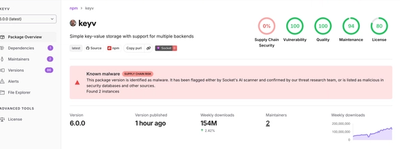
Popular npm Packages in the keyv and Cacheable Namespaces Compromised in Active Supply Chain Attack
Popular npm packages keyv and cacheable compromised.
By Socket Research Team - Aug 04, 2026
pronounce-mcp
Advanced tools
MCP server for pronounce.renlab.ai — look up how engineers actually pronounce project / product / jargon names from any MCP-aware client.
mcp-name: io.github.anzy-renlab-ai/pronounce
An MCP server that exposes the community pronunciation dictionary at https://pronounce.renlab.ai as tools any MCP-aware client (Claude Desktop, Continue, Zed, ...) can call.
When a user asks an LLM "how do you pronounce kubectl?", the client invokes pronounce("kubectl") and gets back the canonical reading, IPA, alternate readings (if contested), source citation, and a link to the human-readable page — without the LLM having to hallucinate.
| Tool | What it does |
|---|---|
pronounce(word) | Look up a single word. Returns IPA, respelling, alts, source URL, confidence, category, notes. |
search_pronunciations(query, limit) | Find entries by partial match on word or category. |
list_pronunciations(category) | List all entries, optionally filtered by category (product, cli-tool, acronym, ...). |
mcp-server/npm/)A zero-dependency Node (>= 18) implementation of the same server lives in mcp-server/npm/. Once published it will be a one-liner in any MCP client:
{
  "mcpServers": {
    "pronounce": {
      "command": "npx",
      "args": ["-y", "pronounce-mcp"]
    }
  }
}
Until it lands on npm, run it straight from a checkout: node mcp-server/npm/index.js.
// ~/Library/Application Support/Claude/claude_desktop_config.json
{
  "mcpServers": {
    "pronounce": {
      "command": "uvx",
      "args": ["pronounce-mcp"]
    }
  }
}
Or with pipx:
pipx install pronounce-mcp
{
  "mcpServers": {
    "pronounce": { "command": "pronounce-mcp" }
  }
}
Restart Claude Desktop. Ask any pronunciation question:
"How do you pronounce kubectl?"
Claude calls pronounce("kubectl") → gets {respelling_us: "koob control", ipa: "/ˈkuːb kənˌtroʊl/", source_label: "Kelsey Hightower (KubeCon)", url: "https://pronounce.renlab.ai/word/kubectl", ...} → answers with the canonical reading plus the citation.
LLMs are bad at pronunciation by default. They've seen the spelling and the IPA, but they confabulate when asked about contested words (GIF? jif or gif?) or project names with non-obvious readings (kubectl is "koob-control", not "kub-cuttle"; Pinia is "pee-nya"; Vite is "veet").
This MCP server gives the LLM a deterministic source: the dictionary is community-maintained, source-citing, and updated continuously. Every contested word has both readings with the rationale. Every "creator-clarified" reading links to where the creator settled it.
The dictionary is at https://github.com/anzy-renlab-ai/pronounce/blob/main/data/pronunciations.tsv — 1,600+ entries (and growing) across cloud / DevOps, frontend & backend frameworks, AI/ML platforms and research, databases, languages, editors, companies, programmer jargon, and acronyms.
Each entry has 10 columns: word | ipa | respelling_us | alt_ipa | alt_respelling_us | source_url | source_label | category | confidence | notes.
confidence is one of: creator-clarified (source URL documents a creator quote), community-consensus (widely used but no single citable source), or contested (multiple readings in active use).
MIT.
FAQs
MCP server for pronounce.renlab.ai — look up how engineers actually pronounce project / product / jargon names from any MCP-aware client.
We found that pronounce-mcp demonstrated a healthy version release cadence and project activity because the last version was released less than a year ago. It has 1 open source maintainer collaborating on the project.
Did you know?

Socket for GitHub automatically highlights issues in each pull request and monitors the health of all your open source dependencies. Discover the contents of your packages and block harmful activity before you install or update your dependencies.
Research
/Security News
Popular npm packages keyv and cacheable compromised.

Security News
A misconfiguration gave three Anthropic models internet access, and one, believing it was in a simulation, shipped a credential-stealing package to PyPI.

Security News
/Company News
Socket has joined the new Composer and Packagist sponsorship program as a launch sponsor, supporting the team that keeps PHP's package ecosystem secure.