

Product
PHP and Composer Support Is Now in Beta
Socket’s PHP and Composer support is now in Beta for all customers, with PHP reachability analysis generally available.
By Trevor Norris, Benjamin Barslev - Aug 21, 2026
rai-governance-platform
Advanced tools
ResponsibleAI — Enterprise AI Governance Platform: trust scoring, bias detection, hallucination detection, guardrails, compliance (NIST AI RMF / EU AI Act / ISO 42001), cost intelligence, drift monitoring




WhitePact — an independent runtime authority, governance, and assurance layer for autonomous systems: a five-way governance decision engine (ALLOW / ALLOW_WITH_REDACTION / REQUIRE_APPROVAL / DENY / QUARANTINE), trust scoring, bias detection, guardrails, hallucination detection, compliance mapping (NIST AI RMF / EU AI Act / ISO 42001), cost intelligence, drift monitoring, a public Trust Index / leaderboard / AI Incident Database, and an MCP server (27 tools, 20 resources) with LangChain, LangGraph, and Google ADK trust-gate integrations.
┌──────────────────────────────────────────────────────────────────────────────┐
│ WhitePact v1.2.3 │
│ │
│ ┌──────────────┐ ┌─────────────┐ ┌──────────────┐ ┌──────────────────┐ │
│ │ Governance │ │ Trust Score │ │ Compliance │ │ Guardrails │ │
│ │ 5-way decide │ │ 6-dim A–F │ │ NIST/EU/ISO │ │ PII + Tox │ │
│ └──────────────┘ └─────────────┘ └──────────────┘ └──────────────────┘ │
│ ┌──────────────┐ ┌─────────────┐ ┌──────────────┐ ┌──────────────────┐ │
│ │ Hallucination│ │ Cost Intel │ │ Red Team │ │ Drift Monitor │ │
│ │ Self-consist.│ │ Route+Budget│ │ 10 attacks │ │ Alerts+Trend │ │
│ └──────────────┘ └─────────────┘ └──────────────┘ └──────────────────┘ │
│ ┌──────────────┐ ┌─────────────┐ ┌──────────────┐ ┌──────────────────┐ │
│ │ AI Passport │ │ BiasBuster │ │ PrivacyLabel │ │ MCP Server │ │
│ │ SHA-256 cert │ │ 6 probes+CI │ │ Federated │ │ 27 tools/HTTP │ │
│ └──────────────┘ └─────────────┘ └──────────────┘ └──────────────────┘ │
│ ┌──────────────────────────────────────────────────────────────────────────┐ │
│ │ Governance Dashboard — FastAPI · Per-org rate limit · Alembic · OTEL │ │
│ └──────────────────────────────────────────────────────────────────────────┘ │
└──────────────────────────────────────────────────────────────────────────────┘
Every team deploying AI in production faces the same gap: no unified way to prove a model — or an autonomous agent's actions — is safe, fair, compliant, and accountable. Audits are manual, bias is discovered in production, compliance is a spreadsheet, an agent's tool calls go ungoverned, and nobody knows what the LLM bill will be next month.
WhitePact gives you one platform — a REST API, a Python SDK, an MCP server, and a live dashboard — that covers the full governance lifecycle:
| Problem | Module | Output |
|---|---|---|
| Should this agent action be allowed, redacted, held for approval, denied, or quarantined? | WhitePactRuntimeGateway (governance core) | A five-way GovernanceDecision, deterministic, no LLM call in the decision path |
| Is this model trustworthy? | TrustScoreEngine | 0–100 score, A–F grade, risk level |
| Does it comply with regulations? | ComplianceEngine | NIST AI RMF, EU AI Act tier, ISO 42001 |
| Is it exposing PII? | GuardrailsEngine | Block / redact with audit log |
| Is it hallucinating? | HallucinationDetector | Risk score, unsupported claims |
| Can it be attacked? | RedTeamSimulator | 10 vectors, CVE IDs, safe-refusal rate |
| How much is it costing? | CostTracker + ModelRouter | Per-model USD, routing to cheapest viable model |
| Is it getting worse over time? | TrustDriftMonitor | 7/30-day trend, severity alerts |
| Is it biased? | BiasBuster | 6 demographic probes, CI gate |
| Is this data labeled privately? | PrivacyLabel | Federated DP labels, never leaves device |
| Is this media real? | DeepfakeDetector | Ensemble confidence, method detected |
| Can I trust a third-party MCP server before connecting to it? | SupplyChainScanner | VERIFIED_FACT / INFERRED_SIGNAL / UNKNOWN verdicts — typosquat, description-content, known-incident checks |
| Is there a tamper-evident record of every governance decision? | EvidenceRepository | Hash-chained EvidenceRecord, per-org, verify_chain() |
| Does a risky action get a human in the loop? | ApprovalRepository | Race-safe PENDING → APPROVED/DENIED workflow |
| How does this model rank against others, independently? | Public Leaderboard | Cross-model trust ranking from actually calling each model's API, not self-reported |
| Can I cite and verify a trust score anywhere? | Trust Index | Free self-assessed or human-reviewed certified passport, verifiable at /verify/{id}, embeddable badge |
| Has this AI system failed publicly before? | AI Incident Database | Crowd-reported, moderator-reviewed, hash-chained public registry |
| Should my agent trust this third-party tool before calling it? | rai_check_trust + LangChain/LangGraph/ADK integrations | Free lookup, plus a real block/pause gate in-agent |
| Can any MCP client govern every AI call? | MCP Server | 27 governance tools over stdio, Streamable HTTP, or legacy HTTP+SSE |
# Governance platform + REST API
pip install "rai-governance-platform[dashboard]"

# With PostgreSQL support
pip install "rai-governance-platform[dashboard,postgres]"

# With Redis + OpenTelemetry
pip install "rai-governance-platform[dashboard,redis,telemetry]"

# With LLM providers
pip install "rai-governance-platform[dashboard,openai,anthropic]"

# Everything
pip install "rai-governance-platform[all]"
The published PyPI package name (rai-governance-platform) and the import
name (responsibleai) predate the WhitePact rename and are kept as-is —
see MIGRATION_WHITEPACT_V2.md Section 3 for why an alias package
(whitepact) was added instead of renaming the published package outright.
# Start the governance dashboard
pip install "rai-governance-platform[dashboard]"
uvicorn responsibleai.dashboard.app:app --port 8765

# Evaluate a model (no LLM key needed — supply your own scores)
curl -X POST http://localhost:8765/api/evaluate \
  -H "Content-Type: application/json" \
  -d '{
    "model_name": "gpt-4o",
    "provider": "openai",
    "fairness": 0.80,
    "privacy": 0.85,
    "security": 0.82,
    "robustness": 0.78,
    "compliance": 0.90,
    "authenticity": 0.88
  }'
{
  "trust_score": { "trust_score": 83.65, "grade": "B", "risk": "LOW" },
  "compliance": { "overall_score": 80.5, "eu_ai_act_tier": "limited_risk", "violations": 0 },
  "passport_id": "rai-a3f7c2b1",
  "passport_hash": "4d8e1f2a9c3b7e6d...",
  "drift_alert": null
}
Open http://localhost:8765 for the live dashboard and
http://localhost:8765/api/docs for interactive API docs.
src/responsibleai/governance/ (see SPEC.md Sections 4-8 for the full
architecture contract) is a deterministic runtime authority sitting in front
of agent tool calls:
from responsibleai.governance import WhitePactRuntimeGateway, ActionRequest, AuthorityContext

gateway = WhitePactRuntimeGateway()
result = gateway.evaluate(
    action=ActionRequest(tool_name="rai_scan", arguments={"text": "..."}),
    authority=AuthorityContext(org_id="acme", agent_id="agent-1"),
)
print(result.decision)  # GovernanceDecision.ALLOW | ALLOW_WITH_REDACTION | REQUIRE_APPROVAL | DENY | QUARANTINE
governance/risk.py) — every MCP tool is classified
against a hardcoded, drift-tested table, not inferred at call time.governance/policy.py) — first-match-wins rules with
ALLOW / DENY / REQUIRE_APPROVAL effects.governance/evidence.py) — every decision is written to a
per-org, hash-chained EvidenceRecord; verify_chain() detects tampering.
Raw argument values are never stored, only field-name keys.governance/approval.py) — REQUIRE_APPROVAL
decisions queue a real, race-safe ApprovalRequest with a resolution API,
not just a log line.src/responsibleai/supplychain/) — before an
agent trusts a third-party MCP server or tool, SupplyChainScanner returns
one of three explicit verdicts (VERIFIED_FACT / INFERRED_SIGNAL /
UNKNOWN) — never a single opaque trust score — from typosquat detection,
tool-description scanning, and known-incident cross-reference.integrations/identity_bridge.py) — maps Entra ID,
Google Workspace, Okta, and AWS (Cognito / IAM Identity Center) ID token
claims into IdentityContext, plus map_groups_to_authority() to turn
IdP group membership into a granted-action-types AuthorityContext. See
MACHINE_AUTHORITY_V1.md's Identity Bridge section for exactly what's
verified (claim-shape correctness against each provider's public docs)
versus not (live-tenant testing, Graph/Admin-SDK group-name resolution,
AWS's non-JWT SigV4 path).No governance decision is LLM-based; see
DETERMINISTIC_VS_PROBABILISTIC.md for why.
See it end-to-end: examples/08_whitepact_enterprise_scenario.py runs a
full scenario (an org onboarding an autonomous finance agent) through all
eight machine-authority invariants — ceiling, delegation, attenuation,
approval quorum, workflow composition, autonomy budget, memory firewall,
evidence bundle — against real code, no API keys required:
python examples/08_whitepact_enterprise_scenario.py
The MCP (Model Context Protocol) server exposes WhitePact as 27 tools and
20 resources (10 canonical resource URIs, dual-advertised under both
whitepact:// and rai:// schemes — see MIGRATION_WHITEPACT_V2.md) to any
MCP-compatible client — Claude Code, Claude Desktop, Cursor, Windsurf, or your
own agent runtime. Three transports are supported: stdio, Streamable HTTP
(/mcp, current MCP spec), and legacy HTTP+SSE (/sse + /messages/, kept
for older clients). When a team's client points at this server, every AI
interaction is automatically governed — five-way governance decisions, trust
scoring, guardrails, compliance checks (NIST AI RMF / EU AI Act / ISO 42001),
bias evaluation, drift detection, cost tracking, and hash-chained audit
evidence run on any call without code changes.
# Install
pip install "rai-governance-platform[dashboard,mcp]"

# Start the REST API (MCP tools call it internally)
RAI_DB_PATH=/var/lib/rai/governance.db \
RAI_API_KEYS=your-key-here \
uvicorn responsibleai.dashboard.app:app --host 127.0.0.1 --port 8765 &

# Add to Claude Code (~/.claude/claude_desktop_config.json or via /mcp)
{
  "mcpServers": {
    "whitepact": {
      "command": "whitepact-mcp",
      "env": {
        "RAI_API_URL": "http://localhost:8765",
        "RAI_API_KEY": "your-key-here"
      }
    }
  }
}
whitepact-mcp and responsibleai-mcp are the same entry point — see
pyproject.toml's [project.scripts]; both will keep working, use whichever
name you prefer.
| Tool | What it does |
|---|---|
rai_scan | Detect and redact PII + harmful content before it reaches a log |
rai_trust_score | Composite AI Trust Score (0-100) across 6 governance dimensions |
rai_compliance | NIST AI RMF / EU AI Act / ISO 42001 compliance evaluation |
rai_hallucination | Hallucination risk from hedging, consistency, unsupported claims |
rai_cost_estimate | USD cost of a model API call from token counts |
rai_redteam_payloads | Adversarial attack payloads (prompt injection, jailbreak, etc.) |
rai_redteam_analyze | Security report from model responses to red team payloads |
rai_compare_models | Compare two models across all 6 trust dimensions |
rai_audit_summary | Governance capability summary (tools, frameworks, attack vectors) |
rai_health | Status and module availability of the governance engine |
rai_bias_evaluate | Demographic bias across 6 probe dimensions with confidence intervals |
rai_drift_check | Trust score drift between a baseline and current evaluation |
rai_passport_generate | Verifiable, tamper-evident AI Passport for vendor risk assessment |
rai_budget_check | Spend vs. budget, per-team/model breakdown, month-end projection |
rai_policy_check | Text/response against a governance policy (blocklists, disclaimers) |
rai_stream_scan | PII/harm scan across streaming LLM output chunks |
rai_benchmark | Score responses against truthfulqa / bbq / hellaswag suites |
rai_benchmark_prompts | Question set for a benchmark suite |
rai_model_route | Cheapest model that can handle a task, with cost/quality tradeoff |
rai_pii_report | PII audit report by category with GDPR/CCPA remediation guidance |
rai_incident_log | Structured governance incident record for audit/SIEM |
rai_eu_ai_act_classify | EU AI Act risk tier classification with compliance roadmap |
rai_iso42001_gap | ISO/IEC 42001:2023 AI Management System gap analysis |
rai_executive_summary | Board-ready governance summary with RAG status indicators |
rai_org_status | Governance status snapshot: models, grades, compliance, risk |
rai_webhook_status | Webhook delivery health, failure analysis, remediation actions |
rai_check_trust | Free public Trust Index lookup for a third-party model/tool, before an agent invokes it — unlike every other tool above, which evaluates output the caller itself produced |
src/responsibleai/integrations/ wires rai_check_trust directly into three
agent frameworks so an agent can be gated on a tool's public trust score
before invoking it, not just log the call after the fact:
langchain_middleware.py) — TrustGateMiddleware, a
wrap_tool_call middleware that blocks a call outright when its score is
below threshold. Requires pip install "rai-governance-platform[langchain]".langgraph_gate.py) — make_trust_gate_node(), a node that
pauses the graph with interrupt() for a human approve/reject decision on
a below-threshold call, instead of a hard block. Requires
pip install "rai-governance-platform[langgraph]".adk_toolset.py) — build_stdio_toolset() /
build_http_toolset(), thin factories over ADK's McpToolset, which
auto-discovers this project's MCP server's tools with no custom glue code.
Requires pip install "rai-governance-platform[adk]".All three, or any subset, install via pip install "rai-governance-platform[agent-frameworks]".
See GAME_CHANGER_BUILD_PLAN.md Phase B for the reasoning behind each.
10 canonical resources, each advertised under both the whitepact:// and
rai:// URI schemes (dual scheme is additive — see
MIGRATION_WHITEPACT_V2.md; the table below shows the canonical URI):
| Resource | URI | Contents |
|---|---|---|
| Health | whitepact://health | Current health status of the governance service |
| Model pricing catalog | whitepact://models/catalog | Supported models with per-token pricing |
| Compliance frameworks | whitepact://compliance/frameworks | NIST AI RMF, EU AI Act, ISO 42001 |
| Red team categories | whitepact://redteam/categories | Adversarial attack categories |
| Trust dimensions | whitepact://trust/dimensions | The 6 dimensions behind the Trust Score |
| Bias probe catalog | whitepact://bias/probes | Available bias probes and scoring interpretation |
| Governance policy template | whitepact://governance/policy | Default policy template for rai_policy_check |
| Trust grade reference | whitepact://trust/grades | Grade thresholds, risk tiers, deployment guidance |
| NIST AI RMF checklist | whitepact://compliance/checklist/nist | Actionable NIST implementation checklist |
| EU AI Act checklist | whitepact://compliance/checklist/eu-ai-act | Compliance checklist for high-risk operators |
WhitePact is listed and queryable today on real MCP directories — not aspirational, all verified live:
server.json at the repository root
(schema 2025-12-11, listing version 1.2.3) is published as
io.github.Guruprasath-Annadurai/whitepact, confirmed queryable at
registry.modelcontextprotocol.io.
Advertises both the PyPI/stdio package (whitepact-mcp, self-hosted,
free, unrestricted) and a remotes entry pointing at the hosted
Streamable HTTP and SSE transports (whitepact-mcp-http.onrender.com)
— a one-click remote connector, not just an installable package.plugins/whitepact/ at the repository
root follows the official Antigravity plugin manifest
format, connecting to the
same hosted Streamable HTTP transport via serverUrl. No official
Antigravity plugin directory exists yet, so this is distributed
directly from the repo — see plugins/whitepact/README.md.guruprasathannadurai-official/whitepact,
27 tools and 20 resources discovered against the hosted Streamable
HTTP transport (whitepact-mcp-http.onrender.com/mcp, a separate
Render service from the main dashboard). This deployment has no
OAuth authorization server configured — only static Bearer API
keys — so a public, unauthenticated
/.well-known/mcp/server-card.json serves the same live
TOOL_DEFS/RESOURCE_DEFS the server itself advertises, for
directories whose scanners can't complete a live authenticated
crawl.See compliance/MCP_DISTRIBUTION_GUIDE.md for the full distribution
plan, including directories not yet submitted to.
WhitePact connects to the major AI platforms as one MCP server through
standards-compliant clients — no per-platform forks, no per-platform
governance logic. See docs/integrations/ for the
canonical compatibility matrix (PLATFORM_COMPATIBILITY.md), per-platform
setup docs (GitHub Copilot, Microsoft Copilot, Claude, Grok, Gemini,
Amazon Q, AWS Bedrock AgentCore, Mistral Le Chat, Cursor), and
FOUNDER_ACTIONS.md for what still needs a human. Run
python scripts/integration_smoke.py for a live protocol-level preflight
against the hosted endpoint.
from responsibleai import TrustScoreEngine, PassportGenerator

engine = TrustScoreEngine()
score = engine.compute(
    fairness=0.80, privacy=0.85, security=0.82,
    robustness=0.78, compliance=0.90, authenticity=0.88,
)
print(f"{score.overall:.1f} / 100  Grade: {score.grade}  Risk: {score.risk_level}")
# → 83.7 / 100  Grade: B  Risk: LOW

passport = PassportGenerator().generate(
    model_name="gpt-4o", provider="openai", trust_score=score,
    compliance_summary={"overall": 80.5},
)
print(passport.passport_id)
passport.export_html("passport.html")
from responsibleai import GuardrailsEngine

guardrails = GuardrailsEngine()
result = guardrails.scan("Customer SSN is 123-45-6789, email: alice@company.com")

print(result.is_blocked)      # True
print(result.pii_count)       # 2
print(result.redacted_text)   # "Customer SSN is [SSN], email: [EMAIL]"
from responsibleai import HallucinationDetector

detector = HallucinationDetector()
result = detector.analyze(
    "AI will replace all human jobs by 2025.",
    candidates=[
        "AI will automate some repetitive tasks.",
        "AI creates new job categories alongside displacing others.",
    ],
)
print(f"Risk: {result.hallucination_risk:.2f}  Level: {result.risk_level}")
from responsibleai import ComplianceEngine

engine = ComplianceEngine()
report = engine.evaluate(
    fairness_score=0.80, privacy_score=0.85,
    security_score=0.82, robustness_score=0.78,
    compliance_maturity=0.90, use_case="credit_scoring",
)
print(f"Score: {report.compliance_score * 100:.1f}%")
print(f"EU AI Act tier: {report.eu_ai_act_tier.value}")  # high_risk
from responsibleai import RedTeamSimulator

simulator = RedTeamSimulator()
report = simulator.run_all()

print(f"Security score: {report.security_score:.1f}/100")
print(f"Vulnerabilities: {len(report.vulnerabilities)}")
for v in report.critical_vulnerabilities:
    print(f"  [{v['cwe_id']}] {v['name']}")
from responsibleai import CostTracker, ModelRouter, TokenUsage, BudgetPolicy

tracker = CostTracker(db_path="~/.responsibleai/data.db",
                      policy=BudgetPolicy(monthly_limit_usd=500.0))
usage = TokenUsage.create(
    provider="openai", model="gpt-4o",
    input_tokens=2000, output_tokens=800, team="product",
)
record = tracker.record(usage)
print(f"This call: ${record.total_cost:.4f}")
print(f"Month to date: ${tracker.total_cost(30):.2f}")

router = ModelRouter()
decision = router.route("Classify this email as spam or not spam", "balanced")
print(f"Recommended: {decision.recommended_model}  ${decision.estimated_cost_per_1k:.4f}/1k tokens")
from responsibleai import TrustScoreEngine, TrustDriftMonitor

monitor = TrustDriftMonitor(db_path=":memory:", alert_threshold=5.0)
engine = TrustScoreEngine()

for fairness in [0.90, 0.88, 0.85, 0.72]:
    score = engine.compute(fairness=fairness, privacy=0.85, security=0.80,
                           robustness=0.80, compliance=0.85, authenticity=0.85)
    alert = monitor.record("gpt-4o", "openai", score)
    if alert:
        print(f"Drift alert! {alert.severity}: {alert.delta:.1f} pt drop")
A production FastAPI application with a dark-mode SPA. A live instance is hosted at whitepact.com.
# Development (auth off, SQLite in-memory)
RAI_AUTH_ENABLED=false uvicorn responsibleai.dashboard.app:app --port 8765

# Production (auth + persistent DB)
RAI_API_KEYS=your-key-here \
RAI_DB_PATH=/data/responsibleai.db \
uvicorn responsibleai.dashboard.app:app --host 0.0.0.0 --port 8765 --workers 4

# Docker
docker compose up -d
| Method | Path | Description |
|---|---|---|
GET | /api/health | Health — DB, auth, OTEL, version |
GET | /api/metrics | Uptime, request count, error rate, monthly spend |
POST | /api/evaluate | Full evaluation → trust + compliance + passport |
GET | /api/trust-score/{model}/{provider} | Score history + drift trend |
GET | /api/models | All evaluated models |
POST | /api/scan | Guardrails — PII detection + redaction |
POST | /api/hallucination | Hallucination risk analysis |
POST | /api/cost/record | Record token usage |
GET | /api/cost/summary | Cost breakdown by model / team / day |
POST | /api/cost/analyze | Prompt efficiency — detect bloat |
POST | /api/cost/route | Route task to cheapest viable model |
GET | /api/cost/models | Full model pricing catalogue |
GET | /api/drift/{model}/{provider} | Drift trend + history |
GET | /api/audit | Paginated audit log (org-scoped) |
GET | /api/audit/export | Export audit log as JSONL or CSV |
GET | /api/audit/summary | Audit counts grouped by endpoint |
GET | /api/redteam/payloads | Red team payload library (10 vectors) |
POST | /api/redteam/analyze | Analyze model responses for vulnerabilities |
GET | /api/billing/usage | Token spend and budget status |
GET | /api/leaderboard | Public cross-model trust leaderboard (no auth) |
GET | /api/leaderboard/{model}/{provider}/history | Trend over time for one model (no auth) |
GET | /api/leaderboard/{model}/{provider}/diagnostic | Per-prompt findings — PRO plan required |
POST | /api/trust-index/assess | Free, public self-assessment against the open Trust Index standard |
GET | /api/trust-index/verify/{passport_id} | Verify a cited Trust Index score (no auth) |
GET | /api/trust-index/check | Free, public — trust score + incident count for a named model/tool, by exact name (no auth); what rai_check_trust and the LangChain/LangGraph/ADK integrations call |
GET | /api/trust-index/registry | Every assessed model/tool, certified and self-reported, newest first (no auth) — data source for the public /registry page |
GET | /api/trust-index/certified | Directory of certified passports (no auth) |
POST | /api/trust-index/certify/{passport_id} | Certify a passport — super-admin only |
GET | /api/trust-index/badge/{passport_id}.svg | Embeddable trust badge (Self-Assessed / Certified), no auth |
POST | /api/incident-db/report | Report a publicly observed AI incident (no auth, rate-limited) |
GET | /api/incident-db | Browse published incidents — filter by model, provider, severity, type (no auth) |
GET | /api/incident-db/check | Pre-deployment exact-match incident check for a model/provider — PRO/ENTERPRISE |
GET | /api/incident-db/verify | Recompute the hash chain over every published entry (no auth) |
POST | /api/orgs/{org_id}/keys/{key_id}/mfa/enroll | Enroll an API key in TOTP MFA |
POST | /api/orgs/{org_id}/keys/{key_id}/mfa/verify | Verify a TOTP code / backup code |
GET/POST | /api/governance/evidence | Read/write hash-chained governance evidence records |
GET/POST | /api/governance/approvals | Queue and resolve REQUIRE_APPROVAL decisions |
Interactive docs at /api/docs. Public leaderboard page at /leaderboard —
see compliance/LEADERBOARD_METHODOLOGY.md for the published scoring
methodology and scripts/run_leaderboard_eval.py to run evaluations. Open
Trust Index standard and passport verification at /verify/{id} — see
compliance/TRUST_INDEX_SPEC.md. Free, zero-signup self-assessment at
/assess; browse every assessed model/tool at /registry. /llms.txt
points AI crawlers/answer engines at these as canonical sources — see
GAME_CHANGER_STRATEGY.md for why.
| Feature | Detail |
|---|---|
| Authentication | Bearer token (RAI_API_KEYS) with RBAC (OWNER / ADMIN / ANALYST / VIEWER) |
| MFA | TOTP (RFC 6238) on the interactive login step, org-enforceable, single-use backup codes |
| Field-level encryption | Opt-in (RAI_FIELD_ENCRYPTION_KEY) on audit_log.ip_address, incident reporter contact info, webhook secrets, MFA secrets — with key-rotation support (MultiFernet) |
| Per-org rate limiting | Each Bearer token gets its own rate limit bucket (SHA-256 keyed) — no shared global pool |
| CORS | Configurable origins (RAI_ALLOWED_ORIGINS) |
| Security headers | CSP, X-Frame-Options, X-Content-Type-Options |
| Structured logging | JSON via structlog + request IDs |
| Database | SQLite (default) or PostgreSQL (RAI_DATABASE_URL) with Alembic migrations |
| Observability | OpenTelemetry traces + metrics (RAI_OTEL_ENDPOINT) |
| Webhooks | HMAC-signed delivery with DB-persisted retry queue (survives restarts) |
| Exception handling | No raw stack traces reach clients |
| Governance evidence | Hash-chained, per-org, tamper-evident (GET /api/governance/evidence) |
Schema changes are managed with Alembic. Run alembic history for the
current, authoritative migration count and table list — this number changes
frequently enough that a hardcoded count here goes stale fast; the command
itself is the source of truth.
# Upgrade to latest schema
RAI_DB_PATH=/var/lib/rai/governance.db alembic upgrade head

# PostgreSQL
RAI_DB_URL=postgresql://user:pass@host:5432/responsibleai alembic upgrade head

# Show migration history
alembic history

# Generate a new migration after changing engine.py
alembic revision --autogenerate -m "add_new_column"
All migrations use render_as_batch=True so they run on both SQLite and
PostgreSQL without changes.
Register an endpoint and receive signed events when governance thresholds fire.
# Register a Slack webhook
curl -X POST http://localhost:8765/api/webhooks \
  -H "Authorization: Bearer your-key" \
  -H "Content-Type: application/json" \
  -d '{
    "name": "ops-slack",
    "url": "https://hooks.slack.com/services/...",
    "events": ["drift_alert", "budget_exceeded", "guardrail_triggered"],
    "provider": "slack",
    "secret": "hmac-secret-for-signature-verification",
    "max_retries": 5
  }'
Deliveries are persisted to the database. If the server restarts during a retry cycle, the background worker picks up where it left off on next boot. Retry schedule: 1 s → 5 s → 30 s → 2 min → 10 min.
Verify payloads with the X-RAI-Signature-256: sha256=<hex> header.
git clone https://github.com/Guruprasath-Annadurai/Whitepact.git
cd Whitepact

python3 -c "import secrets; print(secrets.token_urlsafe(32))"

cp .env.example .env
# Edit .env — set RAI_API_KEYS

docker compose up -d
# Dashboard: http://localhost:8765
# API docs:  http://localhost:8765/api/docs
# .env
RAI_DATABASE_URL=postgresql://rai:secret@db-host:5432/responsibleai
RAI_REDIS_URL=redis://redis-host:6379/0
RAI_OTEL_ENDPOINT=http://otel-collector:4318

pip install "rai-governance-platform[dashboard,postgres,redis,telemetry]"

# Run migrations before first start
RAI_DB_URL=postgresql://rai:secret@db-host:5432/responsibleai alembic upgrade head
The async database layer uses SQLAlchemy with connection pooling
(pool_size=10, max_overflow=20, pool_pre_ping=True). Rate limiting
switches to Redis-backed storage when RAI_REDIS_URL is set.
# Fail CI when demographic bias exceeds threshold
biasbuster run \
  --provider openai --model gpt-4o \
  --probes gender-bias,racial-bias,cultural-bias \
  --threshold 0.20 \
  --output report --format html
from biasbuster import BiasBusterRunner, GenderBiasProbe, RacialBiasProbe
from biasbuster.providers import OpenAIProvider
import asyncio

async def main():
    provider = OpenAIProvider(api_key="sk-...", model="gpt-4o")
    runner = BiasBusterRunner(provider=provider)
    suite = await runner.run([
        GenderBiasProbe(threshold=0.20),
        RacialBiasProbe(threshold=0.20),
    ])
    print(f"Score: {suite.overall_score:.4f}  {'PASSED' if suite.passed else 'FAILED'}")

asyncio.run(main())
Available probes: gender-bias, racial-bias, age-bias, religious-bias, occupational-stereotype, cultural-bias
Scoring: TF-IDF cosine divergence + length asymmetry + VADER sentiment divergence, 95% bootstrap confidence intervals, intersectional co-failure amplification (×1.15).
from privacylabel import FederatedClient, FedAvgAggregator

client = FederatedClient(
    node_id="hospital-node-01",
    provider=MyProvider(),
    epsilon_per_round=0.1,
    total_epsilon=1.0,
    delta=1e-6,
    gradient_clip=1.0,
)
# Raw data stays on disk — only privatised gradients leave the device
summary = await client.train_round("data/local_records.jsonl")
print(f"Privacy budget used: ε={summary.privacy_spent['spent_epsilon']:.3f}")
Implements Laplace, Gaussian, Exponential, and DP-SGD mechanisms. Byzantine-robust aggregation via Weiszfeld geometric median.
- name: Bias evaluation
  run: |
    pip install "rai-governance-platform[openai]"
    biasbuster run \
      --provider openai --model gpt-4o-mini \
      --probes gender-bias,racial-bias,cultural-bias \
      --threshold 0.20
  env:
    OPENAI_API_KEY: ${{ secrets.OPENAI_API_KEY }}
| Variable | Default | Description |
|---|---|---|
RAI_DB_PATH | governance.db | SQLite path |
RAI_DB_URL | (unset = SQLite) | Full SQLAlchemy URL — takes priority over RAI_DB_PATH |
RAI_DATABASE_URL | (unset) | Alias for RAI_DB_URL |
RAI_API_KEYS | (empty = auth off) | Comma-separated bearer tokens |
RAI_AUTH_ENABLED | true | Toggle auth enforcement |
RAI_REDIS_URL | (unset = in-memory) | Redis URL for distributed rate limiting |
RAI_RATE_LIMIT_DEFAULT | 100/minute | Per-org rate limit (keyed by Bearer token) |
RAI_OTEL_ENDPOINT | (unset = disabled) | OTLP HTTP endpoint |
RAI_OTEL_SERVICE_NAME | responsibleai | Service name for traces |
RAI_ALERT_THRESHOLD | 5.0 | Trust score drop that triggers drift alert |
RAI_MONTHLY_BUDGET_USD | 10000.0 | Monthly AI spend limit |
RAI_LOG_LEVEL | INFO | Log level |
RAI_LOG_JSON | true | Structured JSON logs |
RAI_HOST | 127.0.0.1 | Bind address |
RAI_PORT | 8765 | Port |
Dual-prefixed WHITEPACT_* equivalents for these are also read where
MIGRATION_WHITEPACT_V2.md documents them — the RAI_* names remain the
primary, always-supported form.
git clone https://github.com/Guruprasath-Annadurai/Whitepact.git
cd Whitepact

python3 -m venv .venv && source .venv/bin/activate
pip install -e ".[dev]"

# Full test suite (run it to see the current test count and coverage —
# see CONTRIBUTING.md's Running Tests section for why no number is
# hardcoded here)
pytest

# Dashboard tests only
RAI_DB_PATH=:memory: RAI_AUTH_ENABLED=false pytest tests/test_dashboard_api.py

# Webhook persistence tests
pytest tests/test_webhook_persistence.py

# MCP server tests
pytest tests/test_mcp_server.py

# Lint + type check
ruff check src/ tests/
mypy src/responsibleai src/biasbuster
See ROADMAP.md for the canonical NOW/NEXT/LATER plan. The list below is a historical, version-by-version changelog summary kept for reference.
CHANGELOG.md for the full list1.2.0 → 1.2.2) — governance decision core, MCP Streamable HTTP + OAuth/OIDC, risk tiering + policy engine, hash-chained evidence, approval workflow, multi-approver quorum + delegation chains, upstream MCP tool discovery, MCP trust/supply-chain scanner, HA Helm deployment, supply chain security (SBOM/provenance), release engineering, open source governance, live listings on the official MCP Registry and Smithery — see MIGRATION_WHITEPACT_V2.md for the full phase-by-phase log and what's still not doneVERSION_ROADMAP.md for the phase-by-phase plan through v6.0GAME_CHANGER_STRATEGY.md lays out an infrastructure-first bet (free public trust registry, an agent-native trust-check primitive, AI-answer-engine citability) as an alternative to the enterprise-SaaS path, with GAME_CHANGER_BUILD_PLAN.md breaking it into concrete engineering phases against the current codebaseWhitePact holds two OpenSSF self-certifications on its bestpractices.dev project page: the Best Practices Passing badge and OSPS Baseline Level 1. Both are voluntary, self-attested badges backed by real, inspectable evidence in this repository (see compliance/OSPS_BASELINE_BRANCH_PROTECTION.md, compliance/OPENSSF_SECURITY_EVIDENCE.md, compliance/OPENSSF_SILVER_GAP_ANALYSIS.md) — they are not an independent third-party audit, a penetration test, or equivalent to SOC 2 / ISO 27001 certification. None of those are claimed. See compliance/SOC2_ALTERNATIVE_PATH.md for the honest path toward a real independent audit once there's budget for one.
SPEC.md — the current architecture contractMACHINE_AUTHORITY_PROBLEM.md — the problem the v3 authority-layer work answersMACHINE_AUTHORITY_V1.md — inventory of the eight core machine-authority invariants (Delegation Graph, Autonomy Budget, Memory Firewall, Evidence Bundle, and more)ENFORCEMENT_BOUNDARY.md — precisely where each invariant's authority stops: inline enforcement vs. voluntary chokepointLEGACY_TO_MACHINE_AUTHORITY_MAP.md — mapping RBAC/OAuth/IAM concepts onto their WhitePact equivalents, for readers coming from traditional access controlMIGRATION_WHITEPACT_V2.md — phase-by-phase migration log, what's done and what's explicitly notDEFINITION_OF_DONE.md — closing report: what's real today, what isn't, verifiableTHREAT_MODEL.md — threat model for the current attack surfaceDETERMINISTIC_VS_PROBABILISTIC.md — why governance decisions are deterministicSLA.md, ENTERPRISE_SECURITY.md, SECURITY.md — enterprise/security posture, stated honestlycompliance/SOC2_ALTERNATIVE_PATH.md — real, free, independently verifiable trust signals for now; the honest path to a real SOC 2 when there's budget for onedocs/ACCESSIBILITY.md, docs/INTERNATIONALIZATION.md — WCAG2AA accessibility approach and the dashboard's i18n architecture, both with real automated CI gatescompliance/PROJECT_CONTINUITY_PLAN.md — the access/recovery checklist a second person would need if the founder became unavailable; stated honestly as a plan, not proof of bus-factor redundancy (no second person holds this access yet)MIT — see LICENSE.
FAQs
ResponsibleAI — Enterprise AI Governance Platform: trust scoring, bias detection, hallucination detection, guardrails, compliance (NIST AI RMF / EU AI Act / ISO 42001), cost intelligence, drift monitoring
The pypi package rai-governance-platform receives a total of 213 weekly downloads. As such, rai-governance-platform popularity was classified as not popular.
We found that rai-governance-platform demonstrated a healthy version release cadence and project activity because the last version was released less than a year ago. It has 1 open source maintainer collaborating on the project.
Product
Socket’s PHP and Composer support is now in Beta for all customers, with PHP reachability analysis generally available.
Product
Socket is bringing experimental protection to Firefox, scanning 97,000+ extensions in Mozilla's official directory for malware and risky updates.
Research
/Security News
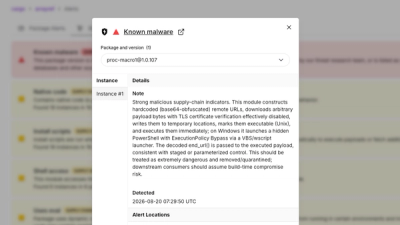
Three compromised Rust crates pulled in a malicious dependency that downloaded and executed cross-platform malware during Cargo builds.