

Company News
AWS Security Hub Adds Socket for Supply Chain Security
Socket is now in the AWS Security Hub Extended plan. Adopt it through AWS, apply committed spend, and block malicious open source packages.
By Feross Aboukhadijeh - Aug 04, 2026
sciple-mcp
Advanced tools
MCP server that lets a local Claude populate and manage Sciple platform content — environments, services, observability dashboards, runbooks, projects, and tickets — via the Sciple REST API. Engineers use it to bootstrap tenant structure, maintain the service catalog, build dashboards, author runbooks, and triage tickets without leaving their AI coding session.
Distribution channels:
| Channel | Use it from | How to install |
|---|---|---|
| PyPI | Claude Code, custom scripts, CI | uvx sciple-mcp |
| MCP Registry | Anywhere an MCP client speaks the registry protocol | Resolves automatically by io.github.navaganeshr/sciple-mcp |
Desktop Extension (.dxt) | Claude Desktop | Double-click sciple-mcp-<version>.dxt from the GitHub release |
# Install uv (one-time, only if you don't have it)
curl -LsSf https://astral.sh/uv/install.sh | sh
uvx sciple-mcp resolves the latest version from PyPI and caches it.
sciple-mcp authenticates against the Sciple platform via OAuth 2.0
with PKCE. The CLI is a credential helper: log in once via the
browser, the access + refresh tokens land in ~/.sciple/credentials.json
(mode 0600), and the MCP server reads + auto-refreshes from there.
PAT support was removed in v0.7.0. Earlier versions accepted
SCIPLE_API_TOKEN=sciple_pat_…in the env (stdio mode). That path is gone — the only credential the MCP server understands is the OAuth JWT minted bysciple-mcp login. Personal Access Tokens on the platform are unchanged and still work for scripts / CI / direct REST calls against/api/v1/*.
sciple-mcp login --platform-url https://your.sciple.cloud
Opens your browser, you click Approve on the consent page, the CLI
captures the callback and writes the credential. No --tenant-id /
--scope needed — the JWT inherits your full role on whichever tenant
the dashboard is currently showing.
The Sciple platform now hosts /mcp itself, so the preferred shape is
Streamable HTTP straight to the platform:
# Claude Code (HTTP transport — preferred)
claude mcp add-json sciple-platform "$(cat <<EOF
{
  "type": "http",
  "url": "https://your.sciple.cloud/mcp",
  "headers": { "Authorization": "Bearer $(sciple-mcp print-token)" }
}
EOF
)"
For Claude Desktop builds that only speak stdio MCP today, use the stdio mode — same credential, no PAT:
{
  "mcpServers": {
    "sciple-platform": {
      "command": "uvx",
      "args": ["sciple-mcp"],
      "env": {
        "SCIPLE_PLATFORM_URL": "https://your.sciple.cloud"
      }
    }
  }
}
SCIPLE_PLATFORM_URL is optional — only needed if you have multiple
platforms cached. Stdio mode reads ~/.sciple/credentials.json
directly.
sciple-mcp print-token            # current valid JWT (auto-refreshes near expiry)
sciple-mcp logout                 # forget local cache
sciple-mcp logout --revoke        # also revoke the refresh token server-side
Revoke any time from Profile → Connected apps on the dashboard.
sciple-mcp serve (local HTTP server)For air-gapped deployments where the client can't reach the platform's
hosted /mcp endpoint, sciple-mcp serve still ships a local
Streamable HTTP MCP server that re-validates OAuth JWTs against the
platform's JWKS. Same credential, same flow — only the network shape
differs. See --help for serve / install / uninstall.
| Tool | Description |
|---|---|
list_aws_accounts | List AWS accounts connected to the tenant (account_id, name, AWS number, regions, payer flag) |
list_cloud_resource_types | List synced resource types + row counts for one AWS service in an account |
query_cloud_resources | Query cached rows from any synced AWS resource table (paginated, region filter) |
list_ec2_instances | Summarize EC2 instances for one account or across all (state/type/id/name/ip) |
These read the platform's last AWS sync — they never call AWS directly and
never mutate anything. They require the credential to hold cloud.view.
Ask Claude in plain language; it chains the tools for you:
You: What EC2 instances are running across all our AWS accounts?
Claude calls list_ec2_instances (no account_id → sweeps every connected
account) and summarizes:
45 EC2 instances across 4 accounts.

### Production (account_id=LlDZzq) — 13 instances (12 running, 1 shutting-down)
  [running] m5.2xlarge i-047323d5f680e822f portal-apps-ondemand (10.40.2.11)
  [running] t2.micro   i-00fcaed2de8131fd1 prod-nat-instance-1a (10.40.0.9)
  ...
To drill into a single account, or a different resource type, Claude discovers what's synced first, then queries it:
You: Show the RDS databases in the Production account.
1. list_aws_accounts                  → Production has account_id "LlDZzq"
2. list_cloud_resource_types(         → aws_rds_db_instance: 4
     account_id="LlDZzq", service="rds")
3. query_cloud_resources(             → 4 rows (engine, class, status, endpoint…)
     account_id="LlDZzq", service="rds",
     resource_type="aws_rds_db_instance")
query_cloud_resources is the generic accessor for any of the 19 supported
services (ec2, rds, s3, vpc, iam, lambda, eks, ecs, ebs,
elasticache, route53, cloudfront, dynamodb, ecr, efs, and the
code* suite) — pass an unknown service and the tool returns the valid set.
Use region to filter ("global" for S3) and page / page_size (≤500) to
walk large tables.
| Tool | Description |
|---|---|
list_environments | List all environments in the tenant (id, name, slug, group, default flag) |
create_environment | Create an environment with optional group assignment and default flag |
update_environment | Update an environment's name, description, group, or sort order |
delete_environment | Delete an environment by id (irreversible) |
list_environment_groups | List environment groups (id, name, slug, AWS account binding) |
create_environment_group | Create an environment group with optional AWS account binding |
| Tool | Description |
|---|---|
list_services | List all services in the tenant catalog (id, name, slug) |
create_service | Create a service in the catalog with kind, language, SCM provider, and repository |
update_service | Update a service's metadata, lifecycle, owner, tags, links, or environment associations |
delete_service | Delete a service from the catalog by id (irreversible) |
| Tool | Description |
|---|---|
list_dashboards | List all observability dashboards in the tenant (id, name, panel count) |
get_dashboard | Get a dashboard's name, description, and panel list |
create_dashboard | Create a new dashboard with optional description |
update_dashboard | Replace a dashboard's name and description (full PUT; name required) |
delete_dashboard | Delete a dashboard and all its panels (irreversible) |
add_panel | Add a panel to a dashboard. Supports 5 shapes end-to-end (pick one): PromQL (promql), CloudWatch Metrics (cw_namespace+cw_metric_name+cw_stat + optional cw_dimensions/cw_period), ElasticSearch/OpenSearch logs (es_index + optional kql_filter), CloudWatch Logs (cw_log_group + optional cw_filter_pattern), or Text (text_content + optional text_background). Log panels also accept display options (log_columns, log_limit, log_wrap_message, log_expandable_rows, log_highlight_by_severity, log_live_tail). Always pass datasource_id for metric + log panels. |
delete_panel | Delete a panel from a dashboard (irreversible) |
| Tool | Description |
|---|---|
list_runbooks | List all runbooks in the tenant with lifecycle status and cell count |
get_runbook | Get a runbook with its cells (name, status, content preview per cell) |
create_runbook | Create a new runbook in draft status |
add_cell | Add a markdown / shell / http cell to a runbook with optional k8s/ecs/ec2 target |
update_cell | Update a cell's content or execution target |
delete_cell | Remove a cell from a runbook |
reorder_cells | Set the execution order of all cells in a runbook |
promote_runbook | Advance the runbook lifecycle: draft → reviewed → standard |
deprecate_runbook | Mark a runbook as deprecated |
Runbook lifecycle: draft → reviewed → standard. Deprecation is one-way from any state.
| Tool | Description |
|---|---|
list_projects | List all projects in the tenant (id, key, name, classification) |
get_project | Get a single project's details (owner, description, classification) |
create_project | Create a new project (name + uppercase key like "PLAT", optional classification + owner) |
list_project_members | List the user_ids and roles of a project's members (use to find an assignee) |
list_project_issue_types | List a project's issue types (required before create_project_ticket) |
| Tool | Description |
|---|---|
list_tickets | List tickets across the tenant with optional filters (service, assignee, status, priority, type, tag, full-text q) |
get_ticket | Get a single ticket's full details + activity counts (by internal id) |
create_ticket | Create a service-level ticket (not bound to a project) — tickets.manage |
update_ticket | PATCH a ticket — change status, priority, assignee, dates, tags, parent |
comment_on_ticket | Add a comment to a ticket — tickets.comment |
link_tickets | Relate two tickets (blocks / relates_to / duplicates) |
list_project_tickets | List tickets in a project |
get_project_ticket | Get a project ticket by sequence number (the NNN in KEY-NNN) |
create_project_ticket | Create a ticket inside a project — returns a "KEY-NNN" display id. Recommended for most ticket creation. Supports custom_fields (JSON string of {field_id: value}). Requires tickets.create. |
Ticket statuses: open → in_progress → done (or cancelled from any state). Priorities: low / medium / high / urgent. Severities (optional): minor / major / critical. Types: epic / story / task / subtask / bug.
The server can only do what the PAT's scope allows. Attempts to write without the relevant manage permission return a 403 from the API and are surfaced as an error in Claude's response. The PAT is revocable at any time from Profile → Access tokens in the Sciple dashboard — revoking it immediately cuts off the server's access without any config change.
To work on the server itself:
git clone https://github.com/navaganeshr/sciple-mcp
cd sciple-mcp
uv sync --all-groups
uv run python -m pytest -q
Releases are tag-driven via a GitHub Actions workflow using PyPI Trusted Publishing (OIDC). To cut a release:
version in pyproject.toml.git tag vX.Y.Z && git push origin vX.Y.Z.pypi environment deployment in the Actions UI.FAQs
MCP server for populating and managing Sciple platform content
The pypi package sciple-mcp receives a total of 94 weekly downloads. As such, sciple-mcp popularity was classified as not popular.
We found that sciple-mcp demonstrated a healthy version release cadence and project activity because the last version was released less than a year ago. It has 1 open source maintainer collaborating on the project.
Did you know?

Socket for GitHub automatically highlights issues in each pull request and monitors the health of all your open source dependencies. Discover the contents of your packages and block harmful activity before you install or update your dependencies.
Company News
Socket is now in the AWS Security Hub Extended plan. Adopt it through AWS, apply committed spend, and block malicious open source packages.
Research
/Security News
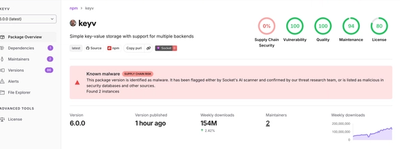
Popular npm packages keyv and cacheable compromised.

Security News
A misconfiguration gave three Anthropic models internet access, and one, believing it was in a simulation, shipped a credential-stealing package to PyPI.