

Company News
AWS Security Hub Adds Socket for Supply Chain Security
Socket is now in the AWS Security Hub Extended plan. Adopt it through AWS, apply committed spend, and block malicious open source packages.
By Feross Aboukhadijeh - Aug 04, 2026
scope-analytics-mcp
Advanced tools
Scope MCP server — install + query tools for AI coding agents (the Scope analytics connector)
The unified Scope MCP server (PRODUCT.md §16) — one server an AI coding agent (Claude Code, Cursor, ChatGPT, …) uses both to install Scope analytics in a project and to query it afterward. Scope is the AI analyst for AI products; this is its programmatic surface.
| Tool | What it does |
|---|---|
scope_detect_stack | Scans the codebase (local, no key) and reports what Scope would auto-instrument for your stack — backend framework, LLM SDKs, frontend, deploy platform — plus honest non-coverage. |
scope_install_frontend | The exact frontend-SDK install steps tailored to your stack (build-time injection or the one-line script tag), with your project's public key embedded. |
scope_install_backend | The exact backend-SDK install steps for your stack — the zero-code scope-run path plus the code-based middleware (FastAPI/Flask/Django). Honest when a path isn't shipped yet (e.g. a Node backend). |
scope_coverage_report | Honest, tenant-scoped data-flow census: which event types/sources are flowing, quarantine state, identity stitching, deploy metadata, and notes on gaps. |
scope_verify_installation | Quick "are events flowing right now?" check, for right after install. |
The install tools propose code changes; your agent shows them to you and applies them on your confirmation (detect-and-confirm). The Scope MCP never silently writes your files, and your secret key is never echoed into a snippet — only a placeholder.
| Tool | What it does |
|---|---|
scope_ask | Natural-language analytics question → the analyst's full reasoned answer (findings + recommendations). The catch-all; runs a real server-side agent loop (can take a minute). |
scope_get_stats | Headline counts — total events, unique users, the per-type breakdown, and a day-by-day trend — over an optional date range / event type. Instant and deterministic; the quick "what are the numbers?" before deciding whether to dig in. |
scope_query_events | The raw event feed (most recent first), optionally filtered by type/user. |
scope_get_session | One session's (or user's) events stitched across frontend + backend + LLM, in time order, with a small census. |
scope_list_metrics | The project's metric definitions — the analyst's recorded recipes ("how we computed it last time"). |
scope_get_metric | One metric's full recipe + provenance. |
All query tools are read-only and tenant-scoped to your key's project. Use the deterministic
primitives for instant lookups you compose yourself; use scope_ask for open-ended "why/what/how".
env keys:
SCOPE_API_KEY — required. Your project's secret key (sk_...), from the Scope dashboard. (The
install tools also read your public key from the API; you don't configure it.)SCOPE_API_BASE — backend base URL. Optional; defaults to https://api.scopeai.dev (the Scope
production backend). Override only for self-hosted / staging deployments.SCOPE_API_TIMEOUT — request timeout seconds (default 90; the free-tier backend can cold-start, and
scope_ask runs a real agent loop, so its client floors the timeout at 180s).Published as scope-analytics-mcp on PyPI — uvx fetches + runs it on demand (no manual
install). It's a standard stdio server, so it drops into any MCP-capable coding agent;
SCOPE_API_BASE is optional (defaults to https://api.scopeai.dev).
.mcp.json or claude mcp add){
"mcpServers": {
"scope": {
"command": "uvx",
"args": ["scope-analytics-mcp"],
"env": {
"SCOPE_API_KEY": "sk_...",
"SCOPE_API_BASE": "https://api.scopeai.dev"
}
}
}
}
Or from the CLI: claude mcp add scope --env SCOPE_API_KEY=sk_... -- uvx scope-analytics-mcp
~/.cursor/mcp.json or .cursor/mcp.json)Identical stdio schema — drop the same mcpServers block into ~/.cursor/mcp.json (global) or
.cursor/mcp.json (project). A one-click Add to Cursor deeplink is also available:
cursor://anysphere.cursor-deeplink/mcp/install?name=scope-analytics&config=<base64 of the inner server object — {command, args, env}, not the mcpServers wrapper>
~/.codex/config.toml)[mcp_servers.scope]
command = "uvx"
args = ["scope-analytics-mcp"]
startup_timeout_sec = 30 # cushion for the first-run uvx fetch
[mcp_servers.scope.env]
SCOPE_API_KEY = "sk_..."
Or from the CLI: codex mcp add scope --env SCOPE_API_KEY=sk_... -- uvx scope-analytics-mcp
Running from a local checkout (development): swap the command for your venv python and the import name —
"command": "/path/to/mcp-server/venv/bin/python", "args": ["-m", "scope_mcp"](the import package staysscope_mcp; the PyPI/uvxname isscope-analytics-mcp).
Then ask your agent things like:
u_123 did in their last session." (→ session)python3.10 -m venv venv
venv/bin/pip install -e ".[dev]"
venv/bin/python -m pytest -q
Not yet shipped (Track C): the sharing tools (
scope_list_reports,scope_get_report, …) and the cross-origin CORS opt-in action. (A multi-projectproject_idarg is intentionally not planned — configure one MCP server per project so each is cleanly tenant-isolated by its own key.)
FAQs
Scope MCP server — install + query tools for AI coding agents (the Scope analytics connector)
We found that scope-analytics-mcp demonstrated a healthy version release cadence and project activity because the last version was released less than a year ago. It has 1 open source maintainer collaborating on the project.
Did you know?

Socket for GitHub automatically highlights issues in each pull request and monitors the health of all your open source dependencies. Discover the contents of your packages and block harmful activity before you install or update your dependencies.
Company News
Socket is now in the AWS Security Hub Extended plan. Adopt it through AWS, apply committed spend, and block malicious open source packages.
Research
/Security News
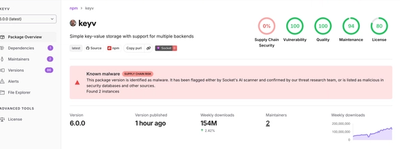
Popular npm packages keyv and cacheable compromised.

Security News
A misconfiguration gave three Anthropic models internet access, and one, believing it was in a simulation, shipped a credential-stealing package to PyPI.