

Product
PHP and Composer Support Is Now in Beta
Socket’s PHP and Composer support is now in Beta for all customers, with PHP reachability analysis generally available.
By Trevor Norris, Benjamin Barslev - Aug 21, 2026
sdcgovernance
Advanced tools
W3C standards-based governance advisory engine for Semantic Data Charter instances.
A Python library that validates governance content in XML data instances against governance components defined in the SDC data model. If the model defines governance (workflow, attestation, party/role, provenance, audit), the instance must carry that content - and this library validates it.
Returns decisions using OASIS XACML semantics: PERMIT, DENY, or INDETERMINATE.
No framework dependency. No middleware. A function call.
SDC data models (XSD) can optionally include governance components: Workflow state machines, Attestation authority requirements, Party/Role constraints, Provenance requirements, and Audit definitions. These are part of the data model, not a separate governance layer.
When governance components are defined, every XML data instance must carry the corresponding governance content. This library validates that content against the model:
from sdcgovernance import validate_governance
result = validate_governance("model.xsd", "instance.xml")
print(result.decision) # PERMIT, DENY, or INDETERMINATE
print(result.has_governance) # True if model defines governance components
print(result.errors) # list of governance validation errors
print(result.receipt) # tamper-evident decision receipt
If the model does not define governance components, the result is PERMIT - no governance to enforce.
sdcvalidator and sdcgovernance are separate, independent libraries. There is no hook, no chaining, no automatic invocation of one from the other.
sdcvalidator (structural validation)
    Does the instance conform to the XSD schema?
    Single-pass. Instance in, pass/fail out.

sdcgovernance (governance advisory)
    Does the model define governance components?
    If yes: does the instance carry valid governance content?
    Conversational. Agents query multiple times during a workflow.
Both libraries read the schema from the instance. Agents call each one independently, at different points in a workflow, in whatever order the operational logic requires. A single workflow may involve multiple calls to both libraries.
| Component | What the model defines | What the instance must carry |
|---|---|---|
| Workflow | Cluster tree of valid paths (sub-clusters with XdOrdinal states) | Current XdOrdinal state, proposed transition validated against ordinal adjacency in valid paths |
| Attestation | Authority requirements per action | Attestation with correct role, party reference, timestamp |
| Party/Role | Role constraints for governed actions | Acting party identification with required role |
| Provenance/Audit | Provenance requirements (PROV-O) + retention policy (DPV) | PROV-formatted record(s) per retention policy: most recent + hash, last N, or full chain |
Governance components are discovered by their position in the DMType root (fixed RM slots: workflow, attestation, party/role, audit, and related), not by CUID2 identity. Once a slot is found, its content is validated by vocabulary binding against the relevant standard (PROV-O, SCXML, VC, DPV). Any component occupying the right slot and bound to the right vocabulary is recognized - whether it comes from the Default project or was custom-built.
| Decision | Meaning |
|---|---|
| PERMIT | All governance checks pass - action is authorized |
| DENY | One or more governance checks fail - action is refused |
| INDETERMINATE | Governance checks partially pass - requires review (configurable) |
Every decision produces a W3C PROV record and a SHA-256 hash-chained receipt.
What happens after the decision is the agent's responsibility. sdcgovernance issues the decision and the receipt. The operational response - routing, escalation, notification, halting - is customer business logic that varies per implementation.
Python API - for direct integration:
from sdcgovernance import validate_governance

result = validate_governance("model.xsd", "instance.xml")
MCP Server - for any agent framework:
sdcgovernance serve --mcp
The MCP server exposes governance as tools that agents call. The agent runs the loop. sdcgovernance advises.
src/sdcgovernance/
├── __init__.py          # Public API: validate_governance()
├── engine.py            # GovernanceEngine - the decision engine agents query
├── model_inspector.py   # Inspect SDC model for governance components
├── workflow.py          # Validate workflow transitions in instance
├── attestation.py       # Validate attestation content in instance
├── party_role.py        # Validate party/role constraints in instance
├── provenance.py        # Validate provenance/audit records + PROV generation + DPV retention policy
├── decision.py          # DMN decision table evaluation
├── receipts.py          # Decision receipt chain (hash-chained)
├── shacl_runtime.py     # SHACL cross-entity constraint validation
└── mcp_server.py        # MCP server exposing governance tools to any agent
Pure Python. No Django. No middleware. No web framework dependency.
pip install sdcgovernance
validate_governance() at data entry boundaries.Production-ready. Available on PyPI under Apache 2.0.
rdflib - RDF/PROV record generationpyshacl - SHACL constraint validationApache 2.0
FAQs
W3C standards-based governance validation for Semantic Data Charter instances
We found that sdcgovernance demonstrated a healthy version release cadence and project activity because the last version was released less than a year ago. It has 1 open source maintainer collaborating on the project.
Product
Socket’s PHP and Composer support is now in Beta for all customers, with PHP reachability analysis generally available.
Product
Socket is bringing experimental protection to Firefox, scanning 97,000+ extensions in Mozilla's official directory for malware and risky updates.
Research
/Security News
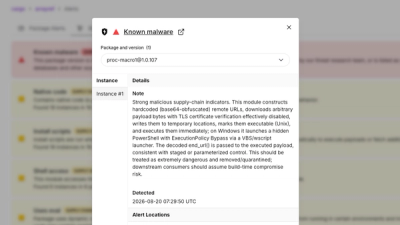
Three compromised Rust crates pulled in a malicious dependency that downloaded and executed cross-platform malware during Cargo builds.