

Product
PHP and Composer Support Is Now in Beta
Socket’s PHP and Composer support is now in Beta for all customers, with PHP reachability analysis generally available.
By Trevor Norris, Benjamin Barslev - Aug 21, 2026
securedact-mcp
Advanced tools
Securedact MCP is an Apache-2.0 local MCP server and reusable Python privacy engine. It detects sensitive text, applies versioned policies, redacts locally, and validates residual output before marking sanitized content approved.
MCP mode does not automatically intercept every prompt. The host must invoke the tool and send only
sanitized_textwhenstatus == "ok"; a misconfigured or malicious MCP host can bypass that ordinary MCP workflow. Provider-native enforced hooks are separate integration assets: when a supported provider invokes such a hook at its prompt lifecycle boundary, it can apply the same deterministic decision before normal model processing. See SecuRedact Enforced.
Use prepare_for_external_ai for normal external-AI preparation:
{
  "text": "Contact alex@example.test",
  "policy": "strict_external_ai",
  "language": "auto",
  "response_mode": "minimal"
}
Approved response:
{
  "schema_version": "1",
  "status": "ok",
  "sanitized_text": "Contact [EMAIL_1]",
  "counts": {"email": 1},
  "policy": "strict_external_ai",
  "policy_version": 1,
  "policy_digest": "...",
  "reason_codes": []
}
review_required and blocked responses never contain approved
sanitized_text. Minimal responses contain no original text, raw entity values,
mapping, exception body, stack trace, model path, or restoration handle unless
restore_capable was explicitly selected.
flowchart LR
    H["MCP host"] --> M["Securedact MCP"]
    M --> D["deterministic detectors"]
    M --> C["contextual detectors"]
    D --> P["policy engine"]
    C --> P
    P --> R["redactor"]
    R --> V["residual validator"]
    V --> O["approved sanitized output"]
    O --> W["host-controlled downstream workflow"]
    H -. "host may bypass MCP" .-> W
The server has no provider clients, OpenAI-compatible proxy, reverse proxy, website, desktop chatbot, provider credentials, or provider-specific forwarding. See ADR 0001 and the threat model.
| Tool | Intended use | Sensitive-response behavior |
|---|---|---|
prepare_for_external_ai | Recommended complete safe workflow | Minimal by default |
analyze_text | Lower-level local analysis/review | Minimal; offsets in review; raw values only in enabled debug mode |
redact_text | Lower-level compatibility operation | Minimal by default; explicit legacy mode is sensitive and deprecated |
restore_text | Consume a local opaque session | Single-use by default; direct mappings require explicit trusted legacy mode |
create_safe_copy | Write approved .txt/.md content under one configured root | Returns no mapping or absolute path |
Response modes are minimal, review, debug, and restore_capable. Debug is
disabled unless the process was started with
SECUREDACT_ENABLE_DEBUG_RESPONSES=1; an MCP request cannot enable it. In-memory
restoration sessions use cryptographic random handles, bounded capacity,
expiration, concurrency protection, and single-use consumption. Process exit
destroys all sessions.
See MCP tools, response privacy, and restoration sessions.
Python >=3.12,<3.13 is supported.
For a normal installation from PyPI:
py -3.12 -m pip install "securedact-mcp[ml]"
securedact-mcp setup
On Linux or macOS, use python3.12 -m pip install "securedact-mcp[ml]";
python -m pip install "securedact-mcp[ml]" is also appropriate when python
already selects a supported 3.12 environment.
setup checks the package, Python and ML dependencies, inspects local model
state, offers the existing consent-based model installer, runs the existing
offline verifier, and offers the packaged Claude Code and Gemini CLI
integrations when those hosts are detected. It uses the providers' official
plugin/extension commands and is safe to rerun. It does not call a provider
model API, accept provider trust automatically, or download a contextual model
unless the user explicitly selects model setup and accepts the existing
upstream prompt.
Manual model commands remain available for advanced or unattended operation:
securedact-mcp install
securedact-mcp models verify
securedact-mcp
The last command starts a local stdio server. Standard output is reserved for
MCP protocol messages. securedact-mcp setup --non-interactive reports state
without implying upstream acceptance or configuring a new provider. Use
--host claude, --host gemini, or --host all for targeted interactive
provider setup.
To work from a reviewed source checkout instead:
git clone https://github.com/GigantesHJI/securedact-mcp.git
cd securedact-mcp
python -m pip install ".[ml]"
securedact-mcp setup
No model checkpoint is included in the repository or wheel, and startup never downloads one. Securedact does not redistribute these model weights. Upstream model weights retain their own licenses and are not relicensed by Apache-2.0. See model installation and third-party licenses.
Deterministic-only local development must be explicitly selected:
$env:SECUREDACT_REQUIRE_FLAIR = "0"
securedact-mcp
Production defaults to requiring contextual capability and fails closed while a configured model is missing, loading, corrupt, or unavailable.
Tested configuration assets and safe-workflow instructions are under
integrations/ for Codex, Cursor, and Windsurf. The automated MCP client harness
validates server startup, tool listing, calls, minimal response shape, stdout
integrity, and shutdown. It does not prove that a real host invokes the tool for
every prompt. See the compatibility evidence.
The repository is also a Gemini CLI extension root: gemini extensions install https://github.com/GigantesHJI/securedact-mcp can install the hooks. The
gemini-cli-extension topic and a release whose tag tree contains the root
manifest are required for that path to resolve; without pip install "securedact-mcp[ml]" and the local models the installed hooks do not enforce
anything. See SecuRedact Enforced.
Built-ins include default, strict_external_ai, gdpr, identifiers_only,
and review_all_contextual; compatibility policies remain available. Local
organization policy files load only from the controlled policy directory, use a
strict declarative schema, and cannot disable fail-closed invariants. Unknown,
duplicate, oversized, malformed, or symlinked policies fail closed.
from securedact_core import RedactionRequest, SecuredactEngine

engine = SecuredactEngine.from_environment()
result = engine.prepare(
    RedactionRequest(
        text="Contact alex@example.test",
        policy="strict_external_ai",
    )
)
from_environment() preserves the contextual-model requirement. Standalone
deterministic development requires SECUREDACT_REQUIRE_FLAIR=0; applications may
also inject tested detector implementations. See public API
and policies.
The committed uv.lock resolves runtime, ML, development, benchmark, and
security extras for Python 3.12.
uv sync --frozen --extra dev --extra benchmark
uv run python scripts\verify.py
Never use real personal information, private documents, credentials, customer logs, or model weights in tests, issues, screenshots, fixtures, or pull requests. See CONTRIBUTING.md.
uv run python -m securedact_eval quality --mode deterministic --gate `
  --thresholds benchmarks\thresholds.json `
  --baseline benchmarks\baselines\quality-deterministic.json
uv run python -m securedact_eval performance --mode deterministic
The versioned synthetic corpus reports exact and relaxed span precision, recall, F1, false-positive and false-negative rates, per-entity/language/domain/split results, action/category accuracy, and bootstrap recall intervals. True negatives are document-level negative examples, not token-level safety. The GDPR-related suite is detection evaluation, not legal compliance certification. Real Flair and GPU benchmarks require an explicitly configured local model and are not ordinary CI. See benchmarking. The benchmark framework documents local data tiers and large profiles; the migration plan defines its future extraction boundary. For a failure before GitHub executes repository steps, use the CI troubleshooting decision tree. Local success does not replace a required GitHub check.
Report vulnerabilities privately using SECURITY.md. Do not put vulnerability details or real data in a public issue.
Original repository source and documentation are licensed under the Apache License 2.0. Copyright attribution is recorded in NOTICE. Third-party dependencies and model weights retain their own licenses.
FAQs
Local-first privacy MCP server for sensitive AI workflows
We found that securedact-mcp demonstrated a healthy version release cadence and project activity because the last version was released less than a year ago. It has 1 open source maintainer collaborating on the project.
Product
Socket’s PHP and Composer support is now in Beta for all customers, with PHP reachability analysis generally available.
Product
Socket is bringing experimental protection to Firefox, scanning 97,000+ extensions in Mozilla's official directory for malware and risky updates.
Research
/Security News
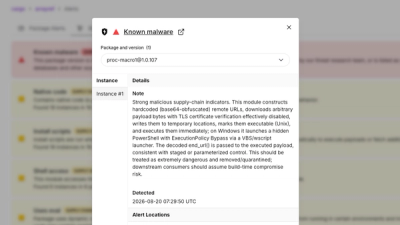
Three compromised Rust crates pulled in a malicious dependency that downloaded and executed cross-platform malware during Cargo builds.