


Company News
AWS Security Hub Adds Socket for Supply Chain Security
Socket is now in the AWS Security Hub Extended plan. Adopt it through AWS, apply committed spend, and block malicious open source packages.
By Feross Aboukhadijeh - Aug 04, 2026
supermemory-agent
Advanced tools
SuperMemory: MCP-first learning memory layer for Claude, Cursor, and agent workflows
MCP-first agent learning layer for Claude, Cursor, and custom agent workflows.
SuperMemory captures distilled lessons from failures and corrections — not full conversation transcripts — validates them before storage, and improves agents over time through a closed-loop cycle.


pip install supermemory-agent
supermemory-agent --storage .supermemory --transport stdio
Or with uv:
uvx supermemory-agent --storage .supermemory --transport stdio
Latest release: v0.2.4 — wheel + sdist attached on every GitHub Release.
| Component | Description |
|---|---|
| MCP server | 29 tools + 4 resources over stdio (or streamable HTTP) |
| Agent skill | skills/supermemory-agent-learning/SKILL.md — bundled in the PyPI package |
| Python SDK | In-process integration via uall_python |
| REST API | FastAPI server for remote / polyglot clients |
| Storage | Local .supermemory/ files by default; SQLite and PostgreSQL optional |
Everything lives in one repo: MCP server, skills, SDK, REST API, tests, and release packages.
pip install supermemory-agent
After install, bundled skills are at site-packages/skills/supermemory-agent-learning/. Copy to your editor skills folder if needed.
Each release ships installable assets:
pip install https://github.com/YashvantHange/SuperMemory/releases/download/v0.2.4/supermemory_agent-0.2.4-py3-none-any.whl
Browse all versions: github.com/YashvantHange/SuperMemory/releases
git clone https://github.com/YashvantHange/SuperMemory.git
cd SuperMemory
pip install -e ".[dev]"
python -m pytest tests/ -v
Copy examples/cursor.mcp.json to .cursor/mcp.json in your project:
{
  "mcpServers": {
    "supermemory": {
      "command": "supermemory-agent",
      "args": ["--storage", ".supermemory", "--transport", "stdio"]
    }
  }
}
Merge examples/claude_desktop_config.json into:
%APPDATA%\Claude\claude_desktop_config.json
Restart Claude Desktop after saving.
Do not run supermemory-agent alone in a terminal — stdio mode expects JSON-RPC from an MCP client. Pressing Enter in the shell causes a JSON parse error.
# For local HTTP testing only:
supermemory-agent --transport streamable-http
When configured in Cursor or Claude Desktop, the client launches the server automatically over stdio.
| Source | Path |
|---|---|
| Canonical (edit here) | skills/supermemory-agent-learning/ |
| Cursor project | .cursor/skills/supermemory-agent-learning/ |
| Claude Code project | .claude/skills/supermemory-agent-learning/ |
| PyPI install | site-packages/skills/supermemory-agent-learning/ |
After editing skills/, sync copies:
python scripts/sync_skills.py
Mention SuperMemory, agent learning, or MCP memory in chat to load the skill.
retrieve → record_failure → reflect(event_ids) → validate → process_promotions
         → retrieve again → report_outcome
Core rule: capture workflow outcomes and distilled lessons only — never full transcripts. Default retrieval budget: max_tokens=800.
Core (13): retrieve, record_event, record_failure, record_correction, reflect, validate, process_promotions, report_outcome, get_policies, add_policy, add_skill, search_skills, get_skill
Extended UALL (16): learn.run.start, learn.run.event, learn.run.end, learn.store, learn.retrieve, learn.reflect, learn.validate, learn.evaluate, learn.feedback, learn.improvements, learn.analytics, learn.policies, learn.experiment, learn.rollback, learn.skills, learn.telemetry
All tools include MCP safety annotations (readOnlyHint / destructiveHint).
supermemory://policies/activesupermemory://lessons/{lesson_id}supermemory://memory/{lesson_id}/provenancesupermemory://skills/{skill_id}from uall_python import UALLClient
client = UALLClient(storage="file")
with client.run(workflow_id="pdf-pipeline", step="planner", namespace="team:eng") as run:
lessons = run.retrieve(step="planner", max_tokens=800)
run.record_failure(snippet="chose OCR for searchable PDF", tags=["routing"])
run.report_lesson_outcome(lesson_id="lesson_001", used=True, accepted=True, improved=True)
python -m uall_server
Server: http://localhost:8000 — see api/openapi.yaml.
| Tier | Backend | Config |
|---|---|---|
| Default | .supermemory/ JSON files | SUPERMEMORY_STORAGE_PATH or UALL_DATA_DIR |
| Optional | SQLite | UALL_STORAGE_BACKEND=sqlite |
| Enterprise | PostgreSQL | UALL_STORAGE_BACKEND=postgres |
SuperMemory/
├── src/supermemory_mcp/          # MCP server (29 tools, 4 resources)
├── skills/supermemory-agent-learning/   # Agent skill (SKILL.md)
├── packages/uall/                # Core learning engine
├── packages/uall_python/         # Python SDK
├── packages/uall_server/         # REST API
├── examples/                     # Cursor + Claude Desktop MCP configs
├── tests/                        # 74 tests incl. stdio MCP transport
└── docs/                         # Publishing, releases, privacy
python -m pytest tests/ -v
python -m pytest tests/test_mcp_server.py -v   # real stdio MCP transport
python -m pytest tests/test_core.py -v         # closed-loop integration
| Doc | Purpose |
|---|---|
| docs/GIT_SETUP.md | Fix commit author name/email on GitHub |
| docs/RELEASES.md | Release checklist — every tag ships wheel + sdist |
| docs/PUBLISHING.md | PyPI, MCP Registry, Cursor & Claude directories |
| PRIVACY.md | Privacy policy |
| skills/README.md | Agent skill install paths |
MCP Registry name: io.github.YashvantHange/supermemory
PyPI package: supermemory-agent
MIT — see LICENSE
FAQs
SuperMemory: MCP-first learning memory layer for Claude, Cursor, and agent workflows
We found that supermemory-agent demonstrated a healthy version release cadence and project activity because the last version was released less than a year ago. It has 1 open source maintainer collaborating on the project.
Did you know?

Socket for GitHub automatically highlights issues in each pull request and monitors the health of all your open source dependencies. Discover the contents of your packages and block harmful activity before you install or update your dependencies.
Company News
Socket is now in the AWS Security Hub Extended plan. Adopt it through AWS, apply committed spend, and block malicious open source packages.
Research
/Security News
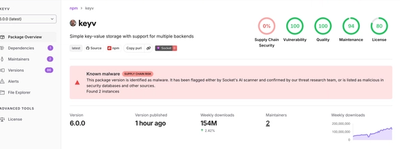
Popular npm packages keyv and cacheable compromised.

Security News
A misconfiguration gave three Anthropic models internet access, and one, believing it was in a simulation, shipped a credential-stealing package to PyPI.