

Product
PHP and Composer Support Is Now in Beta
Socket’s PHP and Composer support is now in Beta for all customers, with PHP reachability analysis generally available.
By Trevor Norris, Benjamin Barslev - Aug 21, 2026
taskswarm-cli
Advanced tools
Self-hosted event server that pushes a notification the instant a parallel coding-agent session blocks, needs review, fails, or finishes.
Self-hosted event server that pushes a notification the instant a parallel coding-agent session blocks, needs review, fails, or finishes.




Running three or four coding-agent sessions in parallel turns into a
tab-switching problem: nothing pushes state to you, so you find out a
session has been sitting on a permission prompt for ten minutes only by
polling terminals by eye. TaskSwarm closes that gap: every agent session
reports its state to a small local HTTP server, and the instant one
transitions to blocked, needs-review, failed, or done, TaskSwarm
fires a local OS notification and updates a live status page over
Server-Sent Events. No polling, no account, no cloud dependency by default.
This package is the Python distribution of TaskSwarm -- a genuine, independent port of the server, CLI, event schema, and notification logic, not a wrapper around the Node binary. It has zero runtime dependencies: no HTTP framework, no schema-validation library, nothing beyond the Python standard library.
Live on PyPI as taskswarm-cli (renamed from the original taskswarm
package, which has stopped receiving updates and points here):
pip install taskswarm-cli
or with uv:
uv add taskswarm-cli
The complementary JS/TS distribution is already live on npm as
taskswarm-cli (npm install -g taskswarm-cli, or npx taskswarm-cli start with no install step) -- see the
project README for
that package. Both are first-class and maintained together; neither is a
replacement for the other.
# Terminal 1: start the server
taskswarm start
# TaskSwarm server listening on http://127.0.0.1:4173
# Live status page: http://127.0.0.1:4173/?token=<your-token>

# Terminal 2: report a session's status as it works
taskswarm agent report-status --task my-fix --repo ./api --state running
taskswarm agent report-status --task my-fix --repo ./api --state done
Open the live status page URL printed by start. The row for my-fix
updates the instant each report-status call lands, no refresh.
Or call the library directly, in-process, without a subprocess:
from taskswarm import start_server
from taskswarm.adapters import GenericAdapter
from taskswarm.client.api_client import post_event

running = start_server()
adapter = GenericAdapter()
event_input = adapter.to_event_input(
    {"session_id": "my-fix", "repo": "./api", "status": "done", "agent_type": "generic"}
)
event = post_event(running.config.to_dict(), event_input)
print(event["session_id"], "->", event["status"])
running.close()
taskswarm start
boots an HTTP+SSE server (stdlib http.server, no framework dependency)
that accepts POST /events, serves GET /events for current session
state, and streams new events over GET /live (Server-Sent Events) to
the bundled live status page.blocked, needs-review,
failed, or done, TaskSwarm fires a native OS notification
(osascript on macOS, a terminal-bell console fallback elsewhere).
Notification dedup keys on the (status, blocked_reason) pair, so a
second, different permission prompt still notifies even though the
status (needs-review) didn't change.taskswarm agent report-status --task <id> --repo <path> --state <state>
is the one primitive every integration is built on -- callable from any
script wrapping any CLI agent (Codex, Cursor, or anything else).taskswarm hooks install claude-code writes Stop and
Notification hook entries into .claude/settings.json, pointed at the
exact, already-installed console script on disk (never a floating PATH
lookup re-resolved on every hook fire).POST /events and the live page both require the token TaskSwarm
generates on first run (~/.taskswarm/config.json, written 0600).
Rotate it with taskswarm token rotate.--json flag with a
stable schema, including error output.~/.taskswarm/config.json.| Command | Description | Key options |
|---|---|---|
taskswarm start | Start the TaskSwarm server and print the live status page URL | --json |
taskswarm task add | Register a new task | --title <title> (required), --repo <path> (required), --json |
taskswarm task list | List tracked tasks, enriched with live status when the server is reachable | --json |
taskswarm agent report-status | Report a status transition for a task/session to the local server | --task <id> (required), --repo <path> (required), --state <state> (required, one of queued|running|blocked|needs-review|done|failed), --blocked-reason <text>, --agent-type <type> (claude-code|codex|cursor|generic, default generic), --json |
taskswarm token rotate | Generate a new bearer token, invalidating the old one | --json |
taskswarm hooks install <adapter> | Install hooks for an agent integration (currently claude-code) | --scope <project|local|user> (default project), --project-dir <path>, --json |
taskswarm hooks claude-code-relay | Internal: reads a hook payload from stdin and relays it. Installed automatically; not meant to be run by hand. | none |
taskswarm --version prints the installed package's own version number,
read live from pyproject.toml (so it always matches whatever release you
actually have installed, rather than a fixed number that would go stale
here). The taskswarm-cli console script installed by this package is an
identical alias, matching both bin entries the npm package ships.
agent session / hook / wrapper script
        |
        v
POST /events (bearer token required)  -> event schema validation
        |
        v
EventStore (in-memory + append-only JSONL log at ~/.taskswarm/events.jsonl)
        |
        +--> notify() -- fires on a transition into blocked/needs-review/failed/done
        |         |
        |         +--> local OS notification (always on)
        |         +--> ntfy.sh (opt-in only)
        |
        +--> GET /live (Server-Sent Events) -> live status page
Full data model and the exact notification-dedup rule are in docs/concepts.md.
The local API is gated by a bearer token generated on first run and stored
0600 at ~/.taskswarm/config.json; the server binds to 127.0.0.1 by
default. Token comparison uses hmac.compare_digest (constant-time,
avoiding timing side-channels), the same property the TypeScript version
gets from crypto.timingSafeEqual. See
SECURITY.md
for the full posture, including what this server does not protect
against (it is a local developer tool, not designed to be exposed on a
shared or public network). Honest note: this project does not currently
publish SLSA provenance, Sigstore signatures, or an SBOM, and has no
OpenSSF Scorecard badge -- none of that infrastructure exists yet for
either distribution, so it isn't claimed here.
See CONTRIBUTING.md for the full guide, covering both the TypeScript and Python codebases.
cd python
python3 -m venv .venv && source .venv/bin/activate
pip install -e ".[dev]"
pytest
MIT, see LICENSE.
FAQs
Self-hosted event server that pushes a notification the instant a parallel coding-agent session blocks, needs review, fails, or finishes.
We found that taskswarm-cli demonstrated a healthy version release cadence and project activity because the last version was released less than a year ago. It has 2 open source maintainers collaborating on the project.
Product
Socket’s PHP and Composer support is now in Beta for all customers, with PHP reachability analysis generally available.
Product
Socket is bringing experimental protection to Firefox, scanning 97,000+ extensions in Mozilla's official directory for malware and risky updates.
Research
/Security News
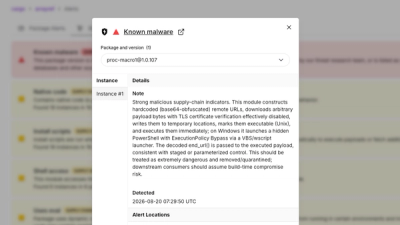
Three compromised Rust crates pulled in a malicious dependency that downloaded and executed cross-platform malware during Cargo builds.