

Product
PHP and Composer Support Is Now in Beta
Socket’s PHP and Composer support is now in Beta for all customers, with PHP reachability analysis generally available.
By Trevor Norris, Benjamin Barslev - Aug 21, 2026
telegram-managed-bot-factory
Advanced tools

A self-hosted MCP control plane that turns one user-owned Telegram manager bot into isolated, useful child bots. Ask Hermes for a supported bot, confirm that specific creation in Telegram, and the persistent Factory worker retrieves and contains the child credential without exposing it to the model or MCP.
Version 0.2.3 is terminal-only: no Desktop bootstrap exists.
Each PyPI version is immutable; install the pinned release below.
Creating a bot manually involves a valuable credential and a real external side effect. Factory makes that workflow explicit: an agent can prepare a bounded request, but the owner approves creation in Telegram and the persistent worker receives the resulting credential outside the agent context.
I designed the MCP/control-plane boundary, the durable worker lifecycle, credential isolation, request state and reconciliation rules, then packaged and released the tool for self-hosted use. The design deliberately does not claim exactly-once external effects: a crash-ambiguous result is surfaced for reconciliation instead of being blindly retried.
Requires Linux with systemd --user, Python 3.11–3.14, uv,
Hermes 0.18, and a separate Telegram bot with Bot Management Mode enabled.
uvx --refresh --from telegram-managed-bot-factory==0.2.3 bot-factory install-hermes
The local installer first verifies systemd --user and enables verified user
lingering so the worker survives SSH logout, then securely prompts once for the manager credential, enrolls the owner, installs and verifies
the persistent user service and a fresh worker heartbeat, registers the nine-tool
stdio server with Hermes, and verifies discovery. It creates no child bot.
Run the install command from an interactive SSH or console terminal on the same Linux host that will run the worker. It performs the complete setup in that terminal:
uv tool (the worker unit
never points at an evictable uvx cache);systemd --user and enable verified user lingering before requesting any credential;There is no GUI launcher and no unconfigured MCP bootstrap tool. Until this command completes, Factory MCP deliberately refuses to start. The token must never be pasted into Hermes chat, an MCP argument, a shell command, or an environment variable.
You → Hermes → Factory MCP ──durable request──▶ persistent worker
                  ▲                                │
                  │ safe status                    │ Bot API
                  │                                ▼
                  └──── Telegram confirmation ◀─ manager bot
                                                   │ child credential
                                                   ▼
                                         isolated child runtime
Hermes and MCP are the non-secret control plane. The persistent worker alone polls the manager bot and retrieves credentials. Each child receives only its own credential and uses instance-local state.
The same four built-in profiles are exposed as a strict Hermes function catalog.
After Telegram confirms and provisions a child, use factory_list_functions, then
factory_attach_function with the existing child slug and confirm=true. Repeating
the same attach is a no-op; rebinding keeps the bot username and Telegram identity.
Pause and resume continue to use the existing stop/start tools.
| Profile | Use it for |
|---|---|
quick_faq | A public menu of 3–8 local plain-text answers and contact text. |
lead_inbox | A privacy-noticed message form with owner notification and confirmed export/purge. |
link_inbox | Owner-only URLs and notes with /list and /done; URLs are never fetched. |
owner_echo is also included as an owner-only isolation and health smoke test.
Profiles cannot provide arbitrary code, executables, filesystem paths, HTML,
agent tools, or remote fetches.
After installation, ask Hermes:
Create a quick FAQ bot named “Studio FAQ” with username
studio_faq_bot. Welcome: “Choose a question.” Add pricing, turnaround, and contact FAQs.
Hermes returns the Telegram creation link. Open it, approve once, then open the
new child and send /start, /faq 1, and /health. If provisioning is still
in progress, ask Hermes for the request status. For the other profiles, submit
one test lead and try owner-only /export confirm then /purge confirm, or
save a URL in link_inbox, inspect /list, and use /done 1.
systemd --user; Ubuntu and WSL2 are tested.2026-07-28 paths.0700, files are 0600, and child credentials travel
through an inherited anonymous file descriptor rather than argv or environment.See the security policy and architecture for the full boundary model.
Check the worker and Hermes registration without sharing unreviewed journal output:
systemctl --user status bot-factory-manager.service
hermes mcp test bot-factory
On WSL2, PID 1 must be systemd, and the distribution must remain running.
Uninstalling the service/package does not delete Factory data or revoke Telegram
bots; review local XDG bot-factory directories and BotFather controls separately.
FAQs
A secure MCP control plane for Telegram Managed Bots
We found that telegram-managed-bot-factory demonstrated a healthy version release cadence and project activity because the last version was released less than a year ago. It has 1 open source maintainer collaborating on the project.
Product
Socket’s PHP and Composer support is now in Beta for all customers, with PHP reachability analysis generally available.
Product
Socket is bringing experimental protection to Firefox, scanning 97,000+ extensions in Mozilla's official directory for malware and risky updates.
Research
/Security News
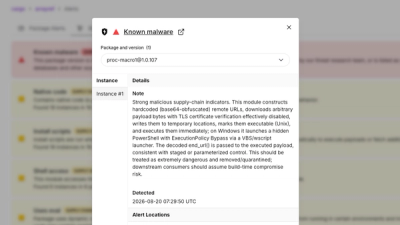
Three compromised Rust crates pulled in a malicious dependency that downloaded and executed cross-platform malware during Cargo builds.