



Security News
The Code You Didn't Write Is Still Yours to Defend
AI agents are pulling packages into environments no scanner is watching, creating exposure before security teams can see it.
By Brad Arkin - Jun 23, 2026
traffic-anomaly
Advanced tools
Robust decomposition, anomaly and changepoint detection on multiple time series for any SQL backend. Designed for traffic data.


traffic-anomaly is a production-ready Python package for robust anomaly and changepoint detection across multi-entity time series. It uses Ibis to integrate with any SQL backend in the cloud or run locally with the included DuckDB backend.
Tested on: Windows, macOS, and Ubuntu with Python 3.9-3.13
Designed for real-world traffic data (volumes, travel times), traffic-anomaly uses medians to decompose series into trend, daily, weekly, and residual components. Anomalies are then classified via Z-score or GEH statistics and change points highlight structural shifts. The package handles missing data and can drop time periods with insufficient observations. Sample data included, try it in Google Colab for detailed examples and explanations. 
It is recommended to use a virtual environment to avoid dependency conflicts.
pip install traffic-anomaly
For enhanced Snowflake compatibility (including support for expressions in window functions, added to Snowflake in August 2024), follow these steps:
Step 1: Install traffic-anomaly normally
pip install traffic-anomaly
Step 2: Reinstall ibis with Snowflake compatibility (without overwriting dependencies)
pip install --force-reinstall --no-deps "ibis-framework @ https://github.com/ShawnStrasser/ibis/archive/a1142d81965dc0f1650c2091de3e405d2dba6e5b.zip"
Windows Users: If Step 2 fails with path-related errors, enable long paths in Windows by running this command as Administrator in PowerShell, then restart your computer:
New-ItemProperty -Path "HKLM:\SYSTEM\CurrentControlSet\Control\FileSystem" -Name "LongPathsEnabled" -Value 1 -PropertyType DWORD -Force
The Snowflake-compatible version uses a forked version of ibis-framework that supports expressions in window functions on Snowflake. This will be replaced with the official PyPI version once the upstream changes are merged.
Example Usage: For a complete example of loading packages from Windows to Snowflake, see the signal-analytics-snowflake repository.
from traffic_anomaly import *
from traffic_anomaly import sample_data

# Load sample data
travel_times = sample_data.travel_times

decomp = decompose(
    data=travel_times, # Pandas DataFrame or Ibis Table (for compatibility with any SQL backend)
    datetime_column='timestamp',
    value_column='travel_time',
    entity_grouping_columns=['id', 'group'],
    freq_minutes=60, # Frequency of the time series in minutes
    rolling_window_days=7, # Rolling window size in days. Should be a multiple of 7 for traffic data
    drop_days=7, # Should be at least 7 for traffic data
    min_rolling_window_samples=56, # Minimum number of samples in the rolling window, set to 0 to disable.
    min_time_of_day_samples=7, # Minimum number of samples for each time of day (like 2:00pm), set to 0 to disable
    drop_extras=False, # lets keep seasonal/trend for visualization below
    return_sql=False # Return SQL queries instead of Pandas DataFrames for running on SQL backends
)
decomp.head(3)
| id | timestamp | travel_time | group | median | season_day | season_week | resid | prediction |
|---|---|---|---|---|---|---|---|---|
| 448838574 | 2022-09-29 06:00:00 | 24.8850 | SE SUNNYSIDE RD | 24.963749 | -4.209375 | 0.57875 | 3.5518772 | 21.333122 |
| 448838574 | 2022-09-22 06:00:00 | 20.1600 | SE SUNNYSIDE RD | 24.842501 | -4.209375 | 0.57875 | -1.0518752 | 21.211876 |
| 448838574 | 2022-09-15 06:00:00 | 22.2925 | SE SUNNYSIDE RD | 24.871250 | -4.209375 | 0.57875 | 1.0518752 | 21.240623 |
Here's a plot showing what it looks like to decompose a time series. The sum of components is equal to the original data. After extracting the trend and seasonal components, what is left are residuals that are more stationary so they're easier to work with.

The image below shows an example application on traffic counts (package does not produce plots).

In road networks, an anomaly may be caused by downstream road segment/entity anomalies. To separate downstream-caused anomalies from locally-originated ones, pass a network connectivity table to anomaly() via connectivity_table. When provided, the output includes an additional boolean column originated_anomaly that indicates whether a detected anomaly is a point source (or originated) anomaly.
Requirements
anomaly() (e.g., entity_grouping_columns=['id']).next_<entity> (for id, this must be next_id).Example
# Decompose as usual (shown above)

# Load connectivity (must have columns like: 'id', 'next_id')
connectivity = sample_data.connectivity

# Detect anomalies with group context and originated-anomaly flag
anomaly_originated = anomaly(
    decomposed_data=decomp,
    datetime_column='timestamp',
    value_column='travel_time',
    entity_grouping_columns=['id'],    # exactly one entity column required
    group_grouping_columns=['group'],  # optional: add group-level context
    entity_threshold=3.5,
    connectivity_table=connectivity,   # enables originated_anomaly
)

# Result will now include column 'originated_anomaly'
traffic-anomaly includes robust changepoint detection that pinpoints when traffic patterns shift due to construction, equipment failure, or events like school starting up in the Fall. Changepoints represent moments when the underlying statistical properties of the data change. This functionality is meant for detecting long term / persistent changes, whereas anomaly detection is for short term / transient changes.
# Load changepoint sample data
changepoint_data = sample_data.changepoints_input

# Apply change point detection
changepoints = changepoint(
    data=changepoint_data,  # Pandas DataFrame or Ibis Table
    value_column='travel_time_seconds',
    entity_grouping_column='ID',
    datetime_column='TimeStamp',
    rolling_window_days=14,  # Size of analysis window
    robust=True,  # Use robust (Winsorized) variance for better outlier handling, but computation is much slower
    score_threshold=5,  # Threshold for change point detection (lower = more sensitive)
    min_separation_days=3,  # Minimum days between detected change points
    recent_days_for_validation=0  # Optional post-filter; set >0 to drop changes that quickly revert, try setting to 3
)
changepoints.head(3)
| ID | TimeStamp | score | avg_before | avg_after | avg_diff |
|---|---|---|---|---|---|
| 448838574 | 2022-09-15 14:00:00 | 2.34 | 45.2 | 52.8 | 7.6 |
| 448838575 | 2022-09-22 08:00:00 | 1.89 | 38.1 | 29.4 | -8.7 |
| 448838576 | 2022-10-01 16:00:00 | 3.12 | 41.5 | 48.9 | 7.4 |
The image below shows an example of changepoint detection on traffic data, highlighting where significant structural changes occur in the time series.

Parameters
robust=True: Uses Winsorized variance (clips extreme values) for more stable detectionscore_threshold: Higher values detect fewer, more significant change pointsrolling_window_days: Size of the analysis window (split between before/after periods)min_separation_days: Prevents detecting multiple change points too close togetherrecent_days_for_validation: Post-filter lookahead window (days) per changepoint. Defaults to 0 (disabled). Must be ≤ half the rolling window; when enabled, changepoints whose recent average is closer to the pre-change baseline than the post-change level are dropped.The seasonal components are not allowed to change over time, therefore, it is important to limit the number of weeks included in the model, especially if there is yearly seasonality (and there is). The recommended use for application over a long date range is to run the model incrementally over a rolling window of about 6 weeks.
Because traffic data anomalies usually skew higher, forecasts made by this model are systemically low because in a right tailed distribution the median will be lower than the mean. This is by design, as the model is meant primarily for anomaly detection and not forecasting.
traffic_anomaly can classify two separate types of anomalies:
Why is that needed? Imagine a snow storm: travel times across a city change together. If you only look at road segments in isolation, everything looks anomalous. Group-level anomalies are rarer and more actionable (e.g., indicative of faults) because they highlight entities that deviate from their peers.
Potentially support Holidays and add a yearly component. Additional changes are not likely unless there is a specific need. Please open an issue if you have a feature request or find a bug.
FAQs
Robust decomposition, anomaly and changepoint detection on multiple time series for any SQL backend. Designed for traffic data.
We found that traffic-anomaly demonstrated a healthy version release cadence and project activity because the last version was released less than a year ago. It has 1 open source maintainer collaborating on the project.
Did you know?

Socket for GitHub automatically highlights issues in each pull request and monitors the health of all your open source dependencies. Discover the contents of your packages and block harmful activity before you install or update your dependencies.
Security News
AI agents are pulling packages into environments no scanner is watching, creating exposure before security teams can see it.

Security News
GitHub Actions checkout now blocks risky pull_request_target checkouts by default to help prevent pwn request supply chain attacks.
Product
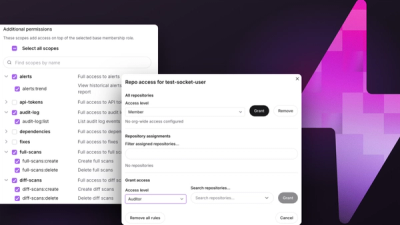
Socket now supports Custom Roles and Repository Access Permissions so organizations can control who can access specific repositories and actions.