

Product
PHP and Composer Support Is Now in Beta
Socket’s PHP and Composer support is now in Beta for all customers, with PHP reachability analysis generally available.
By Trevor Norris, Benjamin Barslev - Aug 21, 2026
trakkr-mcp
Advanced tools
MCP server for Trakkr: AI visibility monitoring for ChatGPT, Perplexity, Gemini, and more
MCP server for Trakkr — AI visibility monitoring.
Connect your AI assistant (Claude Code, Claude Desktop, Cursor, VS Code, Codex CLI, Windsurf, Zed, Cline, Continue, and any other MCP client) to Trakkr and query your brand's AI search visibility data conversationally.
The fastest path is uv — uvx auto-installs and runs the server with zero setup:
# One-time, if you don't have uv:
brew install uv

# Set your MCP connect token from Settings > Developer:
export TRAKKR_API_KEY="mcp_connect_your_token_here"

# Optional, run the server directly to verify it works:
uvx trakkr-mcp
You usually don't run uvx trakkr-mcp yourself — your MCP client runs it for you based on the config below.
Scale users with legacy sk_live_ REST keys can still use those keys for direct local mode, but new setups should use the MCP connect token.
Registry name: io.github.macklpgr/trakkr-mcp
The Registry entry offers both supported connection paths:
https://api.trakkr.ai/mcp over Streamable HTTP. Compatible clients discover Trakkr's OAuth endpoints and ask the user to authorize the connection.uvx trakkr-mcp over stdio. Set TRAKKR_API_KEY to an MCP connect token, or omit it to use the device authorization flow.The source repository is currently private. The published PyPI artifacts, this package README, the hosted OAuth metadata, and the public product documentation are the reviewable release surfaces. The Registry metadata does not claim that the private repository is publicly browsable.
Pick the client you use. The full setup guide, including a live picker that updates the snippet per client, lives at trakkr.ai/learn/api/mcp.
Run once in any terminal:
claude mcp add trakkr \
  -e TRAKKR_API_KEY=mcp_connect_your_token_here \
  -- uvx trakkr-mcp
~/Library/Application Support/Claude/claude_desktop_config.json (macOS) or %APPDATA%\Claude\claude_desktop_config.json (Windows):
{
  "mcpServers": {
    "trakkr": {
      "command": "uvx",
      "args": ["trakkr-mcp"],
      "env": {
        "TRAKKR_API_KEY": "mcp_connect_your_token_here"
      }
    }
  }
}
~/.cursor/mcp.json (global) or .cursor/mcp.json (project):
{
  "mcpServers": {
    "trakkr": {
      "command": "uvx",
      "args": ["trakkr-mcp"],
      "env": {
        "TRAKKR_API_KEY": "mcp_connect_your_token_here"
      }
    }
  }
}
.vscode/mcp.json — uses the input-prompt pattern so the key never lands in source:
{
  "servers": {
    "trakkr": {
      "type": "stdio",
      "command": "uvx",
      "args": ["trakkr-mcp"],
      "env": {
        "TRAKKR_API_KEY": "${input:trakkr-connect-token}"
      }
    }
  },
  "inputs": [
    {
      "type": "promptString",
      "id": "trakkr-connect-token",
      "description": "Trakkr MCP connect token",
      "password": true
    }
  ]
}
~/.codex/config.toml:
[mcp_servers.trakkr]
command = "uvx"
args = ["trakkr-mcp"]
env = { TRAKKR_API_KEY = "mcp_connect_your_token_here" }
~/.codeium/windsurf/mcp_config.json:
{
  "mcpServers": {
    "trakkr": {
      "command": "uvx",
      "args": ["trakkr-mcp"],
      "env": {
        "TRAKKR_API_KEY": "mcp_connect_your_token_here"
      }
    }
  }
}
~/.config/zed/settings.json:
{
  "context_servers": {
    "trakkr": {
      "source": "custom",
      "command": {
        "path": "uvx",
        "args": ["trakkr-mcp"],
        "env": {
          "TRAKKR_API_KEY": "mcp_connect_your_token_here"
        }
      }
    }
  }
}
Most clients accept the standard mcpServers JSON shown above for Cursor/Claude Desktop/Windsurf. Check your client's MCP documentation for the exact config file location, and see trakkr.ai/learn/api/mcp for an up-to-date picker.
The heaviest read tools (get_citations, get_competitors, get_reports, get_research_run) take a response_format argument: concise (the default) caps long lists and drops verbose dumps so the result never swamps the model's context, while detailed returns the full payload. Either way a size guard holds every response under the context ceiling and, when it trims, tells you how to fetch the rest (page with offset, narrow the window, or read the matching trakkr:// resource).
| Tool | Description |
|---|---|
report_unmet_need | Record a request that no current Trakkr tool can complete. This is a product signal only and does not perform the missing action. |
list_brands | List all brands you're tracking. Returns brand IDs needed for other tools. |
get_visibility_scores | Get AI visibility scores and trends over time. |
list_prompts | List tracked search queries for a brand. |
list_tags | List all prompt tags for a brand, including unused tags and current prompt counts. |
manage_prompt | Create, update, or delete a tracked prompt. |
manage_prompt_tags | Create, rename, recolour, or delete a tag, or add/remove it across up to 200 prompts. Add and remove are safe to retry. |
suggest_prompts | Suggest fresh prompts to track, grounded in the brand's own profile and deduped against what it already tracks. |
update_brand_aliases | Update the brand's aliases (alternate names folded into its visibility). Add, remove, or set. |
| Tool | Description |
|---|---|
get_citations | Citation URLs and trends. Views: list, history, queries, sources, feed, heatmap. |
get_rankings | Competitive rankings in AI search results. |
get_model_breakdown | Visibility by AI model (ChatGPT, Perplexity, Gemini, etc.). |
get_competitors | Competitor analysis. Views: summary, arena, head-to-head, by-model, threats. |
manage_competitor | Track, untrack, hide, or unhide a competitor. add/remove touch the tracked set; hide/unhide suppress a competitor from views; list reads current state. |
| Tool | Description |
|---|---|
get_opportunities | Citation gaps where competitors appear but you don't. |
get_content_ideas | AI-generated content ideas to improve visibility. |
get_perception | How AI models describe and position the brand. Paid plan required. |
get_prism | AI Pages analysis: positioning, strengths, weaknesses, opportunities. Paid plan required. |
get_narratives | Narrative intelligence: tracked topics and storylines. Scale plan required. |
Read access to the full prompt research analytics — the same payload that powers the in-app /research page. Topic snapshots can be triggered too, gated by the brand's monthly snapshot credits (Trial 1, Growth 5, Scale 5, per active brand). Full prompt research runs are not exposed — they run daily on a schedule.
| Tool | Description |
|---|---|
get_latest_research | Most recent completed run with the full analytics payload. Canonical "what does my latest research show" lookup. |
get_research_runs | List runs newest-first with visibility, mention rate, top competitors, and snapshot topic where applicable. |
get_research_run | Full payload for one run: visibility, position distribution, competitor share, intent and focus breakdowns, best/missed prompts, per-prompt results. |
get_research_credits | Topic snapshot credit usage for the current month. |
run_research_snapshot | Trigger a topic snapshot (50 focused prompts). Async, 3-5 min; consumes one monthly credit (5/mo per active brand). |
| Tool | Description |
|---|---|
get_crawler_overview | Overview tab: hero stats, chart, setup state, top pages, and recent preview. |
get_crawler_live | Live tab: activity, pages, or sessions with dashboard filters. |
get_crawler_pages | Pages tab: pages, paths, or normalized bots. |
get_crawler_detail | Drawer data for one page, path, or bot (kind + entity_id): verdict, pipeline, health, traffic, diagnostics. |
get_crawler_access | Access tab: findings, bot matrix, robots.txt, llms.txt, submit-to-search. |
preview_crawler_access_fix | Preview an Access fix without applying it. |
send_crawler_verification_ping | Send the verification ping shown in the dashboard. |
submit_crawler_to_search | Submit crawler pages to AI search via IndexNow. |
get_crawler_submit_status | Read submit-to-search status and summary. |
Read-only access to Trakkr's unified recommendation queue and site-audit data. These tools never trigger analysis or generation — they surface data the dashboard has already produced. Ideal for running an AI-search technical audit conversationally.
| Tool | Description |
|---|---|
get_actions | List recommended actions from the unified queue (audit, crawler, prompts, citations, etc.). Filter by source, category, action_type, lens, or quick_win. |
get_action_stats | Aggregate counts by status, category, action_type, and source. |
list_audits | List site audits for a brand (overall_score, issue counts, detected CMS). |
get_audit_findings | Audit issues + flagged pages for the latest (or specified) audit. Includes has_llms_txt / ai_crawler_blocked / has_sitemap rollups. |
list_page_analyses | List recent cached deep page analyses for a brand. |
get_page_analysis | Cached deep analysis for one URL — AI diagnosis, citation verdict, failed checks, ready-to-paste schema, entities, bot visibility. |
| Tool | Description |
|---|---|
get_results | List measured outcomes from completed work, including earned, no movement, drops, and results that could not be measured. |
get_proof | Legacy compatibility alias for get_results. |
manage_action | Act on one item in the recommendation queue: complete, dismiss, reopen, start, snooze, unsnooze, pin, unpin, assign, or note. One explicit verb per call, no destructive default. Editor access to the brand required. |
run_diagnosis | Diagnose a search query across AI models in real-time. |
get_diagnosis_result | Get diagnosis results, history, or usage quota. |
generate_report | Generate an AI visibility report (executive, weekly, or full). |
get_reports | List or retrieve generated reports. |
export_data | Export data as JSON or CSV. |
get_search_performance | Read the brand's connected Google Search Console data: property or page clicks, impressions, CTR, average position, top queries, and optional previous-period comparison. |
| Tool | Description |
|---|---|
get_reddit | Reddit monitoring data. Views: overview, feed, opportunities, thread, subreddits, triggers, analytics. |
manage_reddit_subreddit | Add or remove monitored subreddits. Add uses the public API subreddit_name body field. |
manage_reddit_trigger | Add or remove keyword triggers that drive Reddit scanning. |
manage_reddit_opportunity | Dismiss an opportunity or mark it responded. |
scan_reddit | Queue an on-demand Reddit scan. |
| Tool | Description |
|---|---|
get_workflows | Read workflow definitions, runs, run details, or templates. |
manage_workflow | Pause, resume, soft-delete, or clone from a template. Delete maps to PATCH /workflows/{id} with status=deleted. |
| Tool | Description |
|---|---|
get_changes | What moved for a brand since a timestamp: visibility, citations, competitors, rank, crawler signals, opportunities, reports. Returns a latest_seen cursor to pass back as since next time. A daily watch digest, not a live feed. |
get_notifications | Read notifications by event_type, unread state, and lookback window. |
mark_notifications_read | Mark specific notifications read or use mark_all=true for the brand. |
manage_webhook | List, inspect, create, delete, or test webhooks. Create uses signing_secret and underscore event names such as visibility_changed. |
| Tool | Description |
|---|---|
get_knowledge | Read knowledge sources or aggregate stats. Views: sources, stats. |
get_articles | Read articles. Views: list, detail. Status filters: draft, review, ready, published. |
get_writing_style | Read writing style profile or source samples. |
add_knowledge | Add a knowledge source from raw text or a URL. Processed async; poll get_knowledge until ready. |
manage_knowledge | Delete or reprocess a knowledge source. |
generate_article | Generate a brand article from a prompt, grounded in the brand's knowledge and voice. Async, consumes one article credit; poll get_articles until draft. Never publishes. |
| Tool | Description |
|---|---|
list_brand_groups | List accessible agency brand groups with member brands. |
compare_brands | Compare 2-10 brands across visibility, citations, and actions. |
get_portfolio_actions | Highest-impact open actions across accessible brands, optionally filtered by group_id or quick_win. |
Resources let a client pull Trakkr context into a chat with no tool call (for example @trakkr://brand/<id>/briefing in clients that support resources). Each one is a small, read-only, bounded view, so reading it never triggers analysis or compute.
Markdown you can @-attach to any chat (writing a page, briefing an agency, steering another AI). Each reads like a brief, not a payload, and is summary-first and bounded.
| Resource | Description |
|---|---|
trakkr://brand | The index of your brands and their IDs, each linked to the briefings below. Start here to find a brand ID. |
trakkr://brand/{brand_id}/brand-book | The star: paste-ready context so any AI describes the brand right. What it is, how AI frames it today, what to set straight, and the proof. |
trakkr://brand/{brand_id}/snapshot | Latest AI visibility: the headline scores, a by-model table, and the prompts where you win and where you lose. |
trakkr://brand/{brand_id}/citation-gaps | Prompts where AI cites a rival but not you, ranked, with who gets cited and what to publish to win them. |
trakkr://brand/{brand_id}/prompts | The AI-search questions Trakkr is tracking for this brand, active and paused. |
Machine-shaped views for programmatic reads.
| Resource | Description |
|---|---|
trakkr://brands | The brands you can access, with the IDs that fill the per-brand templates below. |
trakkr://brand/{brand_id}/briefing | Headline state: current visibility and trend plus the open-action snapshot. |
trakkr://brand/{brand_id}/actions | The brand's top open actions, most impactful first. |
trakkr://brand/{brand_id}/changes | What moved in the last week. The same digest as get_changes. |
trakkr://brand/{brand_id}/latest-report | The most recent generated report (headline metrics and metadata). |
Every rival shows you your own numbers. These resources expose Trakkr's public research on what actually moves the needle in AI search: the evidence behind getting cited. Each one reads as a sharp analyst briefing (a lead number, a tight table, a short "what to do"), fetched live from Trakkr's public /data studies and cached, so the figures stay current and the package never ships stale numbers. The data is public/CC, so attribution is welcome.
| Resource | Description |
|---|---|
trakkr://data | Index of the research briefings below, with a one-line hook for each. |
trakkr://data/what-gets-cited | Which page types earn AI citations (blogs win, product and help pages lose), and owned vs third-party. |
trakkr://data/crawler-personalities | What each AI bot actually fetches and reads, and how aggressively it crawls. |
trakkr://data/llms-txt-truth | The honest null result: llms.txt shows no detectable citation lift. |
trakkr://data/schema-advantage | How strongly structured data correlates with getting cited by AI. |
trakkr://data/citation-decay | How fast AI citations fade: most last a single day. |
trakkr://data/model-divergence | Where AI models disagree on who to recommend (they agree under half the time). |
trakkr://data/playbook | The synthesis: the rules for getting cited in AI search, with links to the evidence. |
Prompts are server-provided slash commands. The moment Trakkr is connected they appear in your client's prompt menu (/weekly-review, /citation-gap-plan, and so on). Each one is a parameterised playbook: it chains the right tools and the trakkr://data research in the right order and shapes the result into a finished, scannable briefing, most important first. Arguments are optional. Leave a brand out and the workflow resolves it for you.
| Prompt | What you get |
|---|---|
weekly-review | Your Monday AI-search brief. Visibility and trend, who is gaining, the biggest citation gaps, and the easy wins, as five tight bullets. Args: brand, period (default 7d). |
competitor-teardown | Where a rival beats you, where you beat them, and three moves to close the gap. Args: brand, competitor. |
citation-gap-plan | The prompts you are losing, cross-referenced with the research on what actually gets cited, ending in a ranked plan of what to publish. Args: brand. |
content-brief | A citation-optimised outline plus the on-page schema to include for one piece, ready to hand to a writing tool. Args: brand, topic. |
setup-tracking | Onboarding in one conversation: confirm the brand, set its market, then propose a starter set of prompts to track and create them on your say-so. Args: domain. |
trakkr-watch | A watch playbook. Pulls the latest changes for a brand, summarizes what moved in plain language, and offers next steps. On repeat checks, pass the last latest_seen cursor so you only see what is new. Args: brand_id, since. |
Once connected, you can ask your AI assistant things like:
trakkr-watch prompt)trakkr://data/what-gets-cited)trakkr://data/llms-txt-truth)trakkr://data/playbook)Full API documentation: trakkr.ai/learn/api
MCP setup guide: trakkr.ai/learn/api/mcp
MIT
FAQs
MCP server for Trakkr: AI visibility monitoring for ChatGPT, Perplexity, Gemini, and more
We found that trakkr-mcp demonstrated a healthy version release cadence and project activity because the last version was released less than a year ago. It has 1 open source maintainer collaborating on the project.
Product
Socket’s PHP and Composer support is now in Beta for all customers, with PHP reachability analysis generally available.
Product
Socket is bringing experimental protection to Firefox, scanning 97,000+ extensions in Mozilla's official directory for malware and risky updates.
Research
/Security News
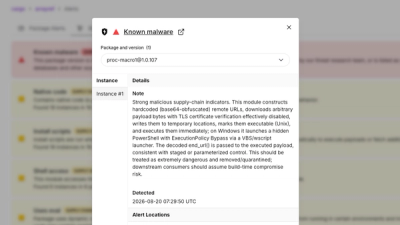
Three compromised Rust crates pulled in a malicious dependency that downloaded and executed cross-platform malware during Cargo builds.