
Research
/Security News
Popular npm Packages in the keyv and Cacheable Namespaces Compromised in Active Supply Chain Attack
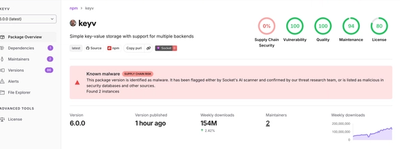
Popular npm packages keyv and cacheable compromised.
By Socket Research Team - Aug 04, 2026
trovex
Advanced tools
trovex: one canonical doc for your coding agents, ~60% fewer tokens.

Your coding agents (Claude Code, Cursor, Windsurf, Zed, any MCP client) reread the repo
every session to work out which .md is current, then answer from a guess. You pay for
that on every session, every agent, every teammate.
trovex indexes your repo's markdown and exposes one MCP tool. Your agent asks a question;
trovex returns the single current doc that answers it as a path:line pointer with a
freshness marker (canonical / stale / duplicate), and serves just the section that answers
instead of the whole file. Agents also write what they learn back through one shared point,
so every agent and teammate reads the same source of truth instead of re-deriving it.
About 60% fewer tokens on doc lookups, measured at equal task-success on our own repo (it varies by yours). Runs locally: vectors in SQLite, embeddings via ONNX, no cloud or API keys.
A 30-second trust check, since the decision happens on the README, not the directory listing:
trovex, trovex_read, trovex_search) and three that mutate only trovex's own doc store (trovex_write, trovex_tag, trovex_delete). No shell execution, no writes to your source files.trovex search prints the savings on yours. Full method at trovex.dev/measure.trovex is in public beta, on PyPI. No clone needed; uv tool install puts trovex
on your PATH:
uv tool install trovex   # one-time, no clone
trovex setup             # wire into Claude Code (skill + hooks + MCP); idempotent

trovex index /path/to/your/repo        # index your markdown (~1 min)
trovex search "how do we roll back a deploy?"   # ask, prints the tokens it saved
trovex serve                           # wire into your agent: MCP at /mcp, dashboard at /savings
Don't have uv? It's a one-line install: curl -LsSf https://astral.sh/uv/install.sh | sh
(or brew install uv).
The search step is the fast way to see the point: it returns the one canonical doc and
prints how many tokens that saved versus reading the top few candidates. Once trovex is
wired into your agent over MCP, the same numbers accumulate on the savings dashboard at
http://localhost:8765/savings.
Prefer not to install anything yet?
uvx trovex search "..."runs a single command in a throwaway environment, no install.
trovex is an MCP server. Point your client at http://localhost:8765/mcp after trovex serve.
Per-client setup (Claude Code, Cursor, Windsurf, Cline, Zed, Roo) is at
trovex.dev/for.
Claude Code, one command. trovex setup installs the Claude Code skill, the
Active-Memory hooks, and registers the MCP server in one step (idempotent, safe to
re-run):
trovex setup
Restart Claude Code afterwards so it loads the skill + hooks. Prefer to wire just the
MCP server by hand? trovex setup --no-skill --no-hooks, or:
claude mcp add --transport http trovex http://localhost:8765/mcp
For Cursor, one click (after trovex serve):
Add trovex to Cursor
trovex turns your repo's markdown into one queryable, canonical store, then serves each agent the single current doc that answers a question, not a pile of candidates to rank.
flowchart LR
  A["Your repo<br/>.md files"] -->|trovex index| B["Chunk + parse"]
  B --> C["Embed locally<br/>ONNX · bge-small"]
  C --> D[("sqlite-vec<br/>vector store")]
  Q["Agent question"] -->|MCP| E["Route + rerank"]
  D --> E
  E --> F["One canonical doc<br/>path:line + freshness"]
  F --> G["Agent answers from<br/>the current doc"]
Four ideas do the work:
path:line pointer to the one doc
and just the section that answers, not the whole file, and not the top-k pile your agent
would otherwise read and rank itself. Closing that gap is where the tokens are saved.bge-small-en-v1.5) and vector search
(sqlite-vec) all run on your machine. No cloud, no API key, no network call to answer a query.trovex_write) in
trovex's own store; every other agent and teammate reads it back (trovex_read) instead
of re-deriving it.The read-and-write loop that keeps every agent on the same source of truth:
sequenceDiagram
  participant A as Agent
  participant T as trovex (MCP)
  participant S as Store (sqlite-vec)
  A->>T: trovex("how do we roll back a deploy?")
  T->>S: route + rerank candidates
  S-->>T: one canonical doc
  T-->>A: path:line + section + freshness
  A->>T: trovex_write("rollback runbook: …")
  T->>S: upsert (dedupes near-copies)
  Note over S: the next agent reads it back via trovex_read
The ~60% is a claim you can run, not a number to take on faith. Two commands:
trovex bench /path/to/your/repo          # token-accounting model, instant, no LLM, no key
trovex bench /path/to/your/repo --eval   # full answer+judge A/B at equal task-success (needs OPENAI_API_KEY)
bench reports the distribution (median + spread), not a best case: the cost of reading the
one routed canonical doc versus the top-k candidates an unaided agent would read. --eval
goes further: both arms answer, an LLM judges, and a saving counts only when both answer
correctly. Full method and our own numbers are at trovex.dev/measure.
Already running trovex through the md-guard hook? trovex measure compares your real .md
token consumption before and after, from the hook's baseline log.
trovex(q): route a question to the right on-disk .md and get back path:line pointers
with freshness markers, not a pile of files to rank.trovex_write(content, kind?, doc_id?, tags?, section?) / trovex_read(query | doc_id, section?):
docs owned inside trovex. An agent stores a record (an incident, a decision, "what
actually worked") once; every other agent and a second dev read it back as content
(optionally just one section) instead of re-deriving it. Pass section= to trovex_write
to patch one heading's section in place instead of replacing the whole doc.trovex_search(query, k?, tags?): passage-level retrieval across the store with tag
filters, for when you want the top matching chunks rather than one canonical doc.trovex_tag(...) / trovex_delete(...): tag or soft-delete a stored doc; delete is a
recoverable archive, not a hard wipe. Both touch only the trovex store, never your files.Humans read trovex-owned docs at /doc/{id} in the rendered reader. To make agents route
.md writes through trovex_write instead of the disk, install the PreToolUse hook
deploy/hooks/trovex-md-guard.sh and carve out exceptions in .trovexignore.
CLAUDE.md / AGENTS.md: one static file that goes stale and can't route a question
to the right doc, vs many docs kept canonical and served per query. More.repomix / files-to-prompt: pack the whole repo into the window vs retrieve the one
answer. More.The reasoning behind the ~60% number is written up in the benchmark methodology.
trovex embeds locally out of the box with BAAI/bge-small-en-v1.5 (ONNX, 384-d).
No API key, nothing leaves your machine. You can swap in any embedder:
TROVEX_EMBED_MODEL=<fastembed model> plus
TROVEX_EMBED_DIM=<its dimension> if it's not a built-in.TROVEX_EMBED_PROVIDER=openai, TROVEX_EMBED_MODEL=<model>,
TROVEX_OPENAI_BASE_URL=http://localhost:11434/v1, TROVEX_EMBED_DIM=<dim>.
Point it at localhost and you stay fully local; point it at OpenAI
(text-embedding-3-large) for stronger retrieval at the cost of sending each
chunk to OpenAI's API.Changing the model changes the vector dimension, so switching requires a reindex.
trovex is in public beta. Install it, run it on your repo, and if it saves you tokens a GitHub star helps other devs find it. Issues and PRs welcome.
Questions, or comparing notes with other people running agents? Join the community on Discord: tsukumo.ch/discord.
trovex is local-first and single-tenant: it runs on your machine, indexes your docs, and
serves your agents. Mutations are gated behind the X-TROVEX-Write-Token header, and the
default is fail-closed: with no token configured, trovex auto-generates a per-instance
token on first run and persists it to <data_dir>/.write_token (chmod 600), so a
network-exposed instance does not accept anonymous writes. Set TROVEX_WRITE_TOKEN to share
one token across machines, or TROVEX_ALLOW_UNAUTH_WRITES=1 to deliberately run with open
writes on a trusted localhost. The trust model, what's hardened, and how to report a
vulnerability are documented in SECURITY.md.
trovex is licensed under the GNU AGPL-3.0-or-later (see LICENSE). You can
self-host and modify it freely; if you run a modified version as a network service, AGPL
requires you to share your changes.
trovex is the context layer of a four-part open-source suite for running AI coding agents in production, built by tsukumo:
trovex is free to run yourself. If your team is rolling out coding agents at scale and wants hands-on help doing it well, or to embed and host a modified trovex privately without the AGPL's copyleft obligations, that's what the consulting is for. Reach out: tsukumo, the team behind trovex.
FAQs
Trovex — token-efficient routing for agent-generated .md docs. MCP + Web UI.
We found that trovex demonstrated a healthy version release cadence and project activity because the last version was released less than a year ago. It has 1 open source maintainer collaborating on the project.
Did you know?

Socket for GitHub automatically highlights issues in each pull request and monitors the health of all your open source dependencies. Discover the contents of your packages and block harmful activity before you install or update your dependencies.
Research
/Security News
Popular npm packages keyv and cacheable compromised.

Security News
A misconfiguration gave three Anthropic models internet access, and one, believing it was in a simulation, shipped a credential-stealing package to PyPI.

Security News
/Company News
Socket has joined the new Composer and Packagist sponsorship program as a launch sponsor, supporting the team that keeps PHP's package ecosystem secure.