

Product
PHP and Composer Support Is Now in Beta
Socket’s PHP and Composer support is now in Beta for all customers, with PHP reachability analysis generally available.
By Trevor Norris, Benjamin Barslev - Aug 21, 2026
url-manager-mcp
Advanced tools


Deliver results as beautiful cards, not raw link dumps. A Model Context Protocol server for saving, organizing, searching, and sharing web resources — cross-device sync, categories, tags, full-text search, batch operations, and team sharing. 21 tools with auto-registration so no manual setup is required.
📖 Usage patterns and best practices → URL Manager Skill
The content human users want to save is everywhere — a YouTube workout video, an Amazon gear link, a Substack training plan — scattered across platforms with no connection.
URL Manager fixes this. Paste any link from any platform. AI auto-identifies the content and suggests a category — confirm and it's a footprint. All saves flow into one platform-agnostic library, organized and always findable. Then share in one click — hand your curated knowledge base to your team, and everyone stays in sync.
A structured, searchable record — a web link, a plain-text note, an idea, or anything worth saving.
| Field | Type | Description |
|---|---|---|
id | UUID | Permanent unique identifier — use for all operations |
url | string (8192) | Original link. Can be empty for text-only footprints |
title | string (512) | Short title |
description | string (1024) | Additional context or notes |
content_type | string (50) | Free text (e.g. article, video, image). Use list_content_types() to see existing values |
category_ids | list[int] | Which categories this belongs to — you assign |
tag_names | list[str] | Free-form keywords — you assign |
A footprint can belong to multiple categories simultaneously.
Like a folder, but a footprint can be in several at once.
| Field | Type | Description |
|---|---|---|
id | int | Permanent numeric identifier — always reference by ID |
name | string (50) | Display name |
mode | string | null | null = personal, "cocreate" = shared co-edit, "subscribe" = shared read-only |
A container that groups related categories. Every user starts with "My Categories" (personal) and "Shared Categories" (shared container).
Category Sets (workspaces)
  └── Categories (labels like "Shopping", "Learning")
        └── Footprints
             └── Tags (free-form keywords)
| Personal | Shared | |
|---|---|---|
mode | null | "cocreate" or "subscribe" |
| Visible to | Only you | You + invited members |
| Members & invite links | No | Yes |
Cocreate — everyone adds/removes footprints. Subscribe — read-only for members (writing returns 403).
| Action | Owner | Admin | Member |
|---|---|---|---|
| Add/remove footprints (cocreate) | ✅ | ✅ | ✅ |
| Add/remove footprints (subscribe) | ✅ | ❌ | ❌ |
| Generate invite link (cocreate) | ✅ | ✅ | ✅ |
| Generate invite link (subscribe) | ✅ | ❌ | ❌ |
| Switch cocreate ↔ subscribe | ✅ | ❌ | ❌ |
| Manage members | Web UI only | — | — |
agent_register()
Create a new account. No parameters. Token is auto-applied for all subsequent calls.
⚠️ Call once only — each invocation creates a fresh account.
my_info()
Verify connection and token validity. Returns username and membership status.
search_footprints(query, limit, offset)
Full-text search across titles, descriptions, and URLs.
query (required) — Search keywordslimit — Results per page (default 10, max 100)offset — Pagination offset (default 0)list_footprints(category_id, limit, offset)
List bookmarks by category. category_id=0 returns all.
limit — Results per page (default 20, max 100)offset — Pagination offset (default 0)get_footprint(footprint_id)
Get full details of a single bookmark.
footprint_id (required) — From list_footprints or search_footprints results (field id)add_footprint(url, title, description, category_ids, tag_names)
Add a new bookmark. Call list_categories() and list_tags() first to discover existing structure.
url (required) — Web page URLtitle — Leave empty to auto-extract from the pagedescription — Summary or notescategory_ids — Comma-separated IDs, e.g. "1,3"tag_names — Comma-separated names, e.g. "AI,tutorial"update_footprint(footprint_id, title, description, category_ids, tag_names)
Update a bookmark. Omitted fields stay unchanged.
⚠️ category_ids replaces the entire list — not append. Call get_footprint() first, then merge IDs.
footprint_id (required) — From search or list resultslist_categories()
List all categories (personal + shared). Returns id, name, and mode fields.
mode=null → personal; mode="cocreate"/"subscribe" → shared.
create_category(name, category_set_id)
Create a new category. Check list_categories() first to avoid duplicates.
name (required) — Category namecategory_set_id — Parent category set (0 = default)list_tags()
List all tags used by this account.
list_content_types()
List all content types the user has used (e.g. article, video, image), ordered most-used first. Use before adding to pick a consistent content_type.
list_category_sets()
List all category sets.
create_category_set(name)
Create a new category set (a container of categories).
name (required) — Category set namecreate_shared_category(name, mode, description)
Create a shared category for team collaboration.
name (required)mode (required) — "cocreate" (multiple editors) or "subscribe" (read-only)description — Optional description
⚠️ In subscribe mode, adding bookmarks returns 403. Use "cocreate" for editable collaboration.create_invite_link(shared_category_id, duration_hours)
Generate an invite link for others to join.
shared_category_id (required) — From list_categories() (shared entries)duration_hours — Default 24join_shared_category(invite_code)
Join a shared category by invite code.
invite_code (required) — 8-character code from the invite linkadd_to_shared_category(shared_category_id, footprint_id)
Add one of your own bookmarks to a shared category.
remove_from_shared_category(shared_category_id, footprint_id)
Remove a bookmark from a shared category. Does not delete the bookmark itself.
copy_footprint(footprint_id, category_ids)
Copy a bookmark from a shared category into your personal collection.
batch_update_footprints(updates)
Bulk edit up to 50 bookmarks at once.
updates (required) — JSON string: [{"id":"...", "title":"New Title", "category_ids":"1,3"}, ...]
Each object may contain title, description, category_ids, tag_names; id is required.agent_magic_link()
🔑 The delivery loop core. After organizing, generate a link → send to user. They click to see a card-based interface with all their organized bookmarks. Valid for 30 days, reusable.
1. agent_register() → get token (auto-memorized)
2. add_footprint(url="...") × N → save bookmarks one by one
3. list_categories() → understand current structure
4. create_category(name="Learning") → create a category
5. update_footprint(id, category_ids="...") → categorize
6. agent_magic_link() → "Done! View your collection here → [link]"
1. my_info() → confirm identity
2. list_categories() + list_tags() → understand current structure
3. search_footprints(query) or list_footprints(category_id) → find targets
4. add_footprint / update_footprint → operate
5. agent_magic_link() → deliver results
1. create_shared_category(name="Team KB", mode="cocreate")
2. create_invite_link(shared_category_id=<returned ID>)
3. Send invite code to user → user shares with teammates
4. Teammates' agents join via join_shared_category(invite_code)
# ❌ Wrong: moving bookmark 42 to category 7 loses existing categories 3 and 5
update_footprint(42, category_ids="7")

# ✅ Right: fetch current categories first, then merge
get_footprint(42) → existing categories [3, 5]
update_footprint(42, category_ids="3,5,7")
Writing to a subscribe-mode shared category returns 403. If the user says "I subscribed but can't add anything", explain it's read-only — the creator needs to change it to cocreate.
Each call creates a fresh empty account. Always check for a saved token first. If unsure, call my_info() to verify the current token is valid.
Rapid consecutive calls may trigger HTTP 429. Add short delays between batch operations; on 429, wait a few seconds and retry.
Inviting or removing members from shared categories requires the web UI at https://ai.ocean94.com. You cannot do this programmatically.
search_footprints for targeted queries instead of dumping everythinglist_categories() and list_tags() before adding to avoid duplicatesURL Manager excels at saving and organizing. Pair it with tools that excel at discovering and fetching:
Fetch MCP scrapes web  →  add_footprint()  →  auto-categorized, permanent, searchable
Firecrawl crawls pages →  add_footprint()  →  organized into cards
Brave Search finds URLs →  add_footprint()  →  one-click save from search results
Agents just pass the upstream MCP's URL + title as params to add_footprint.
git clone https://github.com/Piccolo123/url-manager-mcp.git
cd url-manager-mcp
pip install -r requirements.txt
Or from PyPI:
uvx url-manager-mcp # or: pip install url-manager-mcp
https://ai.ocean94.comAdd to your profile's cordis.patch.yml (e.g. ~/.dsh/profiles/headless/cordis.patch.yml or the web profile):
- insert:
    - id: mcp-url-manager
      name: '@deepseek-ai/dsh-mcp-client'
      config:
        serverName: url_manager
        transport: stdio
        command: uvx
        args: ['url-manager-mcp']
        env:
          FOOTPRINTS_ENDPOINT: 'https://ai.ocean94.com'
All 21 tools appear as mcp__url_manager__* (add_footprint, search_footprints, list_categories, agent_magic_link, …). The model auto-registers on first use — no API key needed. The companion skill (Piccolo123/url-manager) is also auto-discovered by dsh when cloned into ~/.dsh/skills/.
{
  "mcpServers": {
    "url-manager": {
      "command": "python",
      "args": ["path/to/url-manager-mcp/server.py"]
    }
  }
}
If the user has an existing account:
{
  "mcpServers": {
    "url-manager": {
      "command": "python",
      "args": ["path/to/url-manager-mcp/server.py"],
      "env": {
        "FOOTPRINTS_TOKEN": "FA_xxxxxxxxxxxx"
      }
    }
  }
}
Same JSON structure as above. Works with any MCP-compatible client supporting STDIO transport.
This server supports both STDIO (default) and Streamable HTTP transports:
# STDIO (default)
python server.py

# Streamable HTTP (for Docker / Glama / hosted environments)
python server.py --http
docker build -t url-manager-mcp .
docker run -e FOOTPRINTS_TOKEN="FA_xxx" url-manager-mcp
One-click hosted deployment: url-manager-mcp
Browser bookmarks are flat lists with no organization, no search, and no sharing. URL Manager adds:
FAQs
URL Manager MCP Server — Agent-first web link collection & knowledge management
We found that url-manager-mcp demonstrated a healthy version release cadence and project activity because the last version was released less than a year ago. It has 1 open source maintainer collaborating on the project.
Product
Socket’s PHP and Composer support is now in Beta for all customers, with PHP reachability analysis generally available.
Product
Socket is bringing experimental protection to Firefox, scanning 97,000+ extensions in Mozilla's official directory for malware and risky updates.
Research
/Security News
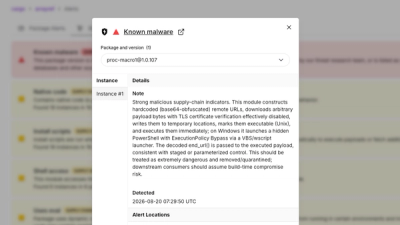
Three compromised Rust crates pulled in a malicious dependency that downloaded and executed cross-platform malware during Cargo builds.