
Research
/Security News
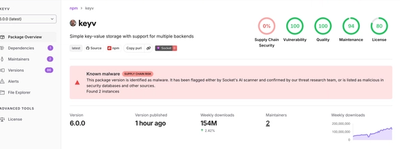
Popular npm Packages in the keyv and Cacheable Namespaces Compromised in Active Supply Chain Attack
Popular npm packages keyv and cacheable compromised.
By Socket Research Team - Aug 04, 2026
vaara
Advanced tools
Accountable Autonomy for AI agents under the EU AI Act: policy-gated tool calls, hash-chained tamper-evident audit trails with external time anchoring, and independently verifiable attestation plus execution receipts per MCP tool call






Accountable Autonomy.
A verifiable receipt for every autonomous action, checkable by anyone.
Your AI agent transferred the funds, wrote the file, called the tool. Later, someone who does not trust you asks you to prove exactly what it did and why: a regulator, an auditor, a customer after an incident. Your own logs will not settle it, because you could have edited them.
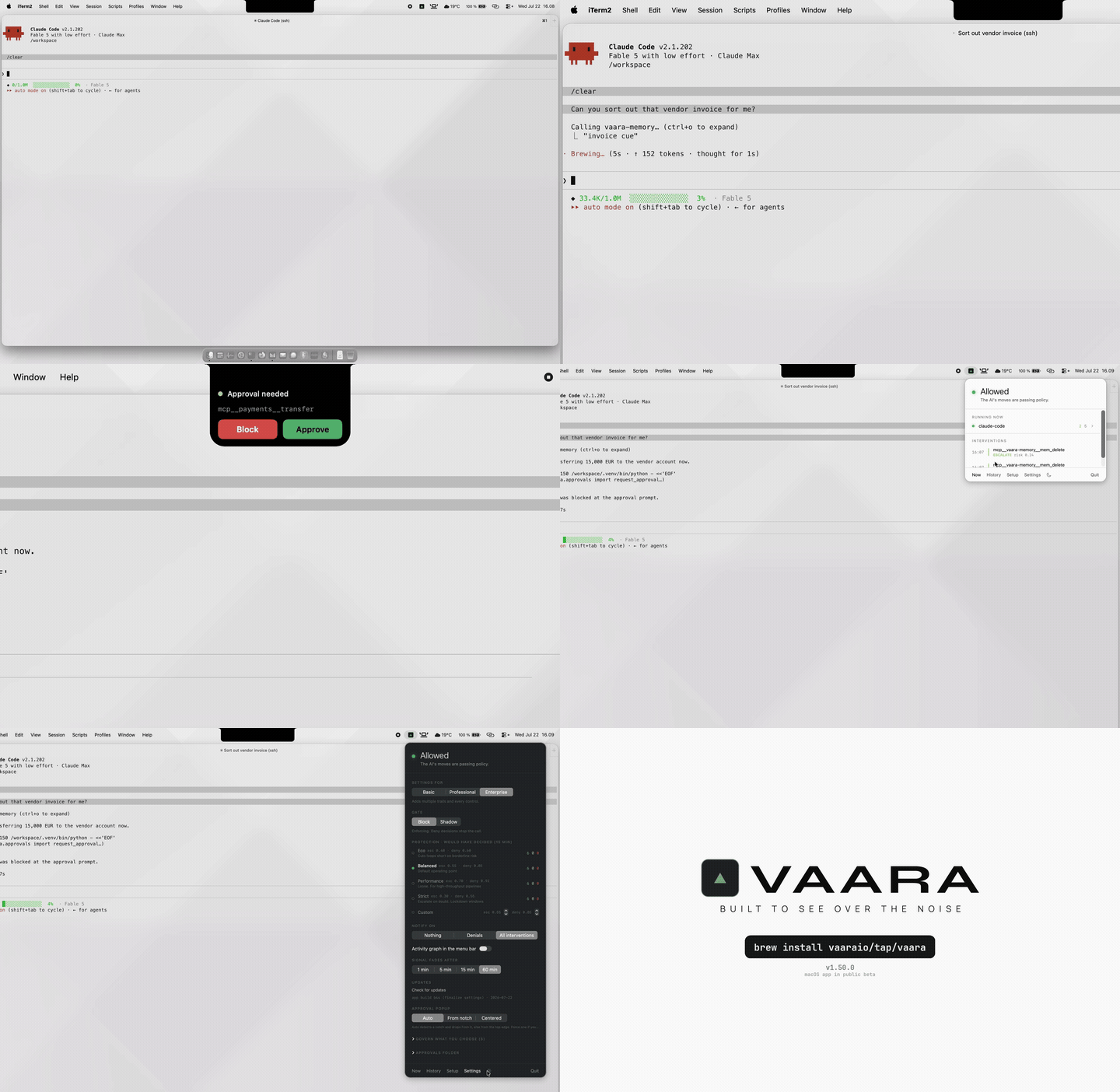
▶ Watch the launch video (24s) · Vaara for macOS is in public beta
pip install vaara # Python: CLI, MCP proxy, server
brew tap vaaraio/tap && brew install vaara # macOS: CLI + menu-bar app (built from source)
npm install @vaara/client # TypeScript client for the HTTP API
import vaara

@vaara.govern
def transfer_funds(to: str, amount: float) -> str:
    ...
That is the whole thing. Every call to a governed function is risk-scored and decided against your policy before the body runs. A blocked call raises vaara.Blocked; an allowed call runs, and the decision, the call, and the outcome land in a hash-chained, tamper-evident record anyone can verify offline — sign it at export (vaara trail export) for third-party proof. Records persist to ~/.vaara/trail/audit.db by default, so evidence survives restarts. Python 3.10+, zero runtime dependencies.
The decorator drives the same engine you can call directly when you want the decision object in hand.
from vaara.pipeline import InterceptionPipeline

pipeline = InterceptionPipeline()
result = pipeline.intercept(
    agent_id="agent-007",
    tool_name="fs.write_file",
    parameters={"path": "/etc/service.yaml", "content": "..."},
    agent_confidence=0.8,
)
if result.allowed:
    pipeline.report_outcome(result.action_id, outcome_severity=0.0)
else:
    print(result.reason)
Every call gets a risk score and an allow / block / escalate decision against your policy, then the call, the decision, and the real outcome are written to the audit trail. report_outcome closes the loop: the scorer reweights based on which signals actually predicted the outcome. Releases ship SLSA Build Level 3 provenance, verifiable with slsa-verifier verify-artifact. Optional ML classifier: pip install 'vaara[ml]'.
Writing a trail is the easy half. The half that matters is letting someone who does not trust you check it, with no key, no access, and none of your code. Every Vaara record is content-addressed and fail-closed on authenticity, and ships with public conformance vectors plus a standalone checker that imports no Vaara code, so an independent party reproduces every verdict offline.
vaara verify-bundle evidence-bundle.json
ok only when a signature is actually established, not merely present in a log. The same property drives the standards work behind the Vaara Receipt Internet-Draft: evidence that holds up for someone who runs none of your software. The full verifier set, the trust model for each verb, and where trust comes from in each case are in docs/verifying-evidence.md.
To check that claim yourself, without installing Vaara, run the standalone checker against the published vectors. Its only dependencies are cryptography and rfc8785:
git clone https://github.com/vaaraio/vaara
cd vaara
pip install cryptography rfc8785        # the checker's only dependencies
python tests/vectors/external_evidence_v0/_check_independent.py
It re-derives every verdict from the receipt bytes and the public key alone. The output shows the property the trail is built for: a receipt dropped from inside a declared boundary is a provable gap from the held set, with no issuer access and no external witness.
For the whole loop in one runnable file, produce a signed record, verify it yourself, then watch a single forged byte get caught, see examples/prove-it-yourself/. The logs-versus-evidence argument behind it is in docs/logs-vs-evidence.md.
The aggregate runner grades every suite at once, and grades another implementation's vectors the same way:
python scripts/conformance_runner.py                                 # grade the reference corpus
python scripts/conformance_runner.py --vectors-dir ./your_vectors    # grade your own
The named, versioned rule set, what a pass does and does not establish, and the full suite list are in docs/conformance-profile.md.
vaara compliance report --format json against a real trail produces an article-level evidence record an auditor reads directly. Articles with no recorded events return evidence_insufficient, not a rubber stamp.
{
  "system_name": "Acme HR Assistant",
  "overall_status": "evidence_insufficient",
  "trail_integrity": {"size": 105, "chain_intact": true},
  "articles": [
    {"article": "Article 12(1)", "title": "Record-Keeping (Logging)",
     "status": "evidence_sufficient", "strength": "strong", "evidence_count": 105},
    {"article": "Article 15(1)", "title": "Accuracy, Robustness and Cybersecurity",
     "status": "evidence_insufficient", "strength": "absent", "evidence_count": 0}
  ]
}
Each verdict carries the threshold-versus-observed snapshot, the rationale, and the underlying records, so a reviewer traces status back to a concrete event. The same data renders as a Notified-Body PDF, a static HTML dashboard, or a Sigstore-signed handoff envelope. See docs/COMPLIANCE.md.
vaara verify-contiguity). Off by default.Native adapters route the major Python agent frameworks through the same pipeline, each via the framework's own hook, emitting identical audit events:
| Framework | Entry point |
|---|---|
| LangChain | VaaraCallbackHandler, vaara_wrap_tool |
| CrewAI | VaaraCrewGovernance |
| OpenAI Agents SDK | VaaraToolGuardrail, vaara_wrap_function |
| MCP server | vaara.integrations.mcp_server |
To put Vaara in front of an MCP server, run it as a proxy. Every tools/call routes through the pipeline before reaching the upstream; allowed calls forward transparently, blocked calls return an MCP error.
vaara-mcp-proxy \
  --upstream npx --upstream-arg -y --upstream-arg @sap/mdk-mcp-server \
  --db ./mcp_audit.db --shadow
Start with --shadow: every call is classified, scored, and recorded, nothing is blocked. After a few days, vaara trail shadow-report --db ./mcp_audit.db shows what enforcement would have done; then drop the flag and enforce, starting from a ready-made perimeter for common MCP servers in examples/policies/mcp-starters/. Point your MCP client (Claude Code, Cursor, any host) at the proxy instead of the upstream. There is also an HTTP API (pip install 'vaara[server]', vaara serve) and a first-party TypeScript client on npm (@vaara/client) for non-Python agents. Framework details, the cloud and OSS guardrail adapters (Bedrock, Azure, GCP, NeMo, Guardrails AI, LLM Guard, Rebuff), and the multi-tenant proxy are in docs/adapters.md.
Each risk score blends five expert signals and keeps adapting as outcomes come back, and it carries a confidence interval with a coverage guarantee that holds regardless of the input distribution. On a held-out adversarial corpus the classifier reaches 84.7% recall (95% Wilson [82.4, 86.7]) at a 4.1% false-positive rate, and 1.2% FPR on benign calls under live injection pressure. The hot-path rule scorer adds 140 µs mean per call on commodity CPU; the ML classifier is opt-in (vaara[ml]) and off that path. Every figure is reproducible via make bench.
Method and per-cell breakdown: docs/architecture.md and bench/.
draft-sirkkavaara-vaara-receipt. A second independent implementation has reproduced the SEP-2828 conformance vectors from a clean checkout with no shared code. Published corpora with independent checkers cover the fallback binding path (tests/vectors/fallback_projection_v0/) and CrewAI governance decisions (tests/vectors/governance_decision_v0/).Details and the offline checkers for each: docs/standards.md.
The public surface is fixed: the signed envelope (vaara.receipt/v1), capability constraints, the credential grant and gateway, and the @vaara.govern entry point. No new primitives are planned. New behavior ships as profiles that pin to vaara.receipt/v1, not as new core types, and no new format bindings will be added (the last was v1.13.0). From here the work is hardening and subtraction within this surface, so anyone building on it has a stable target.
| Path | Contents |
|---|---|
| docs/verifying-evidence.md | Every verifier and its trust model |
| docs/logs-vs-evidence.md | Logs vs evidence: proving what an agent did, and what the AI Act actually requires |
| docs/prove-what-an-ai-agent-did.md | The four properties a provable record of agent actions needs |
| docs/eu-ai-act-article-12.md | Article 12 record-keeping: what it requires, what it does not, what to demand from tooling |
| docs/tamper-evident-audit-trail.md | How the trail works, its honest limits, and what it costs |
| docs/vaara-vs-observability-vs-grc.md | Vaara vs Datadog/Splunk vs Vanta/Drata: three different questions |
| docs/dogfood/ | Our marketing runs under this gate; the signed trail and key to verify it |
| docs/architecture.md | Scoring, conformal coverage, time anchor, formal properties |
| SPEC.md | The canonical vaara.receipt/v1 receipt format spec |
| docs/standards.md | SEP-2828, SEP-2787, OVERT, the sovereign inference harness |
| docs/adapters.md | Framework and cloud/OSS guardrail adapters, multi-tenant proxy |
| docs/COMPLIANCE.md | EU AI Act and DORA article mapping, eval numbers |
| docs/multi-replica-deployment.md | Scaling past one proxy process: per-replica chains, rotation, archive index |
| CHANGELOG.md | Version-by-version evolution |
| docs/PRIOR_ART.md | When each concept first shipped, plus adjacent work |
Vaara helps deployers assemble evidence for their own conformity work. It does not certify compliance or constitute legal advice. Deployers own their obligations under the EU AI Act and other applicable law.
Commercial license and paid pilots available: see vaara.io or contact hello@vaara.io. Licensing terms are in LICENSING.md.
If you build on Vaara or its receipt format, cite the repository (see CITATION.cff) and the specification it implements:
Henri Sirkkavaara. The Vaara Receipt: A Recomputable Receipt Format for Decisions About Agent Actions. IETF Internet-Draft draft-sirkkavaara-vaara-receipt.
Copyright © 2026 Henri Sirkkavaara. Licensed under AGPL-3.0-or-later. See LICENSE.
FAQs
Accountable Autonomy for AI agents under the EU AI Act: policy-gated tool calls, hash-chained tamper-evident audit trails with external time anchoring, and independently verifiable attestation plus execution receipts per MCP tool call
The pypi package vaara receives a total of 1,067 weekly downloads. As such, vaara popularity was classified as popular.
We found that vaara demonstrated a healthy version release cadence and project activity because the last version was released less than a year ago. It has 1 open source maintainer collaborating on the project.
Did you know?

Socket for GitHub automatically highlights issues in each pull request and monitors the health of all your open source dependencies. Discover the contents of your packages and block harmful activity before you install or update your dependencies.
Research
/Security News
Popular npm packages keyv and cacheable compromised.

Security News
A misconfiguration gave three Anthropic models internet access, and one, believing it was in a simulation, shipped a credential-stealing package to PyPI.

Security News
/Company News
Socket has joined the new Composer and Packagist sponsorship program as a launch sponsor, supporting the team that keeps PHP's package ecosystem secure.