

Company News
AWS Security Hub Adds Socket for Supply Chain Security
Socket is now in the AWS Security Hub Extended plan. Adopt it through AWS, apply committed spend, and block malicious open source packages.
By Feross Aboukhadijeh - Aug 04, 2026
vcp-sdk
Advanced tools
Python SDK for the Value Context Protocol (VCP) — portable AI ethics
validation — plus the Creed Commons client (vcp CLI) for installing
signed value artifacts.
pip install vcp-sdk            # core SDK (stdlib-only)
pip install "vcp-sdk[hub]"     # + the vcp CLI for Creed Commons
from vcp import Token, CSM1Code, validate_lite

token = Token.parse("family.safe.guide@1.0.0")
code = CSM1Code.parse("N5+F+E")
errors = validate_lite({"vcp_version": "lite-1.0", ...})
Creed Commons distributes constitutions, creeds, and detector configs as signed data that a values engine interprets — never executable code. Installing an artifact is a signature-verification decision, not a code-execution one:
vcp search gaslighting
vcp install creed-space/anti_gaslighting     # verify Ed25519 + sha256 + schema, then write
vcp verify                                    # re-check installed tree against vcp.lock
vcp install verifies against a trust root pinned inside this package
(the registry cannot vouch for itself), pins name@version + content sha256 +
the verifying key in vcp.lock, and never imports, evals, or executes what it
fetched.
Community namespaces are delegated, never a new root: the hub's
namespace_registry.json binds each namespace to its publisher's Ed25519 keys
and is itself signed by the pinned root; artifacts must verify against a key
registered to their own namespace. Registration and moderation:
GOVERNANCE.md.
Trust tiers: signed proves integrity and origin, not semantics; verified
additionally carries a domain-separated root counter-signature (issued
after lint + red-team + human review) that the client checks on install and
on every vcp verify.
Alongside the Creed Commons commands, vcp runs the protocol operations
directly. These call the same functions the MCP tools do, so scripted CLI
output and MCP tool output carry the same fields.
vcp token validate family.safe.guide@1.0.0   # parse a VCP/I token
vcp token parse N5+F+E                       # parse a CSM1 code
vcp lite validate agent.json                 # validate a VCP-Lite document
vcp lite to-csm1 agent.json                  # VCP-Lite document -> CSM1 code
vcp encode --space office --agency peer      # context -> VCP/A wire format
vcp classify "Never endanger a child"        # principle -> Schwartz value
vcp status                                   # versions, capabilities, vocabularies
Output is JSON by default. --quiet prints just the value the command is
about, for shell consumption:
$ vcp lite to-csm1 agent.json --quiet
N5+F+E

$ vcp encode --space office --constraints legal --constraints time --quiet
📍office|🔒legal+time
The validate/parse commands exit 0 when valid and 1 when invalid, so
they work as a CI gate:
vcp lite validate agent.json --quiet || exit 1
vcp encode takes one flag per context dimension (--space, --agency,
--cognitive-state, …); --company and --constraints repeat for multiple
values, and each personal dimension has a matching --<dim>-intensity (1-5).
Run vcp encode --help for the full list.
vcp-mcp exposes the SDK to any MCP client (Claude Code, Claude Desktop, or
anything else that speaks the protocol). It runs over stdio by default and is
pure local computation — no network calls, no state between calls, no user
data read.
pip install "vcp-sdk[mcp]"
vcp-mcp
Claude Desktop / Claude Code config:
{
  "mcpServers": {
    "vcp": {
      "command": "vcp-mcp"
    }
  }
}
| Tool | What it does |
|---|---|
vcp_status | SDK/spec versions, capabilities, dimension and persona vocabularies |
vcp_validate_token | Parse a VCP/I token into domain / approach / role / version / namespace |
vcp_parse_csm1 | Parse a CSM1 code; reports scopes, deprecations, and scope conflicts |
vcp_encode_context | Encode the 18 VCP/A context dimensions to wire, JSON, and session metadata |
vcp_validate_lite | Validate a VCP-Lite document; returns the equivalent CSM1 code and token |
vcp_lite_to_csm1 | Convert VCP-Lite persona/adherence/scopes to a CSM1 code |
creed_classify_principle | Map a constitution principle to a Schwartz value; flag circular-model tensions |
Resource vcp://lite/examples serves the bundled VCP-Lite example documents.
For hosted deployments, vcp-mcp also speaks Streamable HTTP:
vcp-mcp --transport http --port 8080 # binds 127.0.0.1, endpoint /mcp
--port defaults to $PORT then 8080. The endpoint runs stateless (a
fresh transport per request), so a gateway may route any request to any
replica. Only POST /mcp is served — GET would otherwise hold an idle event
stream open per connection, so it is refused with a clean JSON-RPC 405. A
GET /health endpoint returns {"status": "ok"}.
The server has no authentication of its own, so binding beyond loopback requires an explicit opt-in:
VCP_MCP_ALLOW_INSECURE_HTTP=true vcp-mcp --transport http --host 0.0.0.0
Set that only where a gateway or reverse proxy fronts the server and handles client auth.
pip install -e ".[dev]"
pytest tests/
Apache-2.0. © Creed Space.
FAQs
Value Context Protocol SDK — portable AI ethics validation
We found that vcp-sdk demonstrated a healthy version release cadence and project activity because the last version was released less than a year ago. It has 1 open source maintainer collaborating on the project.
Did you know?

Socket for GitHub automatically highlights issues in each pull request and monitors the health of all your open source dependencies. Discover the contents of your packages and block harmful activity before you install or update your dependencies.
Company News
Socket is now in the AWS Security Hub Extended plan. Adopt it through AWS, apply committed spend, and block malicious open source packages.
Research
/Security News
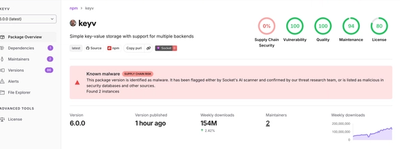
Popular npm packages keyv and cacheable compromised.

Security News
A misconfiguration gave three Anthropic models internet access, and one, believing it was in a simulation, shipped a credential-stealing package to PyPI.