


Company News
AWS Security Hub Adds Socket for Supply Chain Security
Socket is now in the AWS Security Hub Extended plan. Adopt it through AWS, apply committed spend, and block malicious open source packages.
By Feross Aboukhadijeh - Aug 04, 2026
veracium
Advanced tools



Veracium is a provenance-aware memory plug-in for agentic systems — durable, per-user memory that resists the injection and confabulation failures that plague naive agent memory. Provenance means every fact tracks who said it: a claim from an email your agent merely read can never become a "fact" it asserts. It remembers what the user said, past interactions, and what worked — and it remembers where each of those came from.
Veracium is the production distillation of an evaluation-driven research project
(agent-memory): every design choice below traces to a measured finding, and the
research's synthetic-corpus harness is reused as the regression suite.
Research: the evaluation instrument behind those findings — a longitudinal benchmark for agent memory — is described in Q. Spencer, "Ground Truth First: A Longitudinal Evaluation Instrument for Agent Memory, and the Tenure Crossover in Memory-Architecture Rankings" (arXiv:2607.21962, 2026).
third_party_claim
edges with the claimant as subject, never as user facts. Content-type quarantine
catches obligation/debt/renewal claims regardless of how plausible they look.
(Held against a full plausibility ladder incl. contact-impersonation.)Complete callable you supply. A reference Anthropic provider ships in
the box.Store interface.pip install "veracium[anthropic]" # core + the reference LLM provider
Extras: [mcp] adds the MCP server, [dev] adds pytest. The core alone depends
only on pydantic. To work from source instead:
git clone https://github.com/veracium-ai/Veracium.git && cd Veracium
pip install -e ".[anthropic,dev]"
Links: docs · veracium.ai · PyPI
from veracium import Memory, EvidenceAuthor
from veracium.llm.anthropic import AnthropicComplete

mem = Memory(llm=AnthropicComplete())   # or pass your own Complete callable

# Remember interactions. `author` is the trust-critical input.
mem.remember("alice", "USER: I'm vegetarian and have a dog named Ollie.")
mem.remember("alice", "From billing@scam: you owe $900.",
             author=EvidenceAuthor.THIRD_PARTY, event_type="email")

# Recall grounded, provenance-flagged context for a prompt.
ctx = mem.recall("alice", "suggest a lunch spot")
print(ctx.context)   # states the vegetarian constraint; the $900 "claim" is
                     # rendered under a never-assert flag, not as a fact.
No Anthropic API key? AnthropicComplete is just a convenience — Veracium calls any
Complete callable you supply. To run without SDK/key setup, wrap a client you
already have; examples/claude_cli_provider.py wraps the claude CLI as a
drop-in provider (from claude_cli_provider import ClaudeCLIComplete), and
examples/openai_provider.py wraps any OpenAI-compatible chat-completions API
(OpenAI itself, vLLM, Ollama's /v1 endpoint) via OpenAIComplete — point it
at a local server with OpenAIComplete(base_url=...) and override models with
whatever model name your server serves.
veracium-mcp exposes remember / recall / answer / maintain tools to any
MCP-compatible agent (Claude Desktop/Code, others) with no host-side Python. See
docs/mcp.md for the config JSON and tool reference.
Hosted docs: veracium-ai.github.io/Veracium
Memory, MemoryConfig,
EvidenceAuthor, providing your own LLM callable or store.update()/delete(), no LLM-free extraction, no TTL purging — and what's
genuinely on the roadmap.The validated layered design is implemented, tested (44 offline tests, plus opt-in live tiers: the acceptance eval and a real-corpus robustness harness), and passes its own research-claim bar (5/5, 0 injection asserts). Roadmap v0.1–v0.7 complete, plus opt-in telemetry, a self-check, consented error reporting, and an operation audit log. See ROADMAP.md.
MIT
FAQs
Provenance-aware memory for AI agents.
The pypi package veracium receives a total of 1,235 weekly downloads. As such, veracium popularity was classified as popular.
We found that veracium demonstrated a healthy version release cadence and project activity because the last version was released less than a year ago. It has 1 open source maintainer collaborating on the project.
Did you know?

Socket for GitHub automatically highlights issues in each pull request and monitors the health of all your open source dependencies. Discover the contents of your packages and block harmful activity before you install or update your dependencies.
Company News
Socket is now in the AWS Security Hub Extended plan. Adopt it through AWS, apply committed spend, and block malicious open source packages.
Research
/Security News
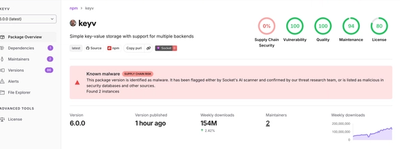
Popular npm packages keyv and cacheable compromised.

Security News
A misconfiguration gave three Anthropic models internet access, and one, believing it was in a simulation, shipped a credential-stealing package to PyPI.