
Research
/Security News
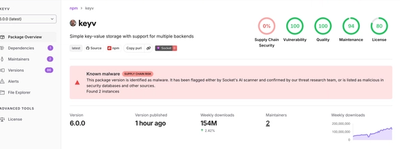
Popular npm Packages in the keyv and Cacheable Namespaces Compromised in Active Supply Chain Attack
Popular npm packages keyv and cacheable compromised.
By Socket Research Team - Aug 04, 2026
yagami
Advanced tools
Open-source AI context firewall for governed model, retrieval, memory, and tool access.





Documentation | Gateway API | Deployment | Security | Roadmap
Yagami sits between your software and local models, cloud LLMs, retrieval systems, and tools. It classifies context locally, evaluates versioned policy, routes only to allowed destinations, inspects outputs, and produces content-free evidence for each decision.
Existing OpenAI SDK applications can adopt it by changing one base_url.
Yagami can run as a headless gateway, in a container or Kubernetes, or with its
included React control surface.
The demo requires no API key, provider account, Ollama model, or Node.js:
python -m pip install yagami
yagami demo
Open http://127.0.0.1:8000. Demo mode uses a local echo backend, blocks cloud routing, and exercises the UI, policy, lineage, storage, and audit path.
Take the no-data security tour or run the flagship security demos for secret containment, poisoned retrieval, and identity-bound tool approval.
Initialize persistent user configuration, check the host, and start Yagami:
yagami init
yagami doctor
yagami serve
Then point an OpenAI client at the gateway:
from openai import OpenAI

client = OpenAI(
    base_url="http://127.0.0.1:8000/v1",
    api_key="your-yagami-project-key",
)

response = client.chat.completions.create(
    model="yagami-auto",
    messages=[{"role": "user", "content": "Summarize this document."}],
    metadata={
        "purpose": "internal-documentation",
        "sensitivity": "none",
        "session_id": "example-session",
    },
)
print(response.choices[0].message.content)
Supported caller sensitivity values are none, phi, phi_medical, and
secret. A caller hint can make the policy stricter; it cannot lower a
sensitivity detected by Yagami.
For production authentication, policy, and deployment settings, follow the deployment guide.
| Area | Included |
|---|---|
| Compatible APIs | OpenAI Chat Completions, core Responses API, Streamable HTTP MCP |
| Identity | Scoped project API keys and OIDC/JWT workload identity |
| Policy | Versioned YAML/JSON rules, restrictive merging, preview, replay, shadow mode, regression tests, signed bundles |
| Privacy | Local classification, caller sensitivity, context lineage, AES-GCM tokenization, rehydration, output DLP, optional Presidio |
| Tools | Function calling, governed built-in skills, stdio and remote MCP, one-time approvals |
| Operations | Spend/rate/concurrency/context limits, health checks, Prometheus, OpenTelemetry, SIEM export, approval webhooks |
| Packaging | Python 3.11-3.14, PyPI, non-root container, Docker Compose, Helm, SBOMs, checksums, and build provenance |
Local generation works with Ollama, llama.cpp through
the optional llama-cpp-python runtime, and Microsoft Foundry Local through
its loopback OpenAI-compatible service. Direct cloud adapters cover Anthropic,
OpenAI, Mistral, Groq, OpenRouter, Google Gemini, and Stability AI image
generation.
Yagami also works with LangChain/LangGraph, the Vercel AI SDK, Microsoft Presidio, Splunk HEC and generic SIEM webhooks, Slack and Teams approval notifications, and upstream gateways such as LiteLLM, Portkey, Kong, or Envoy. See the integration recipes.
application or agent
  -> authentication and project limits
  -> local sensitivity and context-lineage inspection
  -> versioned policy and optional transformation
  -> allowed local model, cloud model, retrieval source, or tool
  -> output DLP
  -> response plus content-free policy passport and audit evidence
Policy is the final authority. Slash commands and explicit backend selection cannot override a sensitive-data restriction. Classifier failures fail local by default, and cloud routes can be blocked entirely or stopped at a daily spend cap.
Yagami is an enforcement component, not a compliance certification. Automated detection can miss sensitive data. Strict deployments should declare sensitivity at the caller, use a local-only policy, test organization-specific cases, encrypt storage at the host or volume layer, and review the threat model.
The project is alpha. Validate policy and failure behavior against your own requirements before production use.
Focused issues and pull requests are welcome. Read CONTRIBUTING.md, the security policy, and the code of conduct.
MIT - Copyright (c) 2026 Matthew Tracy and Yagami contributors.
FAQs
Open-source AI context firewall for governed model, retrieval, memory, and tool access.
We found that yagami demonstrated a healthy version release cadence and project activity because the last version was released less than a year ago. It has 1 open source maintainer collaborating on the project.
Did you know?

Socket for GitHub automatically highlights issues in each pull request and monitors the health of all your open source dependencies. Discover the contents of your packages and block harmful activity before you install or update your dependencies.
Research
/Security News
Popular npm packages keyv and cacheable compromised.

Security News
A misconfiguration gave three Anthropic models internet access, and one, believing it was in a simulation, shipped a credential-stealing package to PyPI.

Security News
/Company News
Socket has joined the new Composer and Packagist sponsorship program as a launch sponsor, supporting the team that keeps PHP's package ecosystem secure.