
Research
/Security News
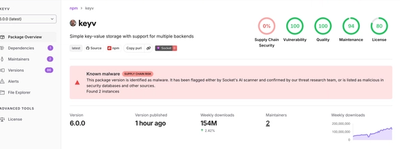
Popular npm Packages in the keyv and Cacheable Namespaces Compromised in Active Supply Chain Attack
Popular npm packages keyv and cacheable compromised.
By Socket Research Team - Aug 04, 2026
zapi-mcp
Advanced tools
English | 日本語
MCP (Model Context Protocol) server for the Zabbix API.
Built for network operations: a single daily_brief call summarizes active
problems plus site-specific categories (DHCP pool usage, SNAT session usage,
core-network problems, …), and individual tools query problems, hosts, and item
values. Organization-specific tags live in a config file, not the code, so the
server stays generic.
Version-adaptive auth: works against Zabbix 6.0 LTS (user + auth field) and
forward-compatible with 6.4 / 7.0 (username + Authorization: Bearer).
| Tool | Description |
|---|---|
health_check | Server version, Zabbix connectivity/auth, detected API version, and configured daily_brief categories — call at session start or after a timeout |
daily_brief | Morning patrol: active problems (Warning+) plus one section per configured category |
get_problems | Active problems by severity and tag, newest-first with age; header shows the true total (showing N of TOTAL when capped); output includes eventid |
get_hosts | List hosts filtered by role/tag/group, with IP and tags |
get_host_items | Current item values for a host (server-side host filter) |
acknowledge_problem | Acknowledge problems and add a message (does not close them) |
# uv
uv pip install zapi-mcp

# pip
pip install zapi-mcp
Or from source:
git clone https://github.com/shigechika/zapi-mcp.git
cd zapi-mcp

# uv
uv sync

# pip
pip install -e .
Set the following environment variables:
| Variable | Description | Default |
|---|---|---|
ZABBIX_URL | Zabbix base URL (e.g. https://zabbix.example.com); /api_jsonrpc.php is appended if absent | required |
ZABBIX_USER | Zabbix API user | required |
ZABBIX_PASSWORD | Zabbix API password | required |
ZABBIX_CATEGORIES_INI | Path to a categories INI file for daily_brief (optional) | — |
ZABBIX_BRIEF_RECENT_HOURS | daily_brief "recent" window in hours; problems older than this are folded to a count | 24 |
ZABBIX_BRIEF_PROBLEM_LIMIT | Max active problems daily_brief fetches per call before counting the rest | 1000 |
The API user needs read permission for the host groups you query, plus
acknowledge permission if you use acknowledge_problem.
daily_briefProblems are grouped by severity and listed newest-first, each annotated with
its age (e.g. 3h ago). Problems older than the recent window
(ZABBIX_BRIEF_RECENT_HOURS, default 24h) are folded to a single
… and N older (stale; oldest …) line — so a backlog of alerts that Zabbix
keeps active because their recovery is never auto-confirmed (ICMP ping down, RDP
down, …) doesn't bury what just happened. Section headers carry the true total
and show showing N of TOTAL when the fetch is capped, never a silent truncation.
daily_brief (optional)daily_brief always lists active problems. To add site-specific sections —
DHCP pool exhaustion, SNAT session usage, core-network problems — point
ZABBIX_CATEGORIES_INI at an INI file. Each [section] is one category:
[dhcp]
name = DHCP Pool Usage
tag = dhcp-pool-usage      ; Zabbix host tag identifying the group
item_key = usage           ; report current values for this exact item key
threshold = 80             ; flag values >= this

[snat]
name = SNAT Session Pool
tag = snat-pool-usage
item_key_search = .usage   ; substring match (catches pool.node0.usage etc.)
threshold = 80

[core]
name = Core Network
tag = role
tag_value = main           ; tag must equal this value
                           ; no item key -> report active problems instead
tag (required): host tag identifying the category. With tag_value, the tag
must equal it (Equal); without, any host carrying the tag matches (Exists).item_key / item_key_search: when either is set, the section reports current
item values sorted high-to-low. item_key matches the key exactly; use
item_key_search for keys that embed an id (e.g. .usage catches
pool.node0.usage). When neither is set, it reports active problems for the tag.threshold: optional; values at or above it are flagged.See categories.ini.example. When the variable is
unset or the file is missing, daily_brief reports active problems only.
Add to .mcp.json:
{
  "mcpServers": {
    "zapi-mcp": {
      "type": "stdio",
      "command": "zapi-mcp",
      "env": {
        "ZABBIX_URL": "https://zabbix.example.com",
        "ZABBIX_USER": "api-user",
        "ZABBIX_PASSWORD": "",
        "ZABBIX_CATEGORIES_INI": "/path/to/categories.ini"
      }
    }
  }
}
Add to claude_desktop_config.json:
{
  "mcpServers": {
    "zapi-mcp": {
      "command": "zapi-mcp",
      "env": {
        "ZABBIX_URL": "https://zabbix.example.com",
        "ZABBIX_USER": "api-user",
        "ZABBIX_PASSWORD": ""
      }
    }
  }
}
export ZABBIX_URL=https://zabbix.example.com
export ZABBIX_USER=api-user
export ZABBIX_PASSWORD=your-password
zapi-mcp
zapi-mcp --version   # Print version and exit
zapi-mcp --check     # Verify environment variables and authentication, then exit
zapi-mcp --brief     # Print the daily_brief to stdout and exit (handy for cron)
zapi-mcp             # Start MCP server (STDIO, default)
--check exit codes: 0 success, 1 config error, 2 auth/connection error.
--brief exit codes: 0 success, 1 a section failed (auth, the active-problems
fetch, or category loading — see the embedded Error: line in the output).
git clone https://github.com/shigechika/zapi-mcp.git
cd zapi-mcp

# uv
uv sync --dev
uv run pytest -v
uv run ruff check .

# pip
python3 -m venv .venv
.venv/bin/pip install -e . && .venv/bin/pip install pytest pytest-cov respx ruff
.venv/bin/pytest -v
.venv/bin/ruff check .
pytest checks logic against fixtures; it cannot tell you that a tool has
stopped returning real data. scripts/smoke_test.py runs every registered
tool against the configured Zabbix and fails on empty, malformed or error
answers:
# needs the same ZABBIX_* environment variables as the server
uv run python scripts/smoke_test.py
uv run python scripts/smoke_test.py --only get_problems --traceback
acknowledge_problem is skipped by name — an acknowledgement
is visible to every operator and cannot be quietly undone — and a test
enforces that. The report prints tool names and statuses only, never
payloads; server-authored error text is redacted too, since Zabbix quotes the
host it was asked about. --traceback still shows the full text on the
operator's own terminal.scripts/smoke_probes.py.
Two tests enforce that: one refuses those parameters as literals, the other
bans anything address-shaped (mail address, URL, hostname, IPv4, IPv6)
anywhere in the file.tests/test_smoke_probes.py), so adding a tool forces the question
"how would we know it works?".scripts/smoke_harness.py is the engine and holds no Zabbix knowledge: it is
kept identical across the servers that share it, so fix engine bugs once and
sync the file rather than patching this copy.Releases are automated with release-please.
Merging Conventional Commits (feat:, fix:, …)
to main keeps a release PR open with the next version and changelog. Merging
that PR tags vX.Y.Z and publishes a GitHub Release, whose release: published
event triggers the release workflow to build and publish to PyPI and the MCP
Registry. release-please owns the version in zapi_mcp/__init__.py and
server.json (do not bump them by hand).
[!IMPORTANT] The release-please workflow should be given a repository secret
RELEASE_PLEASE_TOKEN(a PAT withcontents: write+pull-requests: write). The defaultGITHUB_TOKENcannot create the Release that triggers the downstreamreleaseworkflow (GitHub blocks workflow runs triggered byGITHUB_TOKEN), so without the PAT nothing gets published. The workflow falls back toGITHUB_TOKENwhen the secret is unset so PR CI keeps working on forks.
MIT
FAQs
MCP server for Zabbix API — daily brief, problems, hosts, items
We found that zapi-mcp demonstrated a healthy version release cadence and project activity because the last version was released less than a year ago. It has 1 open source maintainer collaborating on the project.
Did you know?

Socket for GitHub automatically highlights issues in each pull request and monitors the health of all your open source dependencies. Discover the contents of your packages and block harmful activity before you install or update your dependencies.
Research
/Security News
Popular npm packages keyv and cacheable compromised.

Security News
A misconfiguration gave three Anthropic models internet access, and one, believing it was in a simulation, shipped a credential-stealing package to PyPI.

Security News
/Company News
Socket has joined the new Composer and Packagist sponsorship program as a launch sponsor, supporting the team that keeps PHP's package ecosystem secure.