SQL wrapper code generator for MySQL


sqlw-mysql is a CLI tool to generate go wrapper code (or any text source) for your MySQL database and queries.
Table of Contents
Install
$ GO111MODULE=on go get -u github.com/huangjunwen/sqlw-mysql
Design/Goals/Features
- Not an
ORM, but provide similar features.
- Database first,
sqlw-mysql generate wrapper code for your database tables.
- Use XML as DSL to describe query statements,
sqlw-mysql generate wrapper code for them.
- Should be work for all kinds of queries, from simple ones to complex ones.
- Highly customizable template. Can be used to generate wrapper code but also any text source.
- Extensible DSL (through directives).
Motivation
See my blog post for this project (in Chinese): 写了一个 MySQL 数据表和查询的 go 代码生成器
Quickstart
Let's start with a small example. (See here for complete source code)
Suppose you have a database with two tables: user and employee; An employee must be a user, but a user need not to be an employee; Each employee must have a superior except those top dogs.
CREATE TABLE `user` (
  `id` int(11) NOT NULL AUTO_INCREMENT,
  `name` varchar(64) NOT NULL,
  `female` tinyint(1) DEFAULT NULL,
  `birthday` datetime DEFAULT NULL,
  PRIMARY KEY (`id`)
);

CREATE TABLE `employee` (
  `id` int(11) NOT NULL AUTO_INCREMENT,
  `employee_sn` char(32) NOT NULL,
  `user_id` int(11) NOT NULL,
  `superior_id` int(11) DEFAULT NULL,
  PRIMARY KEY (`id`),
  UNIQUE KEY `employee_sn` (`employee_sn`),
  UNIQUE KEY `user_id` (`user_id`),
  KEY `superior_id` (`superior_id`),
  CONSTRAINT `fk_superior` FOREIGN KEY (`superior_id`) REFERENCES `employee` (`id`),
  CONSTRAINT `fk_user` FOREIGN KEY (`user_id`) REFERENCES `user` (`id`)
);
Now run sqlw-mysql. You will see a models directory is created with several source files generated:
$ sqlw-mysql -dsn "user:passwd@tcp(host:port)/db?parseTime=true"
$ ls ./models
... table_user.go ... table_employee.go
Especially, a table_<table name>.go is generated for each table containing structs/methods for some common single table operations:
type User struct {
Id int32 `json:"id" db:"id"`
Name string `json:"name" db:"name"`
Female null.Bool `json:"female" db:"female"`
Birthday null.Time `json:"birthday" db:"birthday"`
}
func (tr *User) Insert(ctx context.Context, e Execer) error {
}
func (tr *User) Reload(ctx context.Context, q Queryer) error {
}
But eventually, you will need more complex quries. For example if you want to query all user and its associated employee (e.g. one2one relationship), then you can write a statement XML like this:
<stmt name="AllUserEmployees">
SELECT
<wc table="user" />,
CAST(DATEDIFF(NOW(), birthday)/365 AS UNSIGNED) AS age,
<wc table="employee" as="empl" />
FROM
user LEFT JOIN employee AS empl ON user.id=empl.user_id
</stmt>
A statement XML contains SQL statement with special directives embeded in. Here you can see two <wc table="table_name"> directives, which are roughly equal to expanded table_name.*.
See Statement XML for detail.
Now run sqlw-mysql again with the statement XML directory:
$ sqlw-mysql -dsn "user:passwd@tcp(host:port)/db?parseTime=true" -stmt ./stmts
$ ls ./models
... table_user.go ... table_employee.go ... stmt_user.go
A new file stmt_user.go is generated from user.xml:
type AllUserEmployeesResult struct {
User *User
Age null.Uint64
Empl *Employee
nxNullUser nxNullUser
nxNullEmpl nxNullEmployee
}
type AllUserEmployeesResultSlice []*AllUserEmployeesResult
func AllUserEmployees(ctx context.Context, q Queryer) (AllUserEmployeesResultSlice, error) {
}
Notice that User and Empl fields in result struct are generated from those <wc> directives. sqlw-mysql is smart enough to figure out their correct positions. See here for detail.
Now you can use the newly created function to iterate through all user and employee:
slice, err := models.AllUserEmployees(ctx, tx)
if err != nil {
  log.Fatal(err)
}

for _, result := range slice {
  user := result.User
  empl := result.Empl

  if empl.Valid() {
    log.Printf("User %+q (age %d) is an employee, sn: %+q\n", user.Name, result.Age.Uint64, empl.EmployeeSn)
  } else {
    log.Printf("User %+q (age %d) is not an employee\n", user.Name, result.Age.Uint64)
  }
}
Another example, if you want to find subordinates of some employees (e.g. one2many relationship):
<stmt name="SubordinatesBySuperiors">
<a name="id" type="...int" />
<v in_query="1" />
SELECT
<wc table="employee" as="superior" />,
<wc table="employee" as="subordinate" />
FROM
employee AS superior LEFT JOIN employee AS subordinate ON subordinate.superior_id=superior.id
WHERE
superior.id IN (<b name="id"/>)
</stmt>
Brief explanation about new directives:
<a> specifies an argument of the generated function.<v> specifies arbitary variables that the template can use. in_query="1" tells the template that the SQL use IN operator.<b> argument binding.
See Directives for detail.
After re-running the command, the following code is generated:
type SubordinatesBySuperiorsResult struct {
Superior *Employee
Subordinate *Employee
nxNullSuperior nxNullEmployee
nxNullSubordinate nxNullEmployee
}
type SubordinatesBySuperiorsResultSlice []*SubordinatesBySuperiorsResult
func SubordinatesBySuperiors(ctx context.Context, q Queryer, id ...int) (SubordinatesBySuperiorsResultSlice, error) {
}
Then, you can iterate the result like:
slice, err := models.SubordinatesBySuperiors(ctx, tx, 1, 2, 3, 4, 5, 6, 7)
if err != nil {
  log.Fatal(err)
}

superiors, groups := slice.GroupBySuperior()
for i, superior := range superiors {
  subordinates := groups[i].DistinctSubordinate()

  if len(subordinates) == 0 {
    log.Printf("Employee %+q has no subordinate.\n", superior.EmployeeSn)
  } else {
    log.Printf("Employee %+q has the following subordinates:\n", superior.EmployeeSn)
    for _, subordinate := range subordinates {
      log.Printf("\t%+q\n", subordinate.EmployeeSn)
    }
  }
}
In fact, sqlw-mysql doesn't care about what kind of relationships between result fields. It just generate helper methods such as GroupByXXX/DistinctXXX for these fields, thus it works for all kinds of relationships.
Statement XML
sqlw-mysql use XML as DSL to describe quries, since XML is suitable for mixed content: raw SQL query and special directives.
The simplest one is a <stmt> element with name attribute, without any directive, like this:
<stmt name="One">
  SELECT 1
</stmt>
But this is not very useful, sometimes we want to add meta data to it, sometimes we want to reduce verbosity ...
That's why we need directives:
Directives
Directive represents a fragment of SQL query, usually declared by an XML element. sqlw-mysql processes directives in several passes:
- The first pass all directives should generate fragments that form a valid SQL statement (e.g.
SELECT * FROM user WHERE id=1). This SQL statement is then used to determine statement type, to obtain result column information by querying the database if it's a SELECT.
- The second pass all directives should generate fragments that form a text statement for template renderring (e.g.
SELECT * FROM user WHERE id=:id). It's no need to be a valid SQL statement, it's up to the template to decide how to use this text.
- Some directives may run extra pass.
The following are a list of current builtin directives. In future new directives may be added. And should be easy enough to implement one: impelemnts a go interface.
Arg directive
- Name:
<arg>/<a>
- Example:
<a name="id" type="int" />
- First pass result:
""
- Second pass result:
""
Declare a wrapper function argument's name and type. Always returns empty string.
Vars directive
- Name:
<vars>/<v>
- Example:
<v flag1="true" flag2="true" />
- First pass result:
""
- Second pass result:
""
Declare arbitary key/value pairs (XML attributes) for template to use. Always returns empty string.
Replace directive
- Name:
<repl>/<r>
- Example:
<r by=":id">1</r>
- First pass result:
"1"
- Second pass result:
":id"
Returns the inner text for the first pass and returns the value in by attribute for the second pass.
Bind directive
- Name:
<bind>/<b>
- Example:
<b name="id" /> or <b name="limit">10</b>
- First pass result:
"NULL" or inner text of <b> element.
- Second pass result:
":id"
<b name="xxx" /> is equivalent to <r by=":xxx">NULL</r> and <b name="xxx">val</b> is equivalent to <r by=":xxx">val</r>. And the bind name must be an argument name.
NOTE: NULL is not allowed in some clause in MySQL. For example:
SELECT * FROM user LIMIT NULL
Thus if you want to bind an argument in the LIMIT clause, you have to write a number explicitly:
LIMIT <b name="limit">1</b>
Text directive
- Name:
<text>/<t>
- Example:
<t>{{ if ne .id 0 }}</t>
- First pass result:
""
- Second pass result:
"{{ if ne .id 0 }}"
<t>innerText</t> is equivalent to <r by="innerText"></r>.
Wildcard directive
- Name:
<wc>
- Example:
<wc table="employee" as="empl" />
- First pass result:
"`empl`.`id`, ..., `empl`.`superior_id`"
- Second pass result:
"`empl`.`id`, ..., `empl`.`superior_id`"
Returns the expanded column list of the table. It runs an extra pass to determine fields positions, see here for detail.
How wildcard directive works
<wc> (wildcard) directive serves several purposes:
- Reduce verbosity, also it's a 'safer' version of
table.* (It expands all columns of the table).
- Figure out the positions of these expanded columns so that template can make use of.
In the extra pass of <wc> directives, special marker columns are added before and after each <wc> directive, for example:
SELECT NOW(), <wc table="user" />, NOW() FROM user
will be expanded to something like:
SELECT NOW(), 1 AS wc456958346a616564_0_s, `user`.`id`, ..., `user`.`birthday`, 1 AS wc456958346a616564_0_e, NOW() FROM user
By finding these marker column name in the result columns, sqlw-mysql can determine their positions.
This even works for subquery:
SELECT * FROM (SELECT <wc table="user" /> FROM user) AS u
And if you only selects a single column (or a few columns) like:
SELECT birthday FROM (SELECT <wc table="user" /> FROM user) AS u
Then the wildcard directive is ignored since you're not selecting all columns of the table.
Template
sqlw-mysql itself only provides information extracted from database/DSL. Most features are in fact implemented in template. A template is a directory looks like:
$ tree default
default
├── interface.go.tmpl
├── manifest.json
├── meta.go.tmpl
├── meta_test.go.tmpl
├── scan_type_map.json
├── stmt_{{.StmtXMLName}}.go.tmpl
├── table_{{.Table.TableName}}.go.tmpl
└── util.go.tmpl
A manifest.json contains lists of templates to render and other customizable information:
{
  "scanTypeMap": "scan_type_map.json",
  "perRun": [
    "interface.go.tmpl",
    "meta.go.tmpl",
    "util.go.tmpl",
    "meta_test.go.tmpl"
  ],
  "perTable": [
    "table_{{.Table.TableName}}.go.tmpl"
  ],
  "perStmtXML": [
    "stmt_{{.StmtXMLName}}.go.tmpl"
  ]
}
manifest["scanTypeMap"] is used to map database type (key) to go scan type (value, value[0] is for NOT nullable type and value[1] is for nullable type):
{
  "bool":      ["bool", "null.Bool"],
  "int8":      ["int8", "null.Int8"],
  "uint8":     ["uint8", "null.Uint8"],
  "int16":     ["int16", "null.Int16"],
  "uint16":    ["uint16", "null.Uint16"],
  "int32":     ["int32", "null.Int32"],
  "uint32":    ["uint32", "null.Uint32"],
  "int64":     ["int64", "null.Int64"],
  "uint64":    ["uint64", "null.Uint64"],
  "float32":   ["float32", "null.Float32"],
  "float64":   ["float64", "null.Float64"],
  "time":      ["time.Time", "null.Time"],
  "decimal":   ["string", "null.String"],
  "bit":       ["string", "null.String"],
  "json":      ["string", "null.String"],
  "string":    ["string", "null.String"]
}
manifest["perRun"] list templates to render once per run. manifest["perTable"] list templates to render once per database table. manifest["perStmtXML"] list templates to render once per statement xml file.
sqlw-mysql templates can use functions provided by sprig, checkout func.go to see the full list of supported functions.
Default template
If no custom template specified, or -tmpl @default is given, then the default template is used.
Genreated code depends on these external libraries:
For statement XML, the default template accept these <vars>:
use_template | use_template="1" | If presented, then the statement text is treated as a go template |
in_query | in_query="1" | If presented, then statement will do an "IN" expansion, see http://jmoiron.github.io/sqlx/#inQueries |
return | return="one" | For SELECT statement only, by default the generated function returns a slice, if return="one", then returns a single item instead |
An example of use_template:
<stmt name="UsersByCond">
  <v use_template="1" />
  <a name="id" type="int" />
  <a name="name" type="string" />
  <a name="birthday" type="time.Time" />
  <a name="limit" type="int" />
  SELECT
    <wc table="user" />
  FROM
    user
  WHERE
    <t>{{ if ne .id 0 }}</t>
      id=<b name="id"/> AND
    <t>{{ end }}</t>

    <t>{{ if ne (len .name) 0 }}</t>
      name=<b name="name"/> AND
    <t>{{ end }}</t>

    <t>{{ if not .birthday.IsZero }}</t>
      birthday=<b name="birthday"/> AND
    <t>{{ end }}</t>
    1
  LIMIT <b name="limit">10</b>
</stmt>
Then the generated statement will be treated as a go template and will be renderred before normal execution. This is useful when you have many WHERE condtions combination.
If enviroment "CAMEL_JSON_KEY" is given, than json tags of structs generated will be use lower camel case such as "createdAt".
Graphviz template
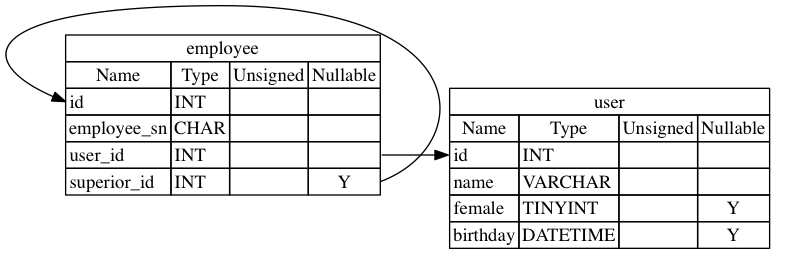
sqlw-mysql can be used to generate other text source as well. For example running with -tmpl @graphviz a .dot file will be generated containing tables and their relationships, which can be convert to a diagram like this:
Command line options
$ sqlw-mysql -h
Usage of sqlw-mysql:
  -blacklist value
    	(Optional) Comma separated table names not to render.
  -dsn string
    	(Required) Data source name. e.g. "user:passwd@tcp(host:port)/db?parseTime=true"
  -out string
    	(Optional) Output directory for generated code. (default "models")
  -pkg string
    	(Optional) Alternative package name of the generated code.
  -stmt string
    	(Optional) Statement xmls directory.
  -tmpl string
    	(Optional) Custom templates directory. Or use '@name' to use the named builtin template.
  -whitelist value
    	(Optional) Comma separated table names to render.
Licence
MIT
Author: huangjunwen (kassarar@gmail.com)