

Company News
Socket Has Acquired Secure Annex
Socket has acquired Secure Annex to expand extension security across browsers, IDEs, and AI tools.
By Feross Aboukhadijeh - Apr 28, 2026
github.com/migueleliasweb/go-github-mock
Advanced tools

A library to aid unittesting code that uses Golang's Github SDK
go get github.com/migueleliasweb/go-github-mock
mock.WithRequestMatchPages)mock.WithRequestMatch)mock.WithRequestMatchHandler)mock.WithRateLimit)import "github.com/migueleliasweb/go-github-mock/src/mock"
mockedHTTPClient := mock.NewMockedHTTPClient(
    mock.WithRequestMatch(
        mock.GetUsersByUsername,
        github.User{
            Name: github.Ptr("foobar"),
        },
    ),
    mock.WithRequestMatch(
        mock.GetUsersOrgsByUsername,
        []github.Organization{
            {
                Name: github.Ptr("foobar123thisorgwasmocked"),
            },
        },
    ),
    mock.WithRequestMatchHandler(
        mock.GetOrgsProjectsByOrg,
        http.HandlerFunc(func(w http.ResponseWriter, _ *http.Request) {
            w.Write(mock.MustMarshal([]github.Project{
                {
                    Name: github.Ptr("mocked-proj-1"),
                },
                {
                    Name: github.Ptr("mocked-proj-2"),
                },
            }))
        }),
    ),
)
c := github.NewClient(mockedHTTPClient)

ctx := context.Background()

user, _, userErr := c.Users.Get(ctx, "myuser")

// user.Name == "foobar"

orgs, _, orgsErr := c.Organizations.List(
    ctx,
    *(user.Name),
    nil,
)

// orgs[0].Name == "foobar123thisorgwasmocked"

projs, _, projsErr := c.Organizations.ListProjects(
    ctx,
    *orgs[0].Name,
    &github.ProjectListOptions{},
)

// projs[0].Name == "mocked-proj-1"
// projs[1].Name == "mocked-proj-2"
mockedHTTPClient := NewMockedHTTPClient(
    WithRequestMatch(
        GetReposIssuesByOwnerByRepo,
        []github.Issue{
            {
                ID:    github.Int64(123),
                Title: github.Ptr("Issue 1"),
            },
            {
                ID:    github.Int64(456),
                Title: github.Ptr("Issue 2"),
            },
        },
        []github.Issue{},
    ),
)

c := github.NewClient(mockedHTTPClient)

ctx := context.Background()

issues1, _, repo1Err := c.Issues.ListByRepo(ctx, "owner1", "repo1", &github.IssueListByRepoOptions{})

// len(issues1) == 2
// repo1Err == nil

issues2, _, repo2Err := c.Issues.ListByRepo(ctx, "owner1", "repo2", &github.IssueListByRepoOptions{})

// len(issues2) == 0
// repo2Err == nil
mockedHTTPClient := mock.NewMockedHTTPClient(
    mock.WithRequestMatchHandler(
        mock.GetUsersByUsername,
        http.HandlerFunc(func(w http.ResponseWriter, r *http.Request) {
            mock.WriteError(
                w,
                http.StatusInternalServerError,
                "github went belly up or something",
            )
        }),
    ),
)
c := github.NewClient(mockedHTTPClient)

ctx := context.Background()

user, _, userErr := c.Users.Get(ctx, "someUser")

// user == nil

if userErr == nil {
    if ghErr, ok := userErr.(*github.ErrorResponse); ok {
        fmt.Println(ghErr.Message) // == "github went belly up or something"
    }
}
mockedHTTPClient := NewMockedHTTPClient(
    WithRequestMatchPages(
        GetOrgsReposByOrg,
        []github.Repository{
            {
                Name: github.Ptr("repo-A-on-first-page"),
            },
            {
                Name: github.Ptr("repo-B-on-first-page"),
            },
        },
        []github.Repository{
            {
                Name: github.Ptr("repo-C-on-second-page"),
            },
            {
                Name: github.Ptr("repo-D-on-second-page"),
            },
        },
    ),
)

c := github.NewClient(mockedHTTPClient)

ctx := context.Background()

opt := &github.RepositoryListByOrgOptions{
    ListOptions: github.ListOptions{
        // in fact, the perPage option is ignored my the mocks
        // but this would be present in production code
        PerPage: 2,
    },
}

var allRepos []*github.Repository

for {
    repos, resp, listErr := c.Repositories.ListByOrg(ctx, "foobar", opt)

    if listErr != nil {
        t.Errorf("error listing repositories: %s", listErr.Error())
    }

    // len(repos) == 2

    allRepos = append(allRepos, repos...)

    if resp.NextPage == 0 {
        break
    }

    opt.Page = resp.NextPage
}

// matches the mock definitions len(page[0]) + len(page[1])
// len(allRepos) == 4
Github Enterprise uses a different prefix for its endpoints. In order to use the correct endpoints, please use the different set of *Enterprise options:
mockedHTTPClient := mock.NewMockedHTTPClient(
    mock.WithRequestMatchEnterprise( // uses enterprise endpoints instead
        mock.GetUsersByUsername,
        github.User{
            Name: github.Ptr("foobar"),
        },
    ),
)

c := githubEnterprise.NewClient(mockedHTTPClient)

ctx := context.Background()

user, _, userErr := c.Users.Get(ctx, "myuser")

// user.Name == "foobar"
WithRateLimit uses a single rate-limiting middleware across all endpoints on the mock router.
NOTE: This is an alpha feature. Future changes might break compatibility, until a stable version is released.
mockedHTTPClient := mock.NewMockedHTTPClient(
    mock.WithRequestMatchPages(
        mock.GetOrgsReposByOrg,
        []github.Repository{{Name: github.Ptr(repoOne)}},
        []github.Repository{{Name: github.Ptr(repoTwo)}},
    ),

    // The rate limiter will allow 10 requests per second, and a burst size of 1.
    // These two options together mean that the rate of requests will be strictly enforced, so if any two requests are
    // made less than 1/10th of a second apart, the latter will be refused and come back with a rate limit error.
    mock.WithRateLimit(10, 1),
)
Some conversations got started on go-github#1800 since go-github didn't provide an interface that could be easily reimplemented for unittests. After lots of conversations from the folks from go-github and quite a few PR ideas later, this style of testing was deemed not suitable to be part of the core SDK as it's not a feature of the API itself. Nonetheless, the ability of writing unittests for code that uses the go-github package is critical.
A reuseable, and not overly verbose, way of writing the tests was reached after some more interactions (months down the line) and here we are.
Thanks for all ideas and feedback from the folks in go-github.
This library is distributed under the MIT License found in LICENSE.
FAQs
Unknown package
Did you know?

Socket for GitHub automatically highlights issues in each pull request and monitors the health of all your open source dependencies. Discover the contents of your packages and block harmful activity before you install or update your dependencies.
Company News
Socket has acquired Secure Annex to expand extension security across browsers, IDEs, and AI tools.

Research
/Security News
Socket is tracking cloned Open VSX extensions tied to GlassWorm, with several updated from benign-looking sleepers into malware delivery vehicles.
Product
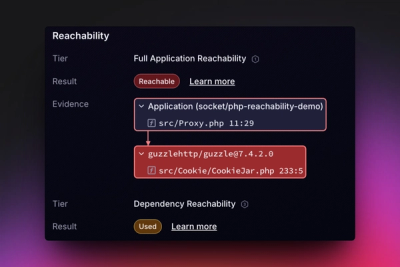
Reachability analysis for PHP is now available in experimental, helping teams identify which vulnerabilities are actually exploitable.