
Product
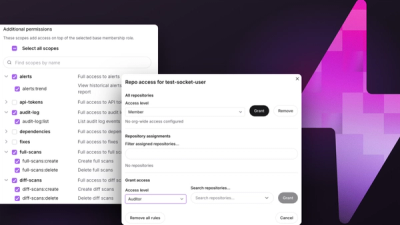
Introducing Repository Access Permissions and Custom Roles
Socket now supports Custom Roles and Repository Access Permissions so organizations can control who can access specific repositories and actions.
By Joe Werle - Jun 19, 2026
@azure/arm-storage
Advanced tools
This package contains an isomorphic SDK (runs both in Node.js and in browsers) for Azure StorageManagement client.
The Azure Storage Management API.
Key links:
See our support policy for more details.
@azure/arm-storage packageInstall the Azure StorageManagement client library for JavaScript with npm:
npm install @azure/arm-storage
StorageManagementClientTo create a client object to access the Azure StorageManagement API, you will need the endpoint of your Azure StorageManagement resource and a credential. The Azure StorageManagement client can use Azure Active Directory credentials to authenticate.
You can find the endpoint for your Azure StorageManagement resource in the Azure Portal.
You can authenticate with Azure Active Directory using a credential from the @azure/identity library or an existing AAD Token.
To use the DefaultAzureCredential provider shown below, or other credential providers provided with the Azure SDK, please install the @azure/identity package:
npm install @azure/identity
You will also need to register a new AAD application and grant access to Azure StorageManagement by assigning the suitable role to your service principal (note: roles such as "Owner" will not grant the necessary permissions).
For more information about how to create an Azure AD Application check out this guide.
Using Node.js and Node-like environments, you can use the DefaultAzureCredential class to authenticate the client.
import { StorageManagementClient } from "@azure/arm-storage";
import { DefaultAzureCredential } from "@azure/identity";

const subscriptionId = "00000000-0000-0000-0000-000000000000";
const client = new StorageManagementClient(new DefaultAzureCredential(), subscriptionId);
For browser environments, use the InteractiveBrowserCredential from the @azure/identity package to authenticate.
import { InteractiveBrowserCredential } from "@azure/identity";
import { StorageManagementClient } from "@azure/arm-storage";

const credential = new InteractiveBrowserCredential({
  tenantId: "<YOUR_TENANT_ID>",
  clientId: "<YOUR_CLIENT_ID>",
});
const subscriptionId = "00000000-0000-0000-0000-000000000000";
const client = new StorageManagementClient(credential, subscriptionId);
To use this client library in the browser, first you need to use a bundler. For details on how to do this, please refer to our bundling documentation.
StorageManagementClient is the primary interface for developers using the Azure StorageManagement client library. Explore the methods on this client object to understand the different features of the Azure StorageManagement service that you can access.
Enabling logging may help uncover useful information about failures. In order to see a log of HTTP requests and responses, set the AZURE_LOG_LEVEL environment variable to info. Alternatively, logging can be enabled at runtime by calling setLogLevel in the @azure/logger:
import { setLogLevel } from "@azure/logger";

setLogLevel("info");
For more detailed instructions on how to enable logs, you can look at the @azure/logger package docs.
Please take a look at the samples directory for detailed examples on how to use this library.
If you'd like to contribute to this library, please read the contributing guide to learn more about how to build and test the code.
FAQs
A generated SDK for StorageManagementClient.
The npm package @azure/arm-storage receives a total of 359,476 weekly downloads. As such, @azure/arm-storage popularity was classified as popular.
We found that @azure/arm-storage demonstrated a healthy version release cadence and project activity because the last version was released less than a year ago. It has 6 open source maintainers collaborating on the project.
Did you know?

Socket for GitHub automatically highlights issues in each pull request and monitors the health of all your open source dependencies. Discover the contents of your packages and block harmful activity before you install or update your dependencies.
Product
Socket now supports Custom Roles and Repository Access Permissions so organizations can control who can access specific repositories and actions.
Product
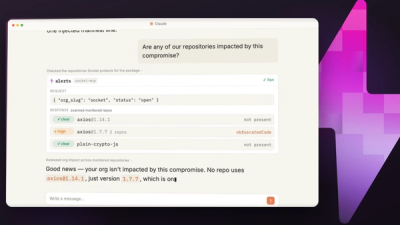
Socket MCP now lets AI assistants review org alerts, investigate threats using the Socket threat feed, and inspect package files in addition to dependency scoring.
Product
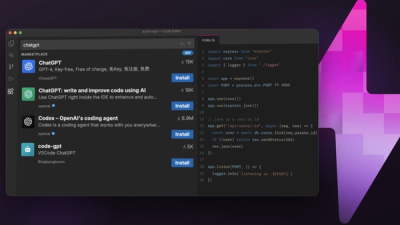
Socket Firewall blocks malicious VS Code and Open VSX extensions before install, protecting developers from compromised editor marketplaces.