
Product
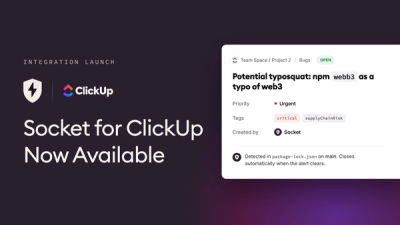
Socket for ClickUp Is Now Available
Create ClickUp tasks from Socket alerts, automate ticketing with custom rules, and keep alert and task status synchronized.
By Jeppe Hasseriis - Aug 26, 2026
@synap-core/cli
Advanced tools
Connect OpenClaw to your Synap pod — sovereign knowledge infrastructure for AI agents.
npx @synap-core/cli init
After synap init + synap finish, you get:
synap skill installed in OpenClaw# Run once (no install needed)
npx @synap-core/cli init
# Or install globally
npm install -g @synap-core/cli
synap init
Requirements: Node.js 20+
Detailed environment setup: docs/INSTALL.md
synap init + synap finish is the full path. init handles detection and provisioning; finish wires everything up.
synap initDetects your environment and picks one of three paths:
| Path | When |
|---|---|
| A — Existing OpenClaw | OpenClaw is already running locally |
| B — Fresh server | No OpenClaw — starts pod + OpenClaw via Docker |
| C — Desktop / managed pod | Connects to a Synap-hosted pod |
On a fresh server, OpenClaw's first boot takes a few minutes (image pull + init). Run synap finish once it's up.
synap finishOne-shot completion. Runs:
openclaw skills install synap (from ClawHub)openclaw config set env.ANTHROPIC_API_KEY …openclaw.yourpod.synap.live via the CP, with Synap-session-based auth (no extra password)After this, everything is ready. No follow-up commands.
Flags:
synap finish --skip-ai-key    # Don't prompt for AI key
synap finish --skip-domain    # Don't offer public domain
synap finish --skip-is        # Don't configure IS
synap openclaw — everything OpenClawWraps the things you actually need after install.
synap openclawOverview: gateway status, AI provider, skill, dashboard URL, next steps.
synap openclaw connectionsSingle-screen summary of what's wired up: AI providers (Anthropic/OpenAI/Google/Synap IS), installed skills, connected channels (Telegram/Discord/WhatsApp/Slack/Signal/iMessage/Matrix), MCP client commands, and the dashboard URL.
synap openclaw connections
Everything marked ○ is something you'd manage from the OpenClaw dashboard — the command shows you exactly how to get there.
synap openclaw open [section]Deep-link to a specific dashboard section.
synap openclaw open                # Main dashboard
synap openclaw open channels       # Channels tab
synap openclaw open skills         # Skills tab
synap openclaw open config         # Config editor
synap openclaw open chat           # Chat
synap openclaw open sessions       # Sessions
synap openclaw open logs           # Logs
Uses the public URL if setup-domain has been run, otherwise localhost.
synap openclaw dashboardOpens the OpenClaw web UI. If a public domain is configured, opens it directly. Otherwise opens http://localhost:18789 or — on a remote Linux server — prints an SSH tunnel command.
synap openclaw connectGenerates MCP client configs for Claude Desktop, Cursor, Windsurf — with the gateway token pre-filled so remote setups work without manual editing.
synap openclaw connect                  # All three clients
synap openclaw connect --client claude  # Just Claude Desktop
synap openclaw configureSets OpenClaw's AI provider via its own config system (openclaw config set env.ANTHROPIC_API_KEY …). No .env hacking — the real OpenClaw config layer.
# Interactive (in CLI)
synap openclaw configure

# Interactive (hand off to OpenClaw's own wizard)
synap openclaw configure --interactive

# Scripted
synap openclaw configure --provider anthropic --key sk-ant-... --model anthropic/claude-sonnet-4-6

# Read current config
synap openclaw configure --show
synap openclaw tokenReads the OpenClaw gateway token from the container. You need this to connect MCP clients to a remote gateway.
synap openclaw token                  # Print it
synap openclaw token --copy           # Copy to clipboard
synap openclaw token --for claude     # Print a ready-to-paste Claude Desktop config
synap openclaw setup-domainExpose the OpenClaw dashboard at a public HTTPS URL.
*.synap.live): calls the CP to create a DNS A record automatically (openclaw.yourpod.synap.live), wires Caddy's forward_auth to validate your existing Synap session cookie. Zero manual auth.caddy hash-password — no bcrypt dependency.Both modes forge X-Real-IP: 127.0.0.1 at the Caddy layer so OpenClaw treats requests as loopback and skips device pairing. Auth is enforced at the Caddy layer.
synap openclaw doctorThin wrapper around OpenClaw's own diagnostic. Use --fix to auto-repair known issues.
synap openclaw doctor
synap openclaw doctor --fix
synap openclaw logssynap openclaw logs # Last 50 lines
synap openclaw logs -n 200 # More
synap openclaw logs -f # Follow
synap openclaw restartRestart the container. Handy after config changes.
synap statusHealth check across the stack: pod, OpenClaw, auth, skill, Intelligence Service.
synap loginsynap login # Opens browser
synap login --token <token> # Headless / server
Token: synap.live/account/tokens. Your session auto-refreshes for 7 days.
synap logoutsynap connectRe-connect to an existing pod without running the full init wizard.
synap updateUpdate the synap skill in OpenClaw to the latest version.
synap security-auditCheck OpenClaw + Synap config for known security issues. --fix auto-repairs fixable ones.
synap openclaw configure from openclaw configure?We delegate to OpenClaw's own config system for the actual write (openclaw config set env.ANTHROPIC_API_KEY …) but wrap it for:
docker exec openclaw … for you--provider / --key flags for automationsynap finish — part of the one-shot flowFor anything we don't wrap, use OpenClaw directly:
docker exec -it openclaw openclaw configure   # Interactive wizard
docker exec openclaw openclaw config get <key>
docker exec openclaw openclaw skills list
docker exec openclaw openclaw channels add --channel telegram --token ...
synap owns: Synap pod connection, skill install, Caddy proxy auth, CP DNS provisioning.
openclaw owns: models, skills, channels, daemon, gateway config.
Stored in ~/.synap/ (user-only, chmod 600):
| File | Contents |
|---|---|
credentials.json | CP auth token |
pod-config.json | Pod URL, workspace ID, agent user ID, Hub API key |
Never commit these.
| Variable | Default | Description |
|---|---|---|
SYNAP_CP_URL | https://api.synap.live | Control plane URL |
SYNAP_LANDING_URL | https://synap.live | Landing page (OAuth callback) |
synap skill gives your agentThe skill is published on ClawHub as synap. Once installed, your agent gains access to Synap's Hub Protocol:
| Capability | How the agent uses it |
|---|---|
| Store a memory | Save atomic facts, keyword or semantic search |
| Create an entity | Structured object (person, task, note, project, …) |
| Search entities | By name, type, content, relationships |
| Relation graph | Link entities, traverse |
| Documents | Long-form markdown with governance |
| Channels | Post messages to any Synap channel |
| Proposals | Request changes for human review |
Agents self-discover entity types and views at runtime — no hardcoding.
git clone https://github.com/synap-core/synap-backend
cd synap-backend/deploy
docker compose --profile openclaw up -d
synap init  # → "Connect to existing pod" → http://localhost:4000
synap init → "Connect to Synap cloud pod"synap finish — offers public domain automatically"Could not reach pod"
Pod unreachable. Check synap status and docker compose.
"OpenClaw is not running yet"
First boot takes 1–2 minutes. Wait, then synap finish.
"AI provider not configured"
Run synap openclaw configure — or use synap openclaw configure --interactive to hand off to OpenClaw's own wizard.
MCP client doesn't show tools
Run synap openclaw token --for claude to get a ready-to-paste config with the token pre-filled. Restart your AI client.
Dashboard: "device approval required"
Shouldn't happen — synap openclaw setup-domain forges X-Real-IP: 127.0.0.1 so OpenClaw treats Caddy traffic as loopback. If it does, run synap openclaw doctor --fix.
"Session expired" in synap status
Run synap login --token <token> on the server.
MIT
FAQs
Synap CLI — connect OpenClaw to sovereign knowledge infrastructure
We found that @synap-core/cli demonstrated a healthy version release cadence and project activity because the last version was released less than a year ago. It has 1 open source maintainer collaborating on the project.
Product
Create ClickUp tasks from Socket alerts, automate ticketing with custom rules, and keep alert and task status synchronized.
Product
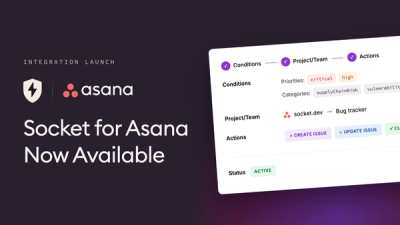
Create and manage Asana tasks directly from Socket alerts, with manual task creation, automated ticketing rules, and two-way sync.

Security News
Open VSX has removed three extension IDs from its malicious-extension list as the legitimate publishers they impersonated move to claim the names for themselves.