



Company News
AWS Security Hub Adds Socket for Supply Chain Security
Socket is now in the AWS Security Hub Extended plan. Adopt it through AWS, apply committed spend, and block malicious open source packages.
By Feross Aboukhadijeh - Aug 04, 2026
67 cross-tool modules (workflows + skills). Quality gates on every commit. Works with Claude Code, Cursor, and Codex.


One source of truth. 67 modules generate native config for Claude Code · Cursor · Codex. Quality gates run on every commit.

npm (any platform — macOS, Linux, Windows):
npm install -g 100xprism && 100xprism install
curl (macOS / Linux):
curl -fsSL https://raw.githubusercontent.com/rajitsaha/100xprism/main/get.sh | bash
Either way, 100xprism install clones the toolkit to ~/100xprism and provisions your AI tools. The npm package is a thin launcher — the modules, hooks, and plugins live in that clone, which 100xprism update keeps current.
Before installing, 100xPrism cleans legacy startup hooks, stale command links, and any old owned dashboard process. Install does not edit ~/.zshrc, ~/.bashrc, or ~/.bash_profile. If you want optional aliases for the current terminal only, run source ~/100xprism/shell/aliases.sh.
Windows: plugin sync works, but native Windows module emit is being reworked (#54). For full module support today, install under WSL with either method above.
Set up a project:
cd your-project && 100xprism init
Keep up to date:
100xprism update                    # pull latest, then add/update/remove skills + plugins
100xprism update --plugins-only     # refresh plugins only (repo already current)
100xprism uninstall                 # stop dashboard + remove legacy shell-startup entries/symlinks
npm install -g 100xprism@latest     # (optional) upgrade the launcher itself
install and update are fully reconciling, not append-only — every run:
Your own hand-authored skills/commands and any plugins you enabled yourself are never touched. See docs/USAGE.md for details.
Cloned to a custom path? The default install lives at
~/100xprism. If you cloned elsewhere, update your shell + Claude Code config — see Custom install location.
/understand → /context → /issue → /spec → /fix → /commit
                                                    ↓
              /techdebt ← /gate → /grill → /pr → /push → /release
Every /commit and /push runs a 5-point gate — tests, security, build, Docker, cloud. Nothing ships without passing.
| 67 modules | 27 slash commands + 40 auto-trigger skills — see full reference below |
| 14 Claude Code plugins | superpowers, playwright, github, hookify, claude-mem, understand-anything, ui-ux-pro-max, motion-framer, and more |
| 7 database engines | Postgres, Cloud SQL, Snowflake, Databricks, Athena, Presto, Oracle — one /db interface |
| 27 SaaS CLIs | /connect installs + authenticates GitHub, AWS, Stripe, Supabase, and more from .env |
| 4 project templates | node-fullstack · node-frontend · python-api · docker-compose |
| CI/Release pipelines | Drop-in GitHub Actions for lint + real-DB tests + E2E + semantic-release |
For a while, the goal was singular: make spec-driven, agentic development as autonomous as possible — let the agent plan, build, gate, and ship with less and less human steering.
That part is mostly working. The harder, more important question is the one that comes next: what is all this autonomy costing, what did it help deliver, and what was that delivery worth? Every agent run spends real money in tokens. The dashboard measures cost and observable engineering delivery separately; business or human value remains explicitly unmeasured until an outcome source is connected.
This is a first, deliberately humble attempt to make the measurement chain visible to everyone, because watching it isn't one person's job. It's everybody's responsibility.
100xprism tokens   # token economics — what every session, across every repo, is costing
100xprism value    # delivery economics — observable work associated with that spend
100xprism tokens — one offline, machine-wide dashboard at a single URL: the input/output/cache split, a startup-bloat meter, an estimated code-vs-files-read-vs-logs-vs-chat composition, and $ cost — by project, model, session, and skill. Claude Code and Codex provide exact local token counters; Cursor agent-transcript JSONL and Antigravity local artifacts contribute project/session/activity coverage but are never assigned invented token cost because their local formats expose no counters. Cursor chats, state.vscdb, and legacy transcript .txt are outside the collector's scope. It auto-refreshes every 30 seconds once started. Start it explicitly with 100xprism tokens, 100xprism dashboard, or 100xprism install --dashboard; shell startup never starts it.100x-value — the dashboard joins exact local token counters to observable delivery evidence. It shows every directory that consumed tokens plus agentic projects discovered machine-wide via marker files. Git supplies commits, deduplicated merged PRs, releases, files, insertions, and deletions; non-repos use an explicitly labeled filesystem-mtime estimate. Directories from unsupported tools show — cost, never a misleading $0. Delivery unit costs use attributed spend only, show attribution coverage, and are never presented as business ROI.Full guide: docs/token-optimization.md.
The following 27 slash commands are available. Run them inside Claude Code. In Codex, use the generated repo skill by name instead, for example $gate, $commit, or /skills.
| Command | What it does |
|---|---|
/branch | Create a conventional feature branch (feat/, fix/, chore/) |
/commit | Gate → stage → conventional commit |
/grill | Adversarial code review before opening a PR |
/pr | Gate → push branch → create PR |
/push | Gate → push → monitor CI → verify production health |
/release patch|minor|major | Semantic versioning + publish to PyPI/npm/Docker Hub |
/launch | Full deploy pipeline in one command |
| Command | What it does |
|---|---|
/gate | Mandatory 5-point quality gate (tests, security, build, Docker, cloud) |
/test | All test layers (unit, integration, E2E) — loops until 95% coverage |
/lint | Auto-detect and fix all lint errors (ESLint, TypeScript, ruff) |
/security | Vulnerability + secrets scan, auto-fix where possible |
/cloud-security | GCP IAM, networking, PII, and compliance scan |
/eval | Run module evals — check triggers and output quality |
| Command | What it does |
|---|---|
/spec | Turn a vague request into an implementation-ready spec |
/fix | Autonomous bug fixer — CI failures, docker logs, Slack pastes |
/orchestrate | Plan-first methodology for complex multi-step tasks |
/techdebt | Dead code, duplication, stale TODOs |
/context | 7-day git + GitHub activity dump — orient before coding |
/update-claude | Write a CLAUDE.md rule after any correction |
| Command | What it does |
|---|---|
/db | Query any of 7 database engines from one interface |
/query | Plain-English analytics — describe what you want, get SQL |
/connect | Install + auth 27 SaaS CLIs from .env |
| Command | What it does |
|---|---|
/docs | Detect code changes and update documentation |
/issue | Investigate a bug and create a detailed GitHub issue |
/architect | Architectural Q&A and decision matrices |
/enterprise-design | Full technical blueprint — IA, API, data model, stack |
These modules activate automatically when you describe a relevant task — no slash command needed.
| Category | Modules |
|---|---|
| Marketing copy | copywriting, copy-editing, cold-email, email-sequence, ad-creative, social-content |
| SEO | seo-audit, ai-seo, programmatic-seo, schema-markup, site-architecture |
| CRO & conversion | page-cro, signup-flow-cro, onboarding-cro, form-cro, popup-cro, paywall-upgrade-cro |
| Growth & strategy | content-strategy, marketing-ideas, marketing-psychology, launch-strategy, referral-program, churn-prevention, free-tool-strategy, ab-test-setup, analytics-tracking, pricing-strategy |
| Sales | sales-enablement, competitor-alternatives, paid-ads, revops, product-marketing-context |
| Design | enterprise-design, visual-system-architect, interaction-engineer, figma-translator |
| Engineering | subagents, terminal-setup |
| Tool | Generated artifact | Auto-trigger? |
|---|---|---|
| Claude Code | ~/.claude/skills/<slug>/ + slash command aliases | Yes — per description |
| Cursor | .cursor/rules/<slug>.mdc (one file per module) | Yes — per description |
| Codex | AGENTS.md + .agents/skills/<slug>/ + .codex/hooks.json | Yes — repo skills |
Every supported tool loads module bodies on demand rather than inlining them, so the always-on context stays small. tier: core marks the modules Cursor keeps resident (alwaysApply: true); everything else is fetched when its description matches. Claude Code plugins remain Claude-specific; use Codex /plugins for Codex-native plugins.
Removed in v3.0.0: Windsurf, Copilot, Gemini, and Antigravity. Those adapters emitted a single concatenated file (~60K chars) that sat in context on every turn — the opposite of progressive disclosure.
This deletes files in your projects.
100xprism updateremoves the.windsurfrules,GEMINI.md,ANTIGRAVITY.md, and.github/copilot-instructions.mdit previously generated from every project in~/.100xprism/tracked-projects;100xprism initdoes the same for the project it runs in.Only files carrying the
Generated by 100xprismheader are touched, so a hand-written file of the same name is left alone. If you edited a generated file, it is still removed — but every removal is copied to~/.100xprism/removed-artifacts/<timestamp>/first, and is only removed once that copy succeeds. These files are also normally committed, so deletions show up ingit statusfor you to review.
npm install 404 inside Docker · useState(false) opacity-0 breaking Playwright · integration tests silently excluded from the gate. Full breakdown →
Built by Rajit Saha · 23 years in enterprise data at Udemy, Experian, LendingClub, VMware, Yahoo

If this saves you time, star the repo.
FAQs
67 cross-tool modules (workflows + skills). Quality gates on every commit. Works with Claude Code, Cursor, and Codex.
We found that 100xprism demonstrated a healthy version release cadence and project activity because the last version was released less than a year ago. It has 1 open source maintainer collaborating on the project.
Did you know?

Socket for GitHub automatically highlights issues in each pull request and monitors the health of all your open source dependencies. Discover the contents of your packages and block harmful activity before you install or update your dependencies.
Company News
Socket is now in the AWS Security Hub Extended plan. Adopt it through AWS, apply committed spend, and block malicious open source packages.
Research
/Security News
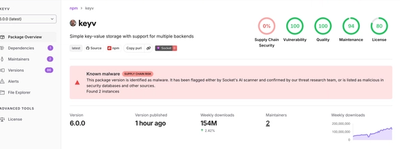
Popular npm packages keyv and cacheable compromised.

Security News
A misconfiguration gave three Anthropic models internet access, and one, believing it was in a simulation, shipped a credential-stealing package to PyPI.