
Security News
The Code You Didn't Write Is Still Yours to Defend
AI agents are pulling packages into environments no scanner is watching, creating exposure before security teams can see it.
By Brad Arkin - Jun 23, 2026
@45ck/content-machine
Advanced tools
CLI-first automated short-form video generator for TikTok, Reels, and Shorts


Automated short-form video generation pipeline for TikTok, Reels, and Shorts.
Status: Early development. Not production-ready yet.

GitHub READMEs can’t reliably inline-play mp4, so this repo uses small previews (GIF/SVG)
and links to full videos hosted elsewhere (GitHub Releases / YouTube / Vimeo).

Shows:
cm import visuals to bring your own clips--gameplay-style subway-surfers)cm render --template brainrot-split-gameplay-top
Shows:
cm import visuals + cm render --template tiktok-captions
Shows:
cm import visualscm render --template tiktok-captions --caption-preset karaokeNote: if you want real gameplay (Subway Surfers / Minecraft parkour), you must supply your own
clips with the appropriate rights in ~/.cm/assets/gameplay/<style>/. This repo does not ship or
download copyrighted gameplay footage by default. On Linux you can import clips with
scripts/download-gameplay.sh (local files or URLs you have rights to).

Full clip: docs/demo/demo-4-latest-news.mp4
This demo uses:
#1, #2, …) with fade/scale animation1: in the text)Replicate the pipeline (exact commands):
# Node >= 20 recommended
nvm use

# (One-time) install deps + whisper for word-level timestamps
npm install
npm run cm -- setup whisper --model base

# 1) Research latest headlines (Jan 2026 example query)
npm run cm -- --yes research --no-angles \
  -q "Davos World Economic Forum Iraq US forces withdrawal North Korea official fired January 2026" \
  -s tavily -t week -l 12 \
  -o output/research.stories.json

# 2) Script (listicle)
npm run cm -- --yes script \
  --topic "global news this week" \
  --research output/research.stories.json \
  --duration 60 \
  -o output/script.stories.v2.json

# 3) Audio + timestamps (audio-first + reconcile for cleaner captions)
npm run cm -- --yes audio \
  -i output/script.stories.v2.json \
  -o output/audio.stories.v2.wav \
  --timestamps output/timestamps.stories.v2.json \
  --sync-strategy audio-first --reconcile --require-whisper --whisper-model base \
  --tts-speed 1.2 \
  --no-music --no-sfx --no-ambience

# 4) Visuals (Pexels)
npm run cm -- --yes visuals \
  -i output/timestamps.stories.v2.json \
  -o output/visuals.stories.v2.json \
  --provider pexels --orientation portrait

# 5) Render (TikTok preset + chunk mode)
npm run cm -- --yes render \
  -i output/visuals.stories.v2.json \
  --audio output/audio.stories.v2.wav \
  --timestamps output/timestamps.stories.v2.json \
  --caption-preset tiktok --caption-mode chunk \
  --caption-offset-ms -80 \
  --hook none \
  -o output/global-news.stories.v2.tiktok-smaller.badges-back.mp4
Content Machine is a CLI-first pipeline that transforms a topic into a short-form video in four stages:
topic -> script.json -> audio.wav + timestamps.json -> visuals.json -> video.mp4
This repo has a few loaded words (template, workflow, archetype, preset, pack).
registry/ubiquitous-language.yamldocs/reference/GLOSSARY.mddocs/reference/ubiquitous-language-system-20260210.mdRun the full pipeline with cm generate or run each stage independently.
These words mean specific things in this repo:
cm script / cm generate.cm render / cm generate.cm generate.Full glossary: docs/reference/GLOSSARY.md.
Key features:
script.jsoncm templates import ...) with explicit opt-in (--allow-template-code)| Stage | Command | Input | Output |
|---|---|---|---|
| script | cm script | topic string | script.json |
| audio | cm audio | script.json | audio.wav, timestamps.json |
| visuals | cm visuals | timestamps.json | visuals.json |
| render | cm render | visuals.json + audio.wav + timestamps.json | video.mp4 |
cm generate runs the full pipeline in order.
# Clone
git clone https://github.com/45ck/content-machine.git
cd content-machine

# Prereqs
# - Node.js >= 20 (recommended: use nvm + .nvmrc)
# - (optional) ffmpeg (for making README demo GIFs)

# Recommended Node setup (if you have nvm)
nvm install
nvm use

# Install dependencies
npm install

# Set up environment
cp .env.example .env
# Add your OPENAI_API_KEY

# Note:
# - In this repo: use `npm run cm -- <command>`
# - If installed globally: use `cm <command>`

# Run the full pipeline in dev mode
npm run cm -- generate "Redis vs PostgreSQL for caching" --archetype versus --output output/video.mp4 --keep-artifacts
For best audio/caption sync, the default pipeline runs audio-first with Whisper timestamps and reconciles ASR output back to the script text.
# One-time Whisper setup (needed for audio-first)
npm run cm -- setup whisper --model base

# Generate a short video with best-sync defaults
npm run cm -- generate "Redis vs PostgreSQL for caching" --archetype versus --output output/video.mp4 --keep-artifacts
cm research gathers evidence across sources and writes research.json. You can then feed that
into cm script / cm generate to keep scripts grounded in the latest info.
# 1) Research (no API keys required: Hacker News + Reddit)
npm run cm -- research -q "latest AI model news" -s hackernews,reddit -t day -o research.json

# 2) Generate a full video using that evidence
npm run cm -- generate "latest AI model news" --research research.json -a story --duration 35 -o output/news.mp4
Auto-research shortcut (runs Stage 0 automatically):
# Use `--research` with no value (or `--research true`).
# Always uses hackernews,reddit; also adds web if BRAVE_SEARCH_API_KEY is set,
# and adds tavily if TAVILY_API_KEY is set.
npm run cm -- generate "latest AI model news" --research -a story --duration 35 -o output/news.mp4
Bring your own audio + clips and still use cm captions/rendering:
# 1) Generate timestamps from existing audio
cm timestamps --audio assets/voiceover.wav --output output/timestamps.json

# 2) Build visuals.json from local footage
cm import visuals --timestamps output/timestamps.json --clips assets/clips --output output/visuals.json

# 3) Render with your assets
cm generate "Launch teaser" \
  --audio assets/voiceover.wav \
  --timestamps output/timestamps.json \
  --visuals output/visuals.json \
  --output output/video.mp4
Import Remotion official/community templates (or any Remotion repo) into CM as a code template:
cm templates import https://www.remotion.dev/templates/tiktok --id remotion-tiktok

cm render -i visuals.json --audio audio.wav --timestamps timestamps.json \
  --template remotion-tiktok --allow-template-code -o out/video.mp4
Docs:
docs/guides/guide-remotion-template-import-20260210.mddocs/reference/cm-templates-reference-20260210.mdFor repeatable pipelines, define a workflow in ./.cm/workflows/<id>/workflow.json:
cm workflows list
cm generate "Product recap" --workflow acme-custom --workflow-allow-exec --output output/video.mp4
This produces the same style as output/demo-subway-pexels/video.mp4: gameplay on one half,
Pexels B-roll on the other, CapCut-style captions, muted gameplay audio.
Prereqs:
.env has OPENAI_API_KEY (keyword extraction) and PEXELS_API_KEY (stock footage).~/.cm/assets/gameplay/<style>/ (or pass --gameplay <path>).# 1) Prepare gameplay clips
mkdir -p ~/.cm/assets/gameplay/subway-surfers
cp /path/to/subway.mp4 ~/.cm/assets/gameplay/subway-surfers/
# 2) Generate script + audio + timestamps
cm script --topic "Redis vs PostgreSQL for caching" -o output/script.json
cm audio --input output/script.json --output output/audio.wav --timestamps output/timestamps.json --tts-speed 1.2
# 3) Match Pexels visuals + gameplay
cm visuals --input output/timestamps.json --provider pexels --orientation portrait \
--gameplay-style subway-surfers \
--output output/demo-subway-pexels/visuals.json
# 4) Render split-screen (gameplay on top, Pexels on bottom)
cm render --template brainrot-split-gameplay-top --split-layout gameplay-top \
--input output/demo-subway-pexels/visuals.json \
--timestamps output/timestamps.json \
--audio output/audio.wav \
--output output/demo-subway-pexels/video.mp4 \
--download-assets
Layout options:
--split-layout gameplay-bottom--gameplay-position full or --content-position fullTroubleshooting:
ffmpeg -y -i input.mp4 -vf "scale=1080:-2" -c:v libx264 -profile:v baseline -level 3.1 -pix_fmt yuv420p -preset veryfast -crf 23 -an -movflags +faststart output.mp4--verbose plus REMOTION_LOG_LEVEL=verboseThis repo vendors several open-source projects for video generation:
vendor/
  remotion/              # React-based video composition
  short-video-maker/     # Reference patterns for Pexels + Kokoro
  open-deep-research/    # Deep research agent patterns
  ...
See VENDORING.md for details.
# Required
OPENAI_API_KEY=sk-...

# Optional
PEXELS_API_KEY=...         # For stock footage
GEMINI_API_KEY=...         # For AI image generation (provider: nanobanana)
GOOGLE_API_KEY=...         # Alias for GEMINI_API_KEY (either works)
BRAVE_SEARCH_API_KEY=...   # For cm research --sources web
TAVILY_API_KEY=...         # For cm research --sources tavily (and auto-research in cm generate)
REDDIT_CLIENT_ID=...       # Optional (some Reddit features may use auth)
REDDIT_CLIENT_SECRET=...   # Optional
Generate per-scene AI images as a first-class visuals provider (and animate them at render-time):
cm visuals --input timestamps.json --provider nanobanana --motion-strategy kenburns --output visuals.json
cm render --input visuals.json --audio audio.wav --timestamps timestamps.json --output video.mp4
Use your own folder of clips/images as a visuals provider:
# Use local video clips (best-match by filename/folders)
cm visuals --input timestamps.json --provider local --local-dir ./my-footage --output visuals.json

# Use local images (requires a motion strategy at render-time)
cm visuals --input timestamps.json --provider localimage --local-dir ./my-images --motion-strategy kenburns --output visuals.json
For deterministic mapping (no fuzzy matching), provide a manifest mapping sceneId -> assetPath:
cm visuals --input timestamps.json --provider pexels --local-manifest ./visuals-manifest.json --output visuals.json
cwd): .content-machine.toml, content-machine.toml, .cmrc.json~/.cm/config.toml, ~/.cm/config.json, ~/.cmrc.jsonCM_CONFIG=/abs/path/to/config.toml or cm --config /abs/path/to/config.toml ...cm config paths, cm config showDefault captions use an Inter-first stack with Montserrat fallback. A small Inter font pack
ships in assets/fonts/Inter for consistent rendering.
CLI overrides:
cm render --caption-font-family "Inter" \
  --caption-font-weight 700 \
  --caption-font-file "assets/fonts/Inter/Inter-Bold.woff2" \
  --input visuals.json --timestamps timestamps.json --audio audio.wav
Config defaults (.content-machine.toml):
[captions]
font_family = "Inter"
font_weight = 700
font_file = "assets/fonts/Inter/Inter-Bold.woff2"
JSON config supports multiple fonts:
{
  "captions": {
    "fontFamily": "Inter",
    "fontWeight": 700,
    "fonts": [
      {
        "family": "Inter",
        "src": "assets/fonts/Inter/Inter-Bold.woff2",
        "weight": 700
      }
    ]
  }
}
Content Machine does not auto-publish to platforms. Instead, it generates a ZIP package:
output/
  2026-01-01-discord-bot-tutorial/
    video.mp4
    cover.jpg
    metadata.json
    upload-checklist.md    # Platform-specific instructions
    platform-hints/
      tiktok.md
      reels.md
      shorts.md
Why? TikTok/Instagram APIs require business verification and audit. Export-first means:
src/
  cli/        # Commander.js entry points
  script/     # Script generation pipeline
  audio/      # TTS + ASR pipeline
  visuals/    # Footage matching
  render/     # Remotion integration
  core/       # Shared infrastructure
  prompts/    # Prompt templates
  hooks/      # Hook selection helpers
  package/    # Packaging outputs
  publish/    # Publish/export helpers
  research/   # Research command logic
  score/      # Scoring pipeline
  validate/   # Validation pipeline
  types/      # Shared types
  test/       # Test stubs/support
  index.ts    # Package exports
MIT - See LICENSE
PRs welcome. Please read:
Built for Vibecord / Vibeforge.
Inspired by:
FAQs
CLI-first automated short-form video generator for TikTok, Reels, and Shorts
The npm package @45ck/content-machine receives a total of 3 weekly downloads. As such, @45ck/content-machine popularity was classified as not popular.
We found that @45ck/content-machine demonstrated a healthy version release cadence and project activity because the last version was released less than a year ago. It has 1 open source maintainer collaborating on the project.
Did you know?

Socket for GitHub automatically highlights issues in each pull request and monitors the health of all your open source dependencies. Discover the contents of your packages and block harmful activity before you install or update your dependencies.
Security News
AI agents are pulling packages into environments no scanner is watching, creating exposure before security teams can see it.

Security News
GitHub Actions checkout now blocks risky pull_request_target checkouts by default to help prevent pwn request supply chain attacks.
Product
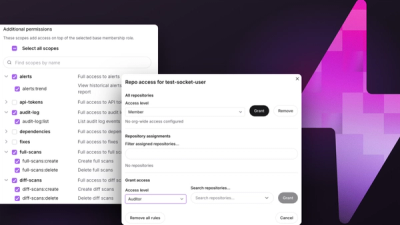
Socket now supports Custom Roles and Repository Access Permissions so organizations can control who can access specific repositories and actions.