
Product
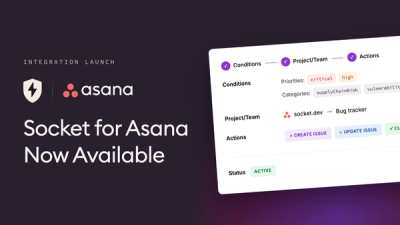
Socket for Asana Is Now Available
Create and manage Asana tasks directly from Socket alerts, with manual task creation, automated ticketing rules, and two-way sync.
By Jeppe Hasseriis - Aug 25, 2026
@aauth/mcp-stdio
Advanced tools
Stdio-to-HTTP proxy for MCP with AAuth signatures. Bridges a local stdio MCP client (like Claude Code) to a remote HTTP MCP server, signing all requests with AAuth.
Part of aauth-dev/packages-js. Protocol spec: dickhardt/AAuth.
npm install @aauth/mcp-stdio
npx @aauth/mcp-stdio https://api.example.com/mcp --agent-url https://user.github.io
The remote MCP server URL is the first positional argument and is required.
| Flag | Env var | Description |
|---|---|---|
--agent-url | AAUTH_AGENT_URL | Agent URL (default: from ~/.aauth/config.json) |
--local | AAUTH_LOCAL | Local part of the agent identifier |
--person-server | AAUTH_PERSON_SERVER | Person server URL (default: from ~/.aauth/config.json) |
--token-lifetime | AAUTH_TOKEN_LIFETIME | Agent token lifetime in seconds (default: 3600) |
The proxy needs a person server to reach a resource that asks for a person or an
auth token. It stamps the PS as the agent token's ps claim, obtains a person
token from the PS's person_token_endpoint when a resource answers
requirement=person-token, and exchanges the resource token that follows at the
PS's auth_token_endpoint. Without one it can only reach resources that serve on
agent identity alone, and it says so on stderr at startup.
Add to your MCP server config:
{
  "mcpServers": {
    "my-server": {
      "command": "npx",
      "args": ["@aauth/mcp-stdio", "https://api.example.com/mcp", "--agent-url", "https://user.github.io"]
    }
  }
}
Or with environment variables:
{
  "mcpServers": {
    "my-server": {
      "command": "npx",
      "args": ["@aauth/mcp-stdio", "https://api.example.com/mcp"],
      "env": {
        "AAUTH_AGENT_URL": "https://user.github.io",
        "AAUTH_PERSON_SERVER": "https://ps.example.com"
      }
    }
  }
}
bridgeTransports(local, remote): Promise<void>Bridges two MCP transports for bidirectional message forwarding.
import { bridgeTransports } from '@aauth/mcp-stdio'
serializeAuthFlows(fetch): ProxyFetchWraps a fetch so that only one POST — and so only one AAuth flow, and one browser interaction — is in flight at a time. GET passes straight through, since the transport's GET is the long-lived SSE stream.
import { serializeAuthFlows } from '@aauth/mcp-stdio'
parseArgs(argv): StdioArgsParses CLI arguments with env var fallbacks. Takes the full process.argv.
import { parseArgs } from '@aauth/mcp-stdio'

const args = parseArgs(process.argv)
// { serverUrl, agentUrl?, local?, personServer?, tokenLifetime? }
MIT
FAQs
Stdio-to-HTTP proxy for MCP with AAuth signatures
The npm package @aauth/mcp-stdio receives a total of 48 weekly downloads. As such, @aauth/mcp-stdio popularity was classified as not popular.
We found that @aauth/mcp-stdio demonstrated a healthy version release cadence and project activity because the last version was released less than a year ago. It has 2 open source maintainers collaborating on the project.
Product
Create and manage Asana tasks directly from Socket alerts, with manual task creation, automated ticketing rules, and two-way sync.

Security News
Open VSX has removed three extension IDs from its malicious-extension list as the legitimate publishers they impersonated move to claim the names for themselves.

Product
Socket’s PHP and Composer support is now in Beta for all customers, with PHP reachability analysis generally available.