
Research
/Security News
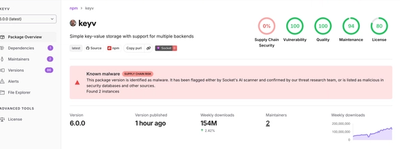
Popular npm Packages in the keyv and Cacheable Namespaces Compromised in Active Supply Chain Attack
Popular npm packages keyv and cacheable compromised.
By Socket Research Team - Aug 04, 2026
@adrkit/mcp
Advanced tools
Local, read-only Model Context Protocol server exposing adrkit decision retrieval over stdio.
@adrkit/mcpDeterministic, offline, read-only decision memory for coding agents — including the decisions you already rejected.
A local Model Context Protocol server that lets an agent harness query one Git-backed ADR (Architecture Decision Record) corpus over stdio: "has this been decided?", "what governs these files?", and "what replaced this?" It surfaces superseded and rejected decisions specifically so agents stop re-proposing paths the team already ruled out.
No model calls. No network calls. No writes. The server reads Markdown files from your repo and returns structured JSON. It never calls an LLM, never opens a socket, and never mutates your corpus. Every tool is annotated
readOnlyHint: true,openWorldHint: false.
Part of adrkit. The corpus lives in git as one Markdown file
per decision with typed YAML frontmatter (@adrkit/core); this server only reads
it. Listed in the official MCP registry
as dev.adrkit/mcp (this is the Node/npm @adrkit/mcp package — unrelated to
the adr-kit Python package on PyPI). A registry listing is distribution, not
adoption; see Maturity below.
adrkit is early. Phases 0–6 are landed / reference-verified against ADR-0014 rungs 1–2 (unit/contract/conformance plus maintainer-owned isolated reference-repository validation). It has no external adopters or production users yet, and rung-3 external/community validation is openly tracked as not-yet-met. The 4-tool surface is locked by a surface test.
The published binary is adrkit-mcp. Run it with npx (no install):
npx -y @adrkit/mcp --cwd /path/to/your/repo --dir docs/adr
It speaks JSON-RPC over stdio, so you normally point an MCP client at it rather than running it by hand. Copy-pasteable client configs follow.
The server speaks both MCP protocol eras on the same stdio connection, and the client picks. The opening exchange selects the era and pins it for the connection's lifetime:
| Client opens with | Server serves |
|---|---|
server/discover, or any request carrying a 2026 _meta envelope | 2026-07-28 — stateless, no handshake |
initialize / notifications/initialized | the 2025-era revision it negotiates |
On 2026-07-28 there is no initialize handshake and no session id: every request
carries its own protocol version and client capabilities in _meta, and every result
is self-describing (resultType, plus server identity in _meta). tools/list and
server/discover are cacheable (SEP-2549) and are served with ttlMs: 300000, cacheScope: "public" — the four-tool surface is immutable for the life of the process
and carries no corpus content, so a client may reuse it instead of re-listing. Corpus
reads are never cacheable: every tools/call loads a fresh projection.
Nothing else about the tools changes between eras — same names, same schemas, same
annotations, same structured results. The server uses none of the features the
2026-07-28 revision deprecated (roots, sampling, logging) or removed (sessions,
ping, resources/subscribe).
Edit claude_desktop_config.json (macOS:
~/Library/Application Support/Claude/claude_desktop_config.json). Claude launches
servers from an arbitrary working directory, so set ADRKIT_MCP_CWD to your repo's
absolute path:
{
  "mcpServers": {
    "adrkit": {
      "command": "npx",
      "args": ["-y", "@adrkit/mcp"],
      "env": {
        "ADRKIT_MCP_CWD": "/absolute/path/to/your/repo",
        "ADRKIT_MCP_DIR": "docs/adr"
      }
    }
  }
}
Create .vscode/mcp.json in your workspace (VS Code uses the servers key and
substitutes ${workspaceFolder}):
{
  "servers": {
    "adrkit": {
      "type": "stdio",
      "command": "npx",
      "args": ["-y", "@adrkit/mcp", "--cwd", "${workspaceFolder}", "--dir", "docs/adr"]
    }
  }
}
Create .cursor/mcp.json (project) or ~/.cursor/mcp.json (global):
{
  "mcpServers": {
    "adrkit": {
      "command": "npx",
      "args": ["-y", "@adrkit/mcp"],
      "env": {
        "ADRKIT_MCP_CWD": "/absolute/path/to/your/repo",
        "ADRKIT_MCP_DIR": "docs/adr"
      }
    }
  }
}
Add to ~/.copilot/mcp-config.json (user-level) or ./.copilot/mcp-config.json
(per-repo). Copilot CLI runs servers from the trusted repo directory, so the default
cwd usually resolves correctly:
{
  "mcpServers": {
    "adrkit": {
      "type": "local",
      "command": "npx",
      "args": ["-y", "@adrkit/mcp", "--dir", "docs/adr"],
      "tools": ["*"]
    }
  }
}
You can also add it interactively with /mcp add inside a copilot session.
| Option | Env | Default | Meaning |
|---|---|---|---|
--cwd <path> | ADRKIT_MCP_CWD | process.cwd() | Repository root; must canonicalize to a directory containing a readable .git entry (a normal clone or a linked-worktree .git file). |
--dir <path> | ADRKIT_MCP_DIR | docs/adr | ADR directory, resolved against --cwd and required to stay contained within it (realpath-checked, so a symlink escape is rejected). |
Flags win over environment variables, which win over the defaults. An unusable
configuration exits non-zero with a diagnostic on stderr (2 for an
unparseable flag, 1 for an invalid root/directory) and never starts a transport.
stdout is reserved for JSON-RPC protocol frames only.
Exactly four tools, all read-only. Each shares fixed annotations
(readOnlyHint: true, destructiveHint: false, idempotentHint: true,
openWorldHint: false), returns a deterministic human-readable summary line in
content[0].text, and carries a findings page with the corpus's own
parse/validation findings. Every substantive response also includes a
corpusHealth sibling: { fingerprint, recordCount, excludedCount }.
Shapes below are the real input/output contracts (see
packages/mcp/src/tools).
Each tool's structured output is { corpusHealth?, result }; the objects shown
under "output" are the members of that discriminated result union (keyed on
outcome). findings and every growing array are cursor-paginated (see
Pagination); findings and repeated pagination
fields are elided here for brevity.
search_decisionsNormalized literal substring search over id, title, tags, and body (the graveyard of
superseded/rejected records is included by default). Filters are ANDed:
status/scope match any-of; tags matches all-of.
// input
{
  "query": "postgres",          // required, 1–256 code units, non-empty after trim
  "status": ["accepted"],        // optional, ≤6, any-of
  "tags": ["database"],          // optional, ≤32 tags × ≤64 chars, all-of
  "scope": ["backend"]           // optional, ≤3, any-of
}
// output → single "results" branch (empty results use the same branch)
{
  "outcome": "results",
  "items": [
    {
      "id": "0007",
      "title": "Adopt Postgres",
      "status": "accepted",
      "sourcePath": "docs/adr/0007-adopt-postgres.md",
      "matchedFields": ["title", "body"]   // subset of id | title | tag | body
    }
  ],
  "cursor": null
}
get_decisionThe complete typed frontmatter + body for one ref.
// input
{ "ref": "0007" }               // AdrRef, 1–128 chars (local id, or a "log:id" federated ref)
// output → discriminated on "outcome"
// found (the full record is nested under "decision"):
{
  "outcome": "found",
  "decision": {
    "requestedRef": "0007",
    "id": "0007",
    "title": "Adopt Postgres",
    "status": "accepted",
    "sourcePath": "docs/adr/0007-adopt-postgres.md",
    "frontmatter": { /* typed YAML: status, tags, affects, relations, ... */ },
    "body": "## Context\n..."
  }
}
// other outcomes:
// { "outcome": "not-found", "requestedRef": "9999" }
// { "outcome": "ambiguous-local-id", "requestedRef": "0007", "candidates": [ /* DecisionSummary[] */ ] }
// { "outcome": "federated-log-unavailable", "requestedRef": "core:12", "log": "core", "id": "12" }
A log:id federated ref is recognized but never resolved or substituted — this
server reads exactly one local corpus.
get_decision_contextGoverning / active-proposal / historical decisions for repo-relative files[], via
each record's own affects matchers. Paths are compared against patterns only —
never opened.
// input
{
  "files": ["src/db/pool.ts", "src/db/schema.sql"]
  // 1–256 entries; each POSIX, 1–1024 chars; no leading "/", no "..", no drive, no "\"
}
// output → single "matches" branch (all three arrays; empty is the same branch)
{
  "outcome": "matches",
  "governing": [
    {
      "id": "0007",
      "title": "Adopt Postgres",
      "status": "accepted",
      "sourcePath": "docs/adr/0007-adopt-postgres.md",
      "firedMatchers": [ { "type": "path", "pattern": "src/db/**" } ],
      "relations": { "supersedes": [], "supersededBy": null, "relatesTo": [], "conflictsWith": [] }
    }
  ],
  "activeProposals": [],
  "history": []
}
list_supersededEvery superseded record with its direct local replacement state — the tool that keeps agents from re-proposing rejected paths.
// input (pagination only)
{}
// output → single "entries" branch
{
  "outcome": "entries",
  "items": [
    {
      "id": "0003",
      "title": "Use MySQL",
      "status": "superseded",
      "sourcePath": "docs/adr/0003-use-mysql.md",
      "supersededBy": {            // one of four states:
        "resolved": true,
        "target": { "id": "0007", "title": "Adopt Postgres", "status": "accepted", "sourcePath": "docs/adr/0007-adopt-postgres.md" }
      }
      // unresolved states:
      //   { "resolved": false, "targetRef": "0099", "reason": "dangling" }
      //   { "resolved": false, "targetRef": "0007", "reason": "ambiguous", "candidateCount": 2 }
      //   { "resolved": false, "targetRef": "core:1", "reason": "federated-unavailable", "log": "core", "id": "1" }
    }
  ],
  "cursor": null
}
Relation refs (supersedes, supersededBy, relatesTo, conflictsWith) are
surfaced verbatim and never expanded — follow them with a second get_decision
call. Supersession is reported one hop deep; there is no transitive traversal.
The package root exports only a sealed lifecycle factory. There is no way to reach the underlying SDK server, its registrations, or its transport:
import { createAdrkitMcpServer } from '@adrkit/mcp';

const server = createAdrkitMcpServer({ cwd: process.cwd(), dir: 'docs/adr' });
await server.start();   // validates the root, then serves one stdio connection
// ... later:
await server.close();
createAdrkitMcpServer(options?) performs no filesystem access at construction and
returns a frozen, null-prototype handle with exactly start() and close().
Transport failures — a transport that fails to start, or a background stream error
such as the EPIPE from a client that has gone away — are reported through the
optional onError option, which defaults to a stderr diagnostic. The adrkit-mcp
binary additionally exits non-zero. Nothing is written to stdout: that is reserved
for protocol frames.
query 1–256 code units (non-empty after trimming); ref 1–128; files[] 1–256
entries of 1–1024 POSIX-only chars (no leading /, no .., no drive letter, no
backslash); status ≤6, scope ≤3, tags ≤32 × ≤64 chars; result and findings
pages default 20, max 100; a per-record ADR source cap of 64 KiB (oversized records
are excluded and surfaced as a record-too-large finding, never truncated). Every
input object is strict — an unknown field is rejected before any corpus access.
Every growing channel returns a cursor (null on the last page). Cursors are
opaque, versioned, and bound to both the corpus fingerprint and the call's query
shape. Reuse a returned cursor only with identical request parameters against
an unchanged corpus; otherwise the response is a non-error invalid-cursor outcome
(corpus-changed, query-mismatch, wrong-channel, offset-out-of-range,
cursor-not-applicable, version-unsupported, or decode-failed) and you should
restart the walk from no cursor. The primary-result and findings channels page
independently. A corpus-unavailable outcome is returned when the ADR directory
cannot be read.
No fifth tool; no writes, proposals, or PR creation; no MCP prompts, resources, subscriptions, or sampling; no HTTP/SSE transport or authentication; no model, embedding, ranking, or network access; no persistent cache/index/database; no named-log federation or multi-repository aggregation; no transitive supersession traversal.
Developed and tested with Bun; published artifacts are ESM targeting Node.js >=22
and are verified on Node 22 and 24. Runtime dependencies are exactly @adrkit/core,
@modelcontextprotocol/server (MCP TypeScript SDK v2), and zod.
Apache-2.0.
FAQs
Local, read-only Model Context Protocol server exposing adrkit decision retrieval over stdio.
The npm package @adrkit/mcp receives a total of 233 weekly downloads. As such, @adrkit/mcp popularity was classified as not popular.
We found that @adrkit/mcp demonstrated a healthy version release cadence and project activity because the last version was released less than a year ago. It has 1 open source maintainer collaborating on the project.
Did you know?

Socket for GitHub automatically highlights issues in each pull request and monitors the health of all your open source dependencies. Discover the contents of your packages and block harmful activity before you install or update your dependencies.
Research
/Security News
Popular npm packages keyv and cacheable compromised.

Security News
A misconfiguration gave three Anthropic models internet access, and one, believing it was in a simulation, shipped a credential-stealing package to PyPI.

Security News
/Company News
Socket has joined the new Composer and Packagist sponsorship program as a launch sponsor, supporting the team that keeps PHP's package ecosystem secure.